Utilization of Sexual and Reproductive Healthcare Services Among Young Women in Two Districts of Hanoi, Vietnam


*Corresponding author: Duc Minh Duong, Department of Population-Reproductive Health, Hanoi University of Public Health, Hanoi, Vietnam. dmd@huph.edu.vn
-
Received: ,
Accepted: ,
Abstract
Background and Objective:
While rapid economic development, urbanization, and investment in Vietnam’s healthcare system have made sexual and reproductive health (SRH) services widely available in the past few decades, utilization of those services remains low. This study assessed the level of and factors associated with utilization of SRH services among young women in a peri-urban and a rural district of Hanoi, Vietnam.
Methods:
This cross-sectional study was conducted with face-to-face interviews with 250 women aged 18–25 from two districts. The data were collected in 2022–2023.
Results:
The overall SRH service utilization rate was found to be 43.6%, with rates of 33.9% in the peri-urban district and 53.7% in the rural district. Attitudes toward SRH service utilization were found to be more favorable in the rural district. The most-utilized SRH service components were gynecological examinations, contraception, and counseling, and most participants visited hospitals and private clinic facilities. Being married, having a high monthly income, and parental discussion of SRH were independently associated with utilization.
Conclusion and Global Health Implications:
The low utilization rate indicates a need to address the key barriers to access in future health service interventions. Promoting more affordable SRH care at high-level facilities and equipping parents and community members with the resources to communicate effectively with their children about SRH should be a key focus in improving SRH utilization among young women.
Keywords
Health Service Utilization
Sexual and Reproductive Health
Vietnam
Youth and Adolescents
INTRODUCTION
Background of the Study
Poor sexual and reproductive health (SRH) outcomes represented a third of the total global burden of disease for women of reproductive age (15–44 years).[1] In Vietnam, the country has made significant improvements in women’s healthcare interventions and outcomes over the past 40 years. The absorption of outer districts into peri-urban and rural zones has resulted in increased resource allocation and marked economic and population growth in these areas.[2] This progress is reflected in the health sector as well, notably in the availability of more widespread and affordable SRH services across Vietnam, including contraception, pregnancy, and sexual health services. However, while these achievements have led to increases in uptake of some SRH services, inequalities in access to and low utilization of these services remain pervasive.[3]
Studies of SRH service utilization in Vietnam reveal that, historically, utilization has been generally low among young women, especially in non-urban areas. National efforts to improve health outcomes in these areas have been consistent, including strategic allocation of resources for high-level health facilities. As a result, gaps in overall SRH service utilization have begun to close.[4] However, these improvements remain uneven across different segments of Vietnam’s population, especially among younger women.[3,4] Furthermore, despite a clear need to examine SRH service utilization rates in this population, only a small number of studies have done. Limited data are available on this topic in the literature. It presents not only an obstacle to improving SRH outcomes but also an opportunity to advance a growing area of research.[5-7]
Available evidence presents several key factors associated with the utilization of SRH services. Marital status and income are implicated in low SRH utilization. With limited sex education in schools nationwide, other modes of exposure to SRH topics, such as parent–child communication, also remain limited.[8] In addition, cultural norms precluding exposure to SRH information, taboos about premarital sex often hinder communication on SRH information. This contributes to the utilization of SRH services by unmarried women. As a result, a focus on married women was found in health interventions, while discrimination against unmarried women remains unaddressed.[9,10] Economic status, and especially the ability to mobilize personal financial resources, enables accessibility to higher-level or better health services.[5]
Objectives of the Study
Understanding the various factors associated with SRH utilization is critical to future research and potential interventions. The present study aims to investigate the level of utilization of SRH services among young women in two outer districts of Hanoi and identify the factors associated with the utilization of those services. The type of SRH services in this study were the most common, such as family planning, counseling, pregnancy services, gynecological examinations, human papillomavirus (HPV) vaccination, and sexually transmitted disease (STD) services. Associated factors that were explored included individual characteristics, SRH status, and knowledge and attitudes regarding SRH services among young people.
METHODS
Study Design and Settings
A cross-sectional analytic study was employed, utilizing quantitative data collection methods in the form of a structured questionnaire administered through oral interviews, with a self-administered written component (on average, 30 min for an interview). Questionnaires were administered by trained female staff from the commune health center, under the supervision of the primary researcher and her assistant.
The study was conducted in two districts of Hanoi: Dong Anh District (a peri-urban area) and Quoc Oai District (a rural district). The study’s data collection period lasted about 4 months in 2022–2023. A peri-urban district and a rural district were selected for this study, as they are highly representative of the settings in which the majority of Hanoi’s and Vietnam’s populations reside.
Participants
Women aged 18–25 residing in the two districts of Hanoi participated in the study. All women aged 18–25 who had been living in the current commune for at least 3 months were eligible to participate in this study. The sample size was estimated based on a population proportion with specified absolute precision, resulting in a minimum sample size of 125 women per district. Communes within each district were randomly selected through cluster sampling, and participants were randomly selected from women aged 18–25 residing in each of the chosen communes, drawn from a list maintained by the district health center. Data collection was partially conducted through oral interviews at the participants’ homes. Female community health workers in each district were employed as data collectors and received careful training on the study’s aims and procedures.
Study Variables
We developed a conceptual framework following the rights-based framework of Anderson et al. and the results of similar studies on SRH service utilization in Vietnam.[11] The dependent variable for the study was whether a participant had utilized any SRH service or services in the past 12 months, at any health facility. This was measured using a dichotomous response (yes or no). The type of SRH service participants further validated the positive reaction reported, including family planning, counseling, pregnancy services, gynecological examinations, HPV vaccination, and STD services. The type of facility visited for SRH services was also reported. We applied the cutoff of 80% or above, as per Bloom’s Cut Point, for “good” knowledge and attitudes.
The questionnaire was adapted from instruments validated in previous literature about SRH utilization, including the Vietnamese Ministry of Health’s Survey Assessment of Vietnamese Youth,[12] World Health Organization’s open-access Illustrative Questionnaire for Interview Surveys with Young People,[13] etc. The questionnaire was piloted before data collection in the study settings.
Statistical Analysis
All records were manually reviewed for accuracy and completeness, and then entered into EpiData 3.1. Ten percent of the records were cross-checked before exporting to STATA for analysis. After performing descriptive statistics, multivariate logistic regression analysis was performed to identify factors associated with the utilization of SRH services. A potential variable was selected for the multivariate logistic regression by applying a cutoff of p < 0.2.[13] Furthermore, this variable should not correlate with any other independent variables, as examined for multicollinearity. The odds ratio (OR) was calculated, along with a 95% confidence interval. In all statistical tests, a p < 0.05 was considered statistically significant.
Ethical Approval
The Institutional Review Board of Hanoi University of Public Health approved the study before data collection, in accordance with Decision 44/2022/YTCC-HD3 dated February 21, 2022.
RESULTS
Sociodemographic Characteristics of Participants
A total of 250 young women (127 in Dong Anh and 123 in Quoc Oai), aged 18–25 years, in Hanoi completed the interview. The mean age of the participants was 21.4 years (standard deviation ± 2.3), and the majority in both districts had completed high school or college. More participants were unmarried than married in both districts. Regarding income, twice as many women reported having no personal income in the rural district as in the peri-urban district [Table 1].
| Variable | Category | Dong Anh (n=127) | Quoc Oai (n=123) | Total (n=250) |
| Frequency (%) | Frequency (%) | Frequency (%) | ||
| Age | 18–21 | 64 (50.4) | 66 (53.6) | 130 (52) |
| 22–25 | 63 (49.6) | 57 (46.3) | 120 (48) | |
| Education level | Secondary school or less | 18 (14.1) | 6 (48.7) | 25 (10) |
| High school | 88 (69.3) | 40 (32.5) | 128 (51.2) | |
| College/university | 21 (16.5) | 76 (61.8) | 97 (38.8) | |
| Marital status | Single | 72 (56.6) | 89 (72.4) | 162 (65.1) |
| Married | 54 (42.5) | 33 (26.8) | 87 (34.9) | |
| Monthly income | No income (0 VND) | 33 (26) | 58 (47.2) | 91 (36.4) |
| <5.000.000 VND | 55 (43.3) | 24 (19.5) | 79 (31.6) | |
| 5.000.000 or greater | 39 (30.7) | 41 (33.3) | 80 (32) | |
| Health insurance | Yes | 114 (89.8) | 112 (91.1) | 226 (90.4) |
| No | 13 (10.2) | 11 (8.9) | 24 (9.6) | |
| Perceived SRH status | Average or below | 27 (21.2) | 27 (22) | 54 (21.6) |
| Good | 78 (61.4) | 89 (72.4) | 167 (66.8) | |
| Very good | 22 (17.3%) | 7 (5.7) | 29 (11.6) | |
| Discussion about SRH | Yes | 41 (32.3) | 80 (65.1) | 121 (48.6) |
| No | 85 (67) | 43 (35) | 128 (51.4) |
SRH: Sexual and reproductive health, VND: Vietnam Dong
Participants were also asked to self-report their SRH status (their own feelings about their SRH). Almost 80% of all participants rated their SRH as good or very good, with slightly better ratings on average in the peri-urban district. The discussion with parents on SRH issues was poor. Twice as many women in the rural district (65.1%) reported that their parents had ever discussed SRH topics with them, compared to the peri-urban district (32.3%) [Table 1].
Knowledge and Attitudes about SRH Services of Young Women in Hanoi
Of all young women who participated in the study, approximately half (49.2%) demonstrated a good knowledge of available SRH services. A significantly lower percentage of positive attitudes toward SRH service quality and utilization (37.6%) was reported. Further, women’s attitudes in the rural district were substantially more favorable toward SRH services, with 53.7% of women reporting positive attitudes in the rural district, compared to only 22% in the peri-urban district.
Utilization of SRH Services of Young Women in Hanoi
The study revealed that 109 (43.6%) of all participants utilized SRH services in the past 12 months. The utilization of SRH services overall was higher in the rural district by approximately 20% points: 43/127 (33.9%) participants in the peri-urban district and 66/123 (53.7%) in the rural district. Participants who utilized SRH services (n = 109) were asked about the types of services they received [Table 2]. The services most used by participants in the rural district were gynecological examinations and contraception, while contraception, information, and counseling were the most utilized services in the peri-urban district [Figure 1]. Figure 1 also shows that, for every type of SRH service, women in the rural district used it more frequently than those in the peri-urban district. For both districts, STD testing and “other” services (such as Pap smears or specialized services) were among the least utilized. Regarding the health facilities that young women used for SRH services, hospitals and private clinic facilities are the most common.
| Content | Dong Anh (n=127) | Quoc Oai (n=123) | Total (n=250) |
| Frequency (%) | Frequency (%) | Frequency (%) | |
| Good knowledge of available SRH services | 63 (49.6) | 60 (48.8) | 123 (49.2) |
| Positive attitude toward SRH service quality and utilization | 28 (22.0) | 66 (53.7) | 94 (37.6) |
| Utilized the SRH service in the last 12 months | 43 (33.9) | 66 (53.7) | 109 (43.6) |
SRH: Sexual and reproductive health
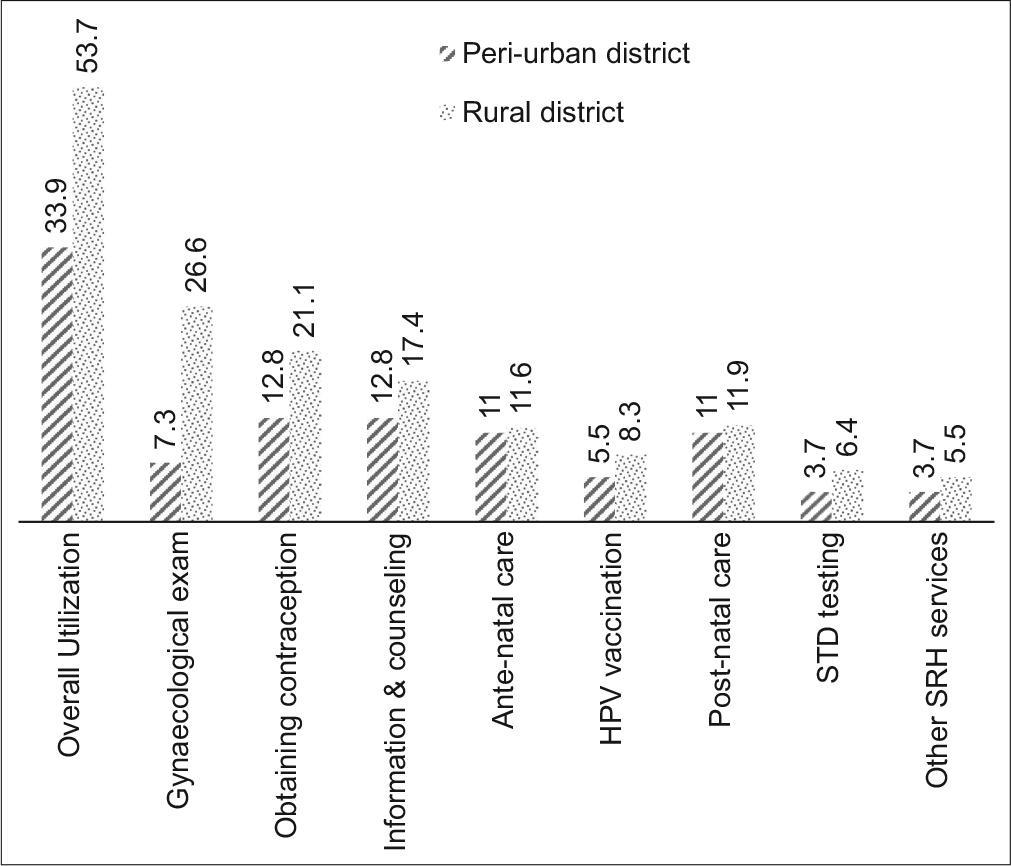
- Sexual and reproductive health service utilization of young women in Hanoi. SRHS: Sexual and reproductive health service.
Factors Associated with the Utilization of SRH Services of Young Women in Hanoi
Of the total sample, a utilization rate of 43.6% (utilized at least one SRH service in the past 12 months) was reported. Logistic regression was used to identify factors associated with the utilization of SRH services for all participants. Estimates from the bivariate binary logistic regression model indicated that the utilization of SRH care services was associated with district of residence, age, marital status, monthly income, perceived SRH status, discussion about SRH with parents, knowledge about SRH services, and attitudes toward SRH services.
Multivariate analysis was used to identify the factors independently associated with SRH utilization. Results from the multivariate regression model found that the factors significantly associated with utilization of SRH care services among participants were being married (adjusted OR [AOR] = 7.65, 95% confidence interval [CI]: 3.23–18.1), having a higher monthly income (AOR = 3.16, 95% CI: 1.33–7.53), and parents having actively discussed SRH topics or issues with them (AOR = 2.83, 95% CI: 1.45–5.52) [Table 3].
| Variable | Category | Utilization | Bivariate analysis | Multivariate analysis |
| Yes (%) | COR (95% CI) | AOR (95%CI) | ||
| District | Dong Anh | 43 (33.9) | 1.0 | 1.0 |
| Quoc Oai | 66 (53.7) | 2.26 (1.36–3.77)** | 1.98 (0.93–4.24) | |
| Age | 18–21 | 46 (35.4) | 1.0 | 1.0 |
| 22–25 | 63 (52.5) | 2.02 (1.21–3.35)** | 0.46 (0.21–1.04) | |
| Education | Secondary school or less | 11 (44) | 1.0 | 1.0 |
| High school | 48 (37.5) | 0.76 (0.32–1.82) | 1.04 (0.36–2.99) | |
| College/university | 50 (51.6) | 1.35 (0.56–3.28) | 1.88 (0.57–6.22) | |
| Marital status | Single | 49 (30.3) | 1.0 | 1.0 |
| Married | 59 (67.8) | 4.86 (2.77–8.52)*** | 7.65 (3.23–18.1)*** | |
| Monthly income | No income (0 VND) | 31 (34.1) | 1.0 | 1.0 |
| <5.000.000 VND | 26 (32.9) | 0.95 (0.5–1.8) | 1.29 (0.56–2.98) | |
| 5.000.000 or greater | 52 (65) | 3.59 (1.91–6.76)*** | 3.16 (1.33–7.53)** | |
| Health insurance | Yes | 101 (44.7) | 1.62 (0.66–3.93) | 2.62 (0.89–7.7) |
| No | 8 (33.3) | 1.0 | 1.0 | |
| SRH status self-rating | Average or below | 27 (50) | 1.0 | 1.0 |
| Good | 75 (44.9) | 0.82 (0.44–1.50) | 0.69 (0.32–1.48) | |
| Very good | 7 (24.4) | 0.32 (0.12–0.87)* | 0.33 (0.09–1.17) | |
| Discussion about SRH | Yes | 73 (60.3) | 3.89 (2.29–6.6)*** | 2.83 (1.45–5.52)** |
| No | 36 (28.1) | 1.0 | 1.0 | |
| Knowledge about SRH services | Good (≥80%=26–32 points) | 69 (56.1) | 2.78 (1.66–4.65)*** | 1.39 (0.74–2.62) |
| Poor (<80%=0–25 points) | 40 (31.5) | 1.0 | 1.0 | |
| Attitudes toward SRH services | Positive (≥80%=84–105 points) | 54 (57.5) | 2.45 (1.45–4.15)** | 1.34 (0.68–2.62) |
| Negative (<80%=1–83 points) | 55 (35.5) | 1.0 | 1.0 |
*p<0.05, **p<0.01, ***p<0.0001. SRH: Sexual and reproductive health, COR: Crude odds ratio, AOR: Adjusted odds ratio, CI: Confidence interval
DISCUSSION
SRH Utilization of Young Women in Hanoi, Vietnam
The total level of utilization of SRH services among young women in the study was 43.6%. This finding is consistent with similar studies in an urban area (Ho Chi Minh City)[6] or in a mountainous area (Son La province),[7] which have identified historically low utilization among young women in non-urban settings, ranging from 30% to 50%.[6,14,15] The utilization was also measured within each district in the study. While both are outer districts of Hanoi, peri-urban Dong Anh’s greater degree of urbanization and proximity to Hanoi might suggest a higher rate of utilization than rural Quoc Oai.
However our study found that the utilization of SRH services in the rural district was 53.7%, which is higher than the 33.9% observed in the peri-urban district. This discrepancy can be attributed to investments made over recent decades in health services in rural areas, aimed at promoting equity and access in Vietnam.[16,17] In our study, the Dong Anh and Quoc Oai district has quite easy-to-access services for local people. Consequently, the narrowing gap in utilization between rural and urban areas may account for the unexpectedly high rates observed in the rural district. However, these trends only partially explain why this rate is lower than in the study’s peri-urban district.
In our study, a significantly higher proportion of women in the rural district (53.7%) held positive attitudes toward SRH services compared to those in the peri-urban district (22%). Previous studies have indicated that attitudes toward SRH services have a more substantial impact on utilization than mere physical access to those services.[18] This could be due to recent investment in high-level healthcare services in rural areas, including improved training provided. A 2023 study found notable preference among rural residents for visiting high-level healthcare facilities, such as hospitals, which aligns with our findings.[19] In addition, exposure to SRH information through parent–child communication may help explain the utilization rates observed in our study. The parents in rural areas spend more time with and engage in more personal communication with their children.[20,21] Subsequent studies have supported these findings, linking parental communication to improved SRH behaviors and higher service utilization. Consistent with these reports, twice as many rural women had parents who discussed SRH topics with them as peri-urban women in the study, which may contribute to the higher rates of SRH service utilization identified in the rural district.
Similar to previous studies, the most commonly utilized SRH service components across all participants, such as examinations and contraception, were comparable to rates found in earlier studies.[5,16] Notably, utilization in the rural district was higher for all individual service components, indicating that the rural district’s overall utilization rate was consistent and not inflated by high use of one specific service component. The higher utilization of hospitals and private clinics was also consistent with the preferences described by women in a similar study. This could be attributed to reported perceptions that these facilities are more confidential and better equipped than public district and commune-level facilities.[22]
The study also identified factors associated with the utilization of SRH services, including marital status, income, and parental discussions about SRH. Young women who were married at the time of the study were significantly more likely to have used available SRH services. Similar studies in Vietnam have consistently reported a strong association between marital status and utilization of SRH services, often due to cultural sensitivities around premarital sex and SRH utilization.[6] In numerous studies, unmarried Vietnamese women have reported reluctance toward using SRH services due to concerns about disclosing premarital sex, health provider discrimination, and the privacy and confidentiality of their visits.[14,19,23] Having a higher monthly income was also found to be a factor in the utilization of SRH services, as it is driven by income and the ability to mobilize resources, as noted in previous studies.[24,25]
Participants whose parents had discussed SRH topics with them were also significantly more likely to utilize SRH services. Exposure to information about SRH topics in general has been well-established to increase the likelihood of using SRH.[8,21] Given the lack of sex education in Vietnamese schools and cultural taboos surrounding the topic, parental communication presents a significant opportunity to improve young women’s SRH knowledge and overcome psychosocial barriers to SRH service utilization. However, poor parent–child communication on sexuality-related issues has been indicated repeatedly in Vietnam.[8,21] In a previous study, many parents reported a belief that information about sexuality and sexual health services was not appropriate for unmarried young people, serving in turn as a barrier to the utilization of SRH services.[8] Alongside interventions targeting youths, equipping parents with tools for discussing SRH and encouraging parent–child communication could improve public awareness and, in turn, utilization of SRH services.
Interestingly, young women with higher education levels did not report higher rates of service utilization compared to those with lower education levels. However, most participants (90%) had either completed high school or attended college, which is significantly higher than the national average. Education level is a correlate of SRH service utilization.[16] The elevated education levels of women aged 18–25 are likely due to the proximity of our study setting to Hanoi’s center, coupled with better access to educational infrastructure and resources than those found in more rural or mountainous districts throughout Vietnam. The study also found a minimal association among young women’s knowledge of available SRH services, their attitudes toward these services, and their utilization of these services. While previous studies have identified these correlates of utilization, they broadly address knowledge or attitudes toward SRH topics in general, which may be a reason why our study did not find an association.[25,26] Although we aimed to investigate this relationship using carefully adapted survey items, few validated tools exist to assess knowledge of available SRH services and attitudes toward utilizing these services. Future efforts to develop such tools could lead to more accurate measurements of these factors and their relationship to service utilization. It is also worth noting that no statistically significant association with women’s SRH utilization was found by district. However, the higher rate of SRH utilization identified in the rural district compared to the peri-urban district suggests a need for further studies investigating the relationship between urbanization and utilization. Consistent with our finding, a recent publication in three provinces in Vietnam (Hanoi, Lao Cai, and Thanh Hoa) reported that awareness of SRH services was significantly higher among young people in rural areas (91.1%) than in urban areas (81.9%) (p < 0.05).[27]
Strengths and Limitations of the Study
The current literature on the utilization of SRH services among young women in Vietnam remains limited.[4,6] In addition to the small number of research on this topic, this cross-sectional study aimed to examine the utilization of available SRH services among young women in a peri-urban and rural district of Hanoi, as well as the factors associated with the utilization of these services.
One of the limitations was the examination of sensitive and personal issues, which may have made it difficult for participants to provide honest responses. Participants, especially unmarried women, may have been hesitant to fully disclose personal SRH and utilization information, given existing cultural taboos around pre-marital sex and perceptions that healthcare providers will judge them or share their information, despite clearly establishing confidentiality at the start of interviews. Our study was also relatively homogeneous, consisting almost entirely of Kinh women, who had higher education levels and health insurance coverage than the national proportion. Thus, the generalizability of these findings might be limited to similar population groups. Finally, while the sample size for the study was sufficient, it was smaller compared to similar studies on the topic outside Vietnam. Further research would benefit from being conducted in more rural and peri-urban settings, with a larger and more demographically diverse population, to increase the representativeness of findings. Despite these limitations, however, the results of this study can inform and situate future research on SRH service utilization among young women in Hanoi’s peri-urban and rural districts.
CONCLUSION AND GLOBAL HEALTH IMPLICATIONS
The overall SRH service utilization rate was found to be 43.6%, with rates of 33.9% in the peri-urban district and 53.7% in the rural district. Our results also show a higher rate of utilization in a rural district of Hanoi than in a peri-urban district, suggesting that the expected relationship between urbanization and service utilization requires further investigation in Vietnam. We also found utilization to be associated with being married, having a higher income, and exposure to SRH topics through parental discussion, not only aligning with findings from previous literature, but also illustrating the need for targeting community and provider-side access for unmarried women. Promoting more affordable SRH care at high-level facilities and equipping parents and community members with the resources to communicate effectively with their children about SRH should also be a key focus of future development efforts. Ultimately, examining the relationship between urbanization and SRH service utilization on a larger scale, as well as the factors associated with utilization, will be critical to informing future effective SRH interventions for young women.
Key Messages
(1) In Vietnam, gaps in sexual and reproductive health (SRH) service utilization, especially among young women, indicate a need for strategic approaches to improving SRH utilization patterns. (2) Overall SRH utilization among young women was low and lower in the peri-urban district in Vietnam. (3) Promoting more affordable SRH care at high-level facilities and equipping parents and community members with the resources to communicate effectively with their children about SRH should be a key focus in improving SRH utilization among young women.
Acknowledgments:
We would like to thank the data collectors and participants in this study, as well as the Dong Anh District Health Center in Hanoi, for their support in implementing this study.
COMPLIANCE WITH ETHICAL STANDARDS
Conflicts of Interest: The authors declare no competing interests. Financial Disclosure: Not applicable. Funding/Support: Not applicable. Ethics Approval: The research/ study was approved by the Institutional Review Board at Hanoi University of Public Health, number 44/2022/YTCC-HD3, dated February 21, 2022. Declaration of Patient Consent: Patient’s consent not required as there are no patients in this study. Use of Artificial Intelligence (AI)- Assisted Technology for Manuscript Preparation: The authors confirm that there was no use of artificial intelligence (AI)-assisted technology for assisting in the writing or editing of the manuscript and no images were manipulated using AI. Disclaimer: Not applicable.
References
- The content and implementation of policies and programs on adolescent sexual and reproductive health in Vietnam: Results and challenges. Health Serv Insights. 2021 Aug 04;14:1-10.
- [CrossRef] [PubMed] [Google Scholar]
- Factors influencing sexual and reproductive health perceptions among mountainous adolescents in Vietnam. Int J Adolesc Youth. 2024 May 03;29(1):2353207.
- [CrossRef] [Google Scholar]
- Evaluation of three adolescent sexual health programs in ha noi and khanh hoa province, Vietnam. AIDS Res Treat. 2012;2012:986978.
- [CrossRef] [PubMed] [Google Scholar]
- Unmet healthcare needs and associated factors in rural and suburban Vietnam: A cross-sectional study. Int J Environ Res Public Health. 2020 Aug 31;17(17):6320.
- [CrossRef] [PubMed] [Google Scholar]
- Knowledge, attitudes and practices on reproductive health among abortion adolescents in Vietnam. Med Arch. 2024;78(2):139-45.
- [CrossRef] [PubMed] [Google Scholar]
- Exploring awareness, attitudes, and access regarding sexual and reproductive health services among young people in Vietnam. Health Promot Pract. 2025 Sep 13;1-8:15248399251362169.
- [CrossRef] [PubMed] [Google Scholar]