
Maternal Caffeine Consumption and Racial Disparities in Fetal Telomere Length
DOI:
https://doi.org/10.21106/ijma.290Keywords:
- Telomere,
- Fetal telomere length,
- Caffeine,
- Pregnancy,
- Maternal-Fetal medicine,
- Racial/ethnic differences
Abstract
The identification of risk factors for shorter telomere length, especially during fetal development, would be important towards caffeine consumption recommendations for pregnant women on a global scale. The purpose of this study was to evaluate the association between caffeine intake and fetal telomere length as well as racial/ethnic differences in telomere length regardless of maternal caffeine consumption status.
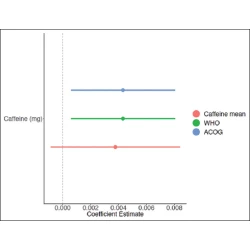
Methods:Caffeine intake was measured using a food frequency questionnaire (FFQ). Three generalized linear models (GLM) were compared based on binary categorical variables of caffeine levels using data mean value of 117.3 mg as cut-off; the World Health Organization (WHO) recommendations of 300 mg; and the American College of Obstetricians and Gynecologists (ACOG) recommendations of 200 mg. The association between caffeine consumption and telomere length (telomere to single-copy [T/S] ratio) was then assessed.
Results:Among 57 maternal-fetal dyads, 77.2% reported less than 200 mg of caffeine (ACOG) and 89.5% less than 300 mg (WHO). Both WHO and ACOG models found that caffeine intake was significantly and positively associated with longer telomere length (p<0.05); and sodium (p<0.05). Other” race (p<0.001) and “white” race (p<0.001) were also significantly and positively associated with longer telomere length in the same models. Increasing maternal age shortened telomere length significantly in all models (p<0.001).
Conclusion and Global Health implications:Caffeine intake, maternal age, and race may be associated with alterations in fetal telomere length. This indicates that caffeine consumption during pregnancy may have long-term implications for fetal development. The racial/ethnic differences in telomere length found in this study warrant larger studies to further confirm these associations.
Downloads
Most read articles by the same author(s)
- Amina Abdullahi, Hassan Adam Murtala, Aisha Adam Abdullahi, Amina Aminu, Muktar H. Aliyu, Sani H. Aliyu, Ololade D. Adeyemi, Deepa Dongarwar, Jordi B. Torrelles, Gambo Aliyu, Hamisu M. Salihu, Drivers of Human Immunodeficiency Virus among Pregnant Women in Conflict and Non-conflict Zones of Nigeria , International Journal of Maternal and Child Health and AIDS: Vol. 14 No. Continuous (2025): International Journal of Maternal and Child Health and AIDS
- Hamisu M. Salih, Deepa Dongarwar, Muktar H. Aliyu, Romuladus E. Azuine, Global Ranking of COVID-19-Related Mortality by Country using a Novel Pandemic Efficiency Index (PEI) , International Journal of Maternal and Child Health and AIDS: Vol. 9 No. 2 (2020): International Journal of Maternal and Child Health and AIDS
- Zubairu Iliyasux, Amina A. Umar, Fatima S. Gaya, Nafisa S. Nass, Hadiza M. Abdullahi, Aminatu A. Kwaku, Taiwo G. Amole, Fatimah I. Tsiga-Ahmed, Hadiza S. Galadanci, Hamisu M. Salihu, Muktar H. Aliyu, ‘We delivered at home out of fear’: Maternity Care in Rural Nigeria During the COVID-19 Pandemic , International Journal of Maternal and Child Health and AIDS: Vol. 12 No. 1 (2023): International Journal of Maternal and Child Health and AIDS
- Zubairu Iliyasu, Fatimah Hassan-Hanga, Sadiq Isah Ajuji, Musa M. Bello, Safiyya S. Abdulkadir, Nafisa S. Nass, Hamisu M. Salihu, Muktar H. Aliyu, Correlates of Health Care Workers’ Knowledge and HIV-Exposed Infant Immunization Counseling Practice in Northern Nigeria , International Journal of Maternal and Child Health and AIDS: Vol. 10 No. 1 (2021): International Journal of Maternal and Child Health and AIDS
- Deepa Dongarwar, Anjali Aggarwal, Kenneth Barning, Hamisu Mohammed Salihu, Stillbirths among Advanced Maternal Age Women in the United States: 2003-2017 , International Journal of Maternal and Child Health and AIDS: Vol. 9 No. 1 (2020): International Journal of Maternal and Child Health and AIDS
- Hamisu M. Salihu, Abraham A. Salinas-Miranda, Lindsey M. King, Deepa Dongarwar, Korede K. Yusuf, Sahra Ibrahimi, Chioma A. Ike dionwu, Estrellita Lo Berry, Racism, Psycho-Social Stress, and Health-related Quality of Life , International Journal of Maternal and Child Health and AIDS: Vol. 9 No. 1 (2020): International Journal of Maternal and Child Health and AIDS
- Renice Obure, Hamisu M. Salihu, Anjali Aggarwal, Acara E. Turner, Estrellita “Lo” Berry, Deborah A. Austin, Usman J. Wudil, Muktar H. Aliyu, Ronee E. Wilson, Evaluation of an Evidence-based and Community-responsive Fatherhood Training Program: Providers’ Perspective , International Journal of Maternal and Child Health and AIDS: Vol. 9 No. 1 (2020): International Journal of Maternal and Child Health and AIDS
- Hamisu M. Salihu, Global Reduction in HIV-related Maternal Mortality: ART as a Key Strategy , International Journal of Maternal and Child Health and AIDS: Vol. 4 No. 2 (2015): International Journal of Maternal and Child Health and AIDS
- Deepa Dongarwar, Anjali Aggarwal, Kenneth Barning, Hamisu Mohammed Salihu, Trends in Stillbirths and Stillbirth Phenotypes in the United States: An Analysis of 131.5 Million Births , International Journal of Maternal and Child Health and AIDS: Vol. 9 No. 1 (2020): International Journal of Maternal and Child Health and AIDS
Similar Articles
- Sara A. Holtz, Rudi Thetard, Sarah N. Konopka, Jennifer Albertini, Anouk Amzel, Karen P. Fogg, A Systematic Review of Interventions to Reduce Maternal Mortality among HIV-Infected Pregnant and Postpartum Women , Vol. 4 No. 2 (2015): International Journal of Maternal and Child Health and AIDS
- Abubakar Sadiq Umar, Lusamba Kabamba, Maternal Mortality in the Main Referral Hospital in Angola, 2010-2014: Understanding the Context for Maternal Deaths Amidst Poor Documentation , Vol. 5 No. 1 (2016): International Journal of Maternal and Child Health and AIDS
- Deepa Dongarwar, Morgan Lee, Christo Manikkuttiyil, Hamisu M. Salihu, Association Between Social Determinants of Health Issues and Maternal Obesity Among American Racial/Ethnic Groups , Vol. 12 No. 1 (2023): International Journal of Maternal and Child Health and AIDS
- Zubairu Iliyasux, Amina A. Umar, Fatima S. Gaya, Nafisa S. Nass, Hadiza M. Abdullahi, Aminatu A. Kwaku, Taiwo G. Amole, Fatimah I. Tsiga-Ahmed, Hadiza S. Galadanci, Hamisu M. Salihu, Muktar H. Aliyu, ‘We delivered at home out of fear’: Maternity Care in Rural Nigeria During the COVID-19 Pandemic , Vol. 12 No. 1 (2023): International Journal of Maternal and Child Health and AIDS
- Wael Hafez, Jalal Al Shareef, Afraa Alyoussef, Mirvat Ghanem, Reem Rizk Abazid, Antesh Yadav, Asrar Rashid, Fardeen Mohammad Sayfoo, Sneha Venkataramani, Pamela Orozco Restrepo, Mohamed Maher Elkott, Vikram Satish Lakshman, Taahira Arief, Alaa Gamal Mohammed, Fatema Abdulaal, Yossef Hossam, Pulmonary Injury as a Complication of Urinary Tract Infection in Pregnancy , Vol. 13 No. Continuous (2024): International Journal of Maternal and Child Health and AIDS
- Yifru Berhan, Sinteyehu Abeba, Thirty Years of United Nations Inter-Agency Working Group’s Global, Regional, and National Maternal Mortality Estimates Revisited , Vol. 13 No. Continuous (2024): International Journal of Maternal and Child Health and AIDS
- Hadiza Galadanci, Deepa Dongarwar, Wolfgang Künzel, Oladapo Shittu, Murtala Yusuf, Sadiq Abdurrahman, Dolapo Lufadeju, Hamisu M. Salihu, Cesarean Section and Maternal-fetal Mortality Rates in Nigeria: An Ecological Lens into the Last Decade , Vol. 9 No. 1 (2020): International Journal of Maternal and Child Health and AIDS
- Jaleah D. Rutledge, Alexis Kiyanda, Christina Jean-Louis, Elizabeth Raskin, Joanne Gaillard, Morgan Maxwell, Tynetta Smith, Trace Kershaw, Jasmine Abrams, Recommendations for Integrating Traditional Birth Attendants to Improve Maternal Health Outcomes in Low- and Middle-Income Countries , Vol. 13 No. Continuous (2024): International Journal of Maternal and Child Health and AIDS
- Abdul-Wahab Inusa, Nana Asha Alhassan, Ana Maria Simono Charadan, Roy Rillera Marzo, Shamsu-Deen Ziblim, Influence of Sociodemographic Factors and Obstetric History on Choice of Place of Delivery: A Retrospective Study Among Post-Natal Women in Ghana , Vol. 12 No. 2 (2023): International Journal of Maternal and Child Health and AIDS
- Nidhi Fotedar, Nugehally Raju Ramesh Masthi, Burden of Fetal Anomalies among Antenatal Mothers Attending a Public Referral Hospital: A Mixed Cohort Study , Vol. 14 No. Continuous (2025): International Journal of Maternal and Child Health and AIDS
<< < 1 2 3 4 5 6 7 8 9 10 > >>
You may also start an advanced similarity search for this article.
Published
How to Cite
Issue
Section
License
Copyright © 2019 Isabel Griffin, Boubakari Ibrahimou, Natasha Navejar, Anjali Aggarwal, Kristopher Myers, Daniel Mauck, Korede K. Yusuf, Usman J. Wudil, Muktar H. Aliyu, Hamisu M. Salihu. Published by Global Health and Education Projects, Inc., USA.

This is an open-access article distributed under the terms of the Creative Commons Attribution-NonCommercial-ShareAlike 4.0 International License , which permits others to remix, transform, and build upon the work non-commercially, provided the original author is credited and the new creations are licensed under the same terms.