
Effectiveness of a 24/7 Dad® Curriculum in Improving Father Involvement: Profiles of Engagement
DOI:
https://doi.org/10.21106/ijma.338Keywords:
- Father Involvement,
- Fatherhood,
- Self-awareness,
- Fathering skills,
- Parenting skills,
- Relationship skills,
- Self-care.24/7 Dad®,
- Curriculum,
- Program Evaluation,
- REACHUP,
- Inc
Abstract
Father involvement is a key component in maintaining healthy families and communities. This study presents quantitative results of the first five years of a comprehensive fatherhood training program offered by REACHUP, Inc. in Florida, United States.
Methods:The program utilized the 24/7 Dad ® curriculum for the fatherhood training program. Key program outcome was differences in pre and post-test scores on self-awareness, fathering skills, parenting skills, relationship skills, and self-care. Demographic and pretest-posttest data collected between 2013 and 2017 were analyzed using chi-square test for categorical variables, McNemar’s test for differences in proportions pre- and post-intervention, paired sample t-test to compare means in pretest and posttest scores and analysis of variance (ANOVA) to test the difference between means across years and demographic characteristics.
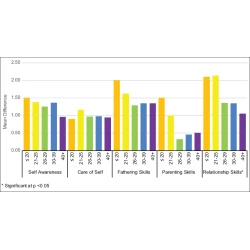
Results:Attendance in the program increased yearly, nearly doubling from 55 participants in 2013 to 97 in 2017. The mean pretest score was 8.90 (±4.04) and the mean posttest score was 16.42 (±4.54) out of 22 total points, representing a highly significant positive effect of the program on self-awareness, fathering skills, parenting skills, relationship skills and self-care which will enable men to establish long-lasting positive relationships with their children. There were significant differences by demographic characteristics. Younger participants tended to score lower on the pretest but made the most knowledge gains following the training as indicated by the difference in pre- and posttest scores (<0.001).
Conclusion and Global Health Implications:Increasing yearly attendance indicates the notion of male involvement is gaining momentum. An important lesson learned over the five-year period is that not all males who participated in the program were biological fathers of infants, young children or adolescents. Many participants were grandfathers, uncles and family friends, indicating that the benefits of a male involvement program can extend beyond the boundaries of biological fatherhood.
Downloads
Most read articles by the same author(s)
- Amina A. Umar, Hamisu M. Salihu, Romuladus E. Azuine, Crisis of Brain Drain in Nigeria’s Health Sector: Challenges, Opportunities, and the Path Forward , International Journal of Maternal and Child Health and AIDS: Vol. 14 No. Continuous (2025): International Journal of Maternal and Child Health and AIDS
- Zenab I. Yusuf, Deepa Dongarwar, Rafeek A Yusuf, Meishon Bell, Toi Harris Harris, Hamisu M. Salihu, Social Determinants of Overweight and Obesity Among Children in the United States , International Journal of Maternal and Child Health and AIDS: Vol. 9 No. 1 (2020): International Journal of Maternal and Child Health and AIDS
- Amina Abdullahi, Hassan Adam Murtala, Aisha Adam Abdullahi, Amina Aminu, Muktar H. Aliyu, Sani H. Aliyu, Ololade D. Adeyemi, Deepa Dongarwar, Jordi B. Torrelles, Gambo Aliyu, Hamisu M. Salihu, Drivers of Human Immunodeficiency Virus among Pregnant Women in Conflict and Non-conflict Zones of Nigeria , International Journal of Maternal and Child Health and AIDS: Vol. 14 No. Continuous (2025): International Journal of Maternal and Child Health and AIDS
- Devon Madelyn Rupley, Deepa Dongarwar, Hamisu M. Salihu, Allison M. Janda, Rachel Pope, Healthcare Access as a Risk-Marker for Obstetric Vesicovaginal Fistula in Malawi , International Journal of Maternal and Child Health and AIDS: Vol. 9 No. 1 (2020): International Journal of Maternal and Child Health and AIDS
- Hamisu M. Salihu, Amina A. Umar, Romuladus E. Azuine, Special Collection: Implementation Research Evidence for Prevention and Treatment of Postpartum Hemorrhage in High-Burden Low- and Middle-Income Countries , International Journal of Maternal and Child Health and AIDS: Vol. 13 No. S1 (2024): International Journal of Maternal and Child Health and AIDS
- Zubairu Iliyasux, Amina A. Umar, Fatima S. Gaya, Nafisa S. Nass, Hadiza M. Abdullahi, Aminatu A. Kwaku, Taiwo G. Amole, Fatimah I. Tsiga-Ahmed, Hadiza S. Galadanci, Hamisu M. Salihu, Muktar H. Aliyu, ‘We delivered at home out of fear’: Maternity Care in Rural Nigeria During the COVID-19 Pandemic , International Journal of Maternal and Child Health and AIDS: Vol. 12 No. 1 (2023): International Journal of Maternal and Child Health and AIDS
- Ahmad Abdulhadi, Nasiru Abdullahi, Ibrahim Yusuf, Basheer I. Waziri, Kasimu Mamuda , Husna F. Ibrahim, Khadija Muhammad, Maryam M. Ibrahim , Aisha A. Abdullahi, Hassan A. Murtala, Muhammad A. Abbas, Hamisu M. Salihu, A Systematic Review and Meta-analysis on Innovative Approaches in Tuberculosis Diagnosis: Challenges and Future Directions , International Journal of Maternal and Child Health and AIDS: Vol. 15 (2026): International Journal of Maternal and Child Health and AIDS
- Muhammad Adamu Abbas, Hassan Adam Murtala, Fauziyya S. Abdullahi, Abubakar L. Yusuf, Aisha Adam Abdullahi, Amina Aminu, Aisha Mustapha, Eknath Naik, Hamisu M. Salihu, Intent to Receive Human Papillomavirus Vaccination among School-going Pre-teens and Adolescent Girls , International Journal of Maternal and Child Health and AIDS: Vol. 14 No. Continuous (2025): International Journal of Maternal and Child Health and AIDS
- Hamisu M. Salihu, Deepa Dongarwar, Toi B. Harris, Third Annual Summer Research Summit on Health Equity Organized by the Center of Excellence in Health Equity, Training and Research, Baylor College of Medicine, Houston, Texas 77030, USA on June 9, 2020: ABSTRACT: Advancing Health Equity Through Innovation , International Journal of Maternal and Child Health and AIDS: Vol. 9 No. S3 (2020): International Journal of Maternal and Child Health and AIDS
- Deepa Dongarwar, Hamisu M. Salihu, Place of Residence and Inequities in Adverse Pregnancy and Birth Outcomes in India , International Journal of Maternal and Child Health and AIDS: Vol. 9 No. 1 (2020): International Journal of Maternal and Child Health and AIDS
Similar Articles
- Vinay Kumar, Gunjan Arora, Ish Kumar Midha, Yogender Pal Gupta, Infant and Young Child Feeding Behaviors among Working Mothers in India: Implications for Global Health Policy and Practice , Vol. 3 No. 1 (2015): International Journal of Maternal and Child Health and AIDS
- Faith Iretioluwa Olaniyi, Ayodele Ebenezer Owolabi, Gideon Temitope Olowe, Ololade Daniella Olunloyo, Eric Anuoluwapo Ogunleye, Ifeoluwapo Oluwafunke Kolawole, Perception, Pattern of Use, and Determinants of Family Planning Uptake Among Women of Childbearing Age in Ibadan, South West Nigeria , Vol. 15 (2026): International Journal of Maternal and Child Health and AIDS
- Gerald J. Makuka, Moses M. Sango, Ayubu E. Mashambo, Abednego E. Mashambo, Sia E. Msuya, Sabina P. Mtweve, Clients’ Perspectives on Quality of Delivery Services in a Rural Setting in Tanzania: Findings from a Qualitative Action-Oriented Research , Vol. 6 No. 1 (2017): International Journal of Maternal and Child Health and AIDS
- Devon Madelyn Rupley, Deepa Dongarwar, Hamisu M. Salihu, Allison M. Janda, Rachel Pope, Healthcare Access as a Risk-Marker for Obstetric Vesicovaginal Fistula in Malawi , Vol. 9 No. 1 (2020): International Journal of Maternal and Child Health and AIDS
- Christina Kinnevey, Michael Kawooya, Tonny Tumwesigye, David Douglas, Sarah Sams, Addressing Obstetrical Challenges at 12 Rural Ugandan Health Facilities: Findings from an International Ultrasound and Skills Development Training for Midwives in Uganda , Vol. 5 No. 1 (2016): International Journal of Maternal and Child Health and AIDS
- Sybil S. Opoku Asiedu, Nana Abena Ansah Apatu, Rosemond Tetteh, Abraham Hodgson, Neonatal Cord Care Practices among Mothers and Caregivers in the Volta Region of Ghana , Vol. 8 No. 1 (2019): International Journal of Maternal and Child Health and AIDS
- Margaret Omowaleola Akinwaare, Funmilayo A. Okanlawon, Monisola A. Popoola, Omotayo O. Adetunji, Birth Preparedness Plans and Status Disclosure Among Pregnant Women Living with HIV Who are Receiving Antiretroviral Therapy in Ibadan, Southwest, Nigeria , Vol. 12 No. 1 (2023): International Journal of Maternal and Child Health and AIDS
- Rachael Bonawitz, Kathleen Lucy McGlasson, Jeanette L. Kaiser, Thandiwe Ngoma, Jody Lori, Carol Boyd, Godfrey Biemba, Davidson H. Hamer, Nancy A. Scott, Maternity Waiting Home Use by HIV-positive Pregnant Women in Zambia: Opportunity for Improved Prevention of Maternal to Child Transmission of HIV , Vol. 8 No. 1 (2019): International Journal of Maternal and Child Health and AIDS
- Mehrete Girmay, Digital Health Divide: Opportunities for Reducing Health Disparities and Promoting Equitable Care for Maternal and Child Health Populations , Vol. 13 No. Continuous (2024): International Journal of Maternal and Child Health and AIDS
- María Isabel Roldós, Phaedra Corso, Justin Ingels, How much are Ecuadorians Willing to Pay to Reduce Maternal Mortality? Results from a Pilot Study on Contingent Valuation , Vol. 6 No. 1 (2017): International Journal of Maternal and Child Health and AIDS
<< < 2 3 4 5 6 7 8 9 10 11 > >>
You may also start an advanced similarity search for this article.
Published
How to Cite
Issue
Section
License
Copyright © 2019 Roneé E. Wilson, Renice Obure, Precious Omokaro Omokaro, Hamisu M. Salihu, Estrellita “Lo” Berry, Deborah A. Austin A. Austin, Jennifer G. Christner. Published by Global Health and Education Projects, Inc., USA.

This is an open-access article distributed under the terms of the Creative Commons Attribution-NonCommercial-ShareAlike 4.0 International License , which permits others to remix, transform, and build upon the work non-commercially, provided the original author is credited and the new creations are licensed under the same terms.