
Association between Intimate Partner Violence, Knowledge and Use of Contraception in Africa: Comparative Analysis across Five African Regions
DOI:
https://doi.org/10.21106/ijma.323Keywords:
- Violence,
- Women,
- Contraception,
- Knowledge,
- Usage,
- Africa,
- Intimate partner violence,
- Demographic and health surveys,
- Benin,
- Burundi,
- Egypt,
- Kenya,
- South Africa
Abstract
Intimate partner violence (IPV) against women is common globally, and is associated with several adverse consequences. This study provides a comparative analysis of potential regional differences in the association between IPV and knowledge and use of contraceptives within Africa.
Methods:A multi-country cross-sectional study was conducted using data on women of reproductive age 15-49 years from the Demographic and Health Surveys covering five African regions. Exposure and outcome variables were IPV and reproductive literacy (comprising modern contraception knowledge and contraception usage) respectively. We used survey log-binomial regression models to generate prevalence ratios that estimated the association between IPV versus knowledge and usage of modern contraception.
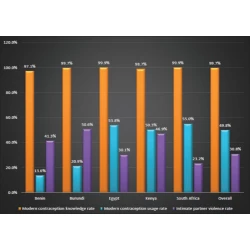
Results:Overall IPV prevalence in Africa was 30.8% with notable regional differences. Demographic, socioeconomic, and reproductive history markers of IPV were more pronounced in younger women, rural residents, women of low socioeconomic status and those with copious knowledge but poor usage of modern contraception. The level of knowledge of contraception was 84% greater among African women who were victims of IPV compared to their counterparts who were not victims of IPV (p < 0.0001). IPV was not associated with actual usage of modern contraception (p = 0.21).
Conclusion And Global Health Implications:IPV against women in Africa may incentivize knowledge seeking of modern contraception as protective mechanisms. Regional variations notwithstanding, understanding the existing and new characteristics predictive of IPV may inform policy development, resource allocation and prevention of IPV globally.
Downloads
Most read articles by the same author(s)
- Amina A. Umar, Hamisu M. Salihu, Romuladus E. Azuine, Crisis of Brain Drain in Nigeria’s Health Sector: Challenges, Opportunities, and the Path Forward , International Journal of Maternal and Child Health and AIDS: Vol. 14 No. Continuous (2025): International Journal of Maternal and Child Health and AIDS
- Zenab I. Yusuf, Deepa Dongarwar, Rafeek A Yusuf, Meishon Bell, Toi Harris Harris, Hamisu M. Salihu, Social Determinants of Overweight and Obesity Among Children in the United States , International Journal of Maternal and Child Health and AIDS: Vol. 9 No. 1 (2020): International Journal of Maternal and Child Health and AIDS
- Amina Abdullahi, Hassan Adam Murtala, Aisha Adam Abdullahi, Amina Aminu, Muktar H. Aliyu, Sani H. Aliyu, Ololade D. Adeyemi, Deepa Dongarwar, Jordi B. Torrelles, Gambo Aliyu, Hamisu M. Salihu, Drivers of Human Immunodeficiency Virus among Pregnant Women in Conflict and Non-conflict Zones of Nigeria , International Journal of Maternal and Child Health and AIDS: Vol. 14 No. Continuous (2025): International Journal of Maternal and Child Health and AIDS
- Chioma A. Ikedionwu, Deepa Dongarwar, Courtney Williams, Evelyn Odeh, Maylis Peguy Nkeng Peh, Hilliary Hooker, Stacey Wiseman, Tramauni Brock, Erinn Payne-Green, Chidinma Chukwudum, Grace Loudd, Andrea Shelton, Jonnae O. Atkinson, Kiara K. Spooner, Jason L. Salemi, Hamisu M. Salihu, Omonike A. Olaleye, Trends and Risk Factors for Leishmaniasis among Reproductive Aged Women in the United States , International Journal of Maternal and Child Health and AIDS: Vol. 10 No. 2 (2021): International Journal of Maternal and Child Health and AIDS
- Devon Madelyn Rupley, Deepa Dongarwar, Hamisu M. Salihu, Allison M. Janda, Rachel Pope, Healthcare Access as a Risk-Marker for Obstetric Vesicovaginal Fistula in Malawi , International Journal of Maternal and Child Health and AIDS: Vol. 9 No. 1 (2020): International Journal of Maternal and Child Health and AIDS
- Chioma A Ikedionwu, Deepa Dongarwar, Korede K. Yusuf, Sitratullah O. Maiyegun, Sahra Ibrahimi, Hamisu M. Salihu, Using Nominal Group Technique to Elucidate a COVID-19 Research Agenda for Maternal and Child Health (MCH) Populations , International Journal of Maternal and Child Health and AIDS: Vol. 9 No. 3 (2020): International Journal of Maternal and Child Health and AIDS
- Hamisu M. Salih, Deepa Dongarwar, Muktar H. Aliyu, Romuladus E. Azuine, Global Ranking of COVID-19-Related Mortality by Country using a Novel Pandemic Efficiency Index (PEI) , International Journal of Maternal and Child Health and AIDS: Vol. 9 No. 2 (2020): International Journal of Maternal and Child Health and AIDS
- Hamisu M. Salihu, Amina A. Umar, Romuladus E. Azuine, Special Collection: Implementation Research Evidence for Prevention and Treatment of Postpartum Hemorrhage in High-Burden Low- and Middle-Income Countries , International Journal of Maternal and Child Health and AIDS: Vol. 13 No. S1 (2024): International Journal of Maternal and Child Health and AIDS
- Hadiza Galadanci, Deepa Dongarwar, Wolfgang Künzel, Oladapo Shittu, Murtala Yusuf, Sadiq Abdurrahman, Dolapo Lufadeju, Hamisu M. Salihu, Cesarean Section and Maternal-fetal Mortality Rates in Nigeria: An Ecological Lens into the Last Decade , International Journal of Maternal and Child Health and AIDS: Vol. 9 No. 1 (2020): International Journal of Maternal and Child Health and AIDS
- Zubairu Iliyasux, Amina A. Umar, Fatima S. Gaya, Nafisa S. Nass, Hadiza M. Abdullahi, Aminatu A. Kwaku, Taiwo G. Amole, Fatimah I. Tsiga-Ahmed, Hadiza S. Galadanci, Hamisu M. Salihu, Muktar H. Aliyu, ‘We delivered at home out of fear’: Maternity Care in Rural Nigeria During the COVID-19 Pandemic , International Journal of Maternal and Child Health and AIDS: Vol. 12 No. 1 (2023): International Journal of Maternal and Child Health and AIDS
Similar Articles
- Nidhi Fotedar, Nugehally Raju Ramesh Masthi, Burden of Fetal Anomalies among Antenatal Mothers Attending a Public Referral Hospital: A Mixed Cohort Study , Vol. 14 No. Continuous (2025): International Journal of Maternal and Child Health and AIDS
- Amina A. Umar, Hamisu M. Salihu, Romuladus E. Azuine, Crisis of Brain Drain in Nigeria’s Health Sector: Challenges, Opportunities, and the Path Forward , Vol. 14 No. Continuous (2025): International Journal of Maternal and Child Health and AIDS
- Kenneth N. Opara, Rebecca T. Akomalafe, Nsima I. Udoidung, Udeme U. Afia, Clement A. Yaro, Bassey E. Bassey, Urogenital Schistosomiasis among Primary School Children in Rural Communities in Obudu, Southern Nigeria , Vol. 10 No. 1 (2021): International Journal of Maternal and Child Health and AIDS
- Jahron P Marriott, José G Pérez-Ramos Pérez-Ramos, Song Hoa Choi, Gersandre Gonsalves-Domond, Beatrice Aladin, Monica Barbosu, Cheryl Smith, Timothy Dye, Assessing Training Interests of Latin American and Caribbean Immigrant-serving HIV/AIDS, STD, and Hepatitis C Providers in New York State, United States , Vol. 9 No. 2 (2020): International Journal of Maternal and Child Health and AIDS
- Bartholomew Boniface Ochonye, Paul Umoh, Olaniyi Felix Sanni, Abiye Kalaiwo, Roger Abang, Agboola Oguntonade, Paul Amechi, Godwin Emmanuel, Pre-Exposure Prophylaxis and HIV Prevention Among Key Populations in Nigeria , Vol. 13 No. Continuous (2024): International Journal of Maternal and Child Health and AIDS
- Veronica B. Ajewole, Ahone E. Ngujede, Emmanuella Oduguwa, Deepa Dongarwar, Manvir Kaur, Cecelia Knight, Maresha Jackson, Uyen Nguyen, Tasha Roshan, Jordan Simpson, Igor Vouffo, Omonike A. Olaleye, Hamisu M. Salihu, A Surveillance System for the Maternal and Child Health (MCH) Population During the COVID-19 Pandemic , Vol. 9 No. 3 (2020): International Journal of Maternal and Child Health and AIDS
- Deepa Dongarwar, Anjali Aggarwal, Kenneth Barning, Hamisu Mohammed Salihu, Stillbirths among Advanced Maternal Age Women in the United States: 2003-2017 , Vol. 9 No. 1 (2020): International Journal of Maternal and Child Health and AIDS
- Ashish Kumar Gupta, Kakoli Borkotoky, Amit Kumar, Household Headship and Infant Mortality in India: Evaluating the Determinants and Differentials , Vol. 3 No. 1 (2015): International Journal of Maternal and Child Health and AIDS
- Renice Obure, Hamisu M. Salihu, Anjali Aggarwal, Acara E. Turner, Estrellita “Lo” Berry, Deborah A. Austin, Usman J. Wudil, Muktar H. Aliyu, Ronee E. Wilson, Evaluation of an Evidence-based and Community-responsive Fatherhood Training Program: Providers’ Perspective , Vol. 9 No. 1 (2020): International Journal of Maternal and Child Health and AIDS
- Ranbir S Balgir, Population and Public Health Implications of Child Health and Reproductive Outcomes Among Carrier Couples of Sickle Cell Disorders in Madhya Pradesh, Central India , Vol. 2 No. 2 (2014): International Journal of Maternal and Child Health and AIDS
<< < 21 22 23 24 25 26 27 28 29 30 > >>
You may also start an advanced similarity search for this article.
Published
How to Cite
Issue
Section
License
Copyright © 2019 Rafeek A. Yusuf, Deepa Dongarwar, Zenab I. Yusuf, Hamisu M. Salihu. Published by Global Health and Education Projects, Inc., USA.

This is an open-access article distributed under the terms of the Creative Commons Attribution-NonCommercial-ShareAlike 4.0 International License , which permits others to remix, transform, and build upon the work non-commercially, provided the original author is credited and the new creations are licensed under the same terms.