
Artificial Intelligence in Global Health —A Framework and Strategy for Adoption and Sustainability
DOI:
https://doi.org/10.21106/ijma.296Keywords:
- Artificial Intelligence,
- AI Framework,
- Global Health,
- Implementation,
- Sustainability,
- AI Strategy
Abstract
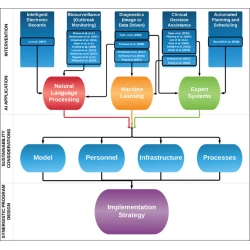
Artificial Intelligence (AI) applications in medicine have grown considerably in recent years. AI in the forms of Machine Learning, Natural Language Processing, Expert Systems, Planning and Logistics methods, and Image Processing networks provide great analytical aptitude. While AI methods were first conceptualized for radiology, investigations today are established across all medical specialties. The necessity for proper infrastructure, skilled labor, and access to large, well-organized data sets has kept the majority of medical AI applications in higher-income countries. However, critical technological improvements, such as cloud computing and the near-ubiquity of smartphones, have paved the way for use of medical AI applications in resource-poor areas. Global health initiatives (GHI) have already begun to explore ways to leverage medical AI technologies to detect and mitigate public health inequities. For example, AI tools can help optimize vaccine delivery and community healthcare worker routes, thus enabling limited resources to have a maximal impact. Other promising AI tools have demonstrated an ability to: predict burn healing time from smartphone photos; track regions of socioeconomic disparity combined with environmental trends to predict communicable disease outbreaks; and accurately predict pregnancy complications such as birth asphyxia in low resource settings with limited patient clinical data. In this commentary, we discuss the current state of AI-driven GHI and explore relevant lessons from past technology-centered GHI. Additionally, we propose a conceptual framework to guide the development of sustainable strategies for AI-driven GHI, and we outline areas for future research.
Downloads
Most read articles by the same author(s)
- Chioma A. Ikedionwu, Deepa Dongarwar, Courtney Williams, Evelyn Odeh, Maylis Peguy Nkeng Peh, Hilliary Hooker, Stacey Wiseman, Tramauni Brock, Erinn Payne-Green, Chidinma Chukwudum, Grace Loudd, Andrea Shelton, Jonnae O. Atkinson, Kiara K. Spooner, Jason L. Salemi, Hamisu M. Salihu, Omonike A. Olaleye, Trends and Risk Factors for Leishmaniasis among Reproductive Aged Women in the United States , International Journal of Maternal and Child Health and AIDS: Vol. 10 No. 2 (2021): International Journal of Maternal and Child Health and AIDS
- Chioma A Ikedionwu, Deepa Dongarwar, Korede K. Yusuf, Sitratullah O. Maiyegun, Sahra Ibrahimi, Hamisu M. Salihu, Using Nominal Group Technique to Elucidate a COVID-19 Research Agenda for Maternal and Child Health (MCH) Populations , International Journal of Maternal and Child Health and AIDS: Vol. 9 No. 3 (2020): International Journal of Maternal and Child Health and AIDS
- Comfort Z. Olorunsaiye, Korede K. Yusuf, Kylie Reinhart, Hamisu M. Salihu, COVID-19 and Child Vaccination: A Systematic Approach to Closing the Immunization Gap , International Journal of Maternal and Child Health and AIDS: Vol. 9 No. 3 (2020): International Journal of Maternal and Child Health and AIDS
- Hadiza Galadanci, Deepa Dongarwar, Wolfgang Künzel, Oladapo Shittu, Murtala Yusuf, Sadiq Abdurrahman, Dolapo Lufadeju, Hamisu M. Salihu, Cesarean Section and Maternal-fetal Mortality Rates in Nigeria: An Ecological Lens into the Last Decade , International Journal of Maternal and Child Health and AIDS: Vol. 9 No. 1 (2020): International Journal of Maternal and Child Health and AIDS
- Hamisu M. Salihu, Ronee E. Wilson, Lindsey M. King, Phillip J. Marty, Valerie E. Whiteman, Socio-ecological Model as a Framework for Overcoming Barriers and Challenges in Randomized Control Trials in Minority and Underserved Communities , International Journal of Maternal and Child Health and AIDS: Vol. 3 No. 1 (2015): International Journal of Maternal and Child Health and AIDS
- Korede K Yusuf, Deepa Dongarwar, Sahra Ibrahimi, Chioma Ikedionwu, Sitratullah O. Maiyegun, Hamisu M. Salihu, Expected Surge in Maternal Mortality and Severe Morbidity among African-Americans in the Era of COVID-19 Pandemic , International Journal of Maternal and Child Health and AIDS: Vol. 9 No. 3 (2020): International Journal of Maternal and Child Health and AIDS
- Faith D. Ihekweazu, Deepa Dongarwar, Hamisu M. Salihu, Richard Kellermayer, National Trends in Hospitalization, Surgical Resection, and Comorbidities in Pediatric Inflammatory Bowel Disease in the United States, 2002-2015 , International Journal of Maternal and Child Health and AIDS: Vol. 11 No. 1 (2022): International Journal of Maternal and Child Health and AIDS
- Sahra Ibrahimi, Korede K. Yusuf, Deepa Dongarwar, Sitratullah Olawunmi Maiyegun, Chioma Ikedionwu, Hamisu M. Salihu, COVID-19 Devastation of African American Families: Impact on Mental Health and the Consequence of Systemic Racism , International Journal of Maternal and Child Health and AIDS: Vol. 9 No. 3 (2020): International Journal of Maternal and Child Health and AIDS
- Veronica B. Ajewole, Ahone E. Ngujede, Emmanuella Oduguwa, Deepa Dongarwar, Manvir Kaur, Cecelia Knight, Maresha Jackson, Uyen Nguyen, Tasha Roshan, Jordan Simpson, Igor Vouffo, Omonike A. Olaleye, Hamisu M. Salihu, A Surveillance System for the Maternal and Child Health (MCH) Population During the COVID-19 Pandemic , International Journal of Maternal and Child Health and AIDS: Vol. 9 No. 3 (2020): International Journal of Maternal and Child Health and AIDS
- Liye Wang, Deepa Dongarwar, Hamisu M. Salihu, Temporal Trends in the Rates of Singletons, Twins and Higher-order Multiple Births Over Five Decades Across Racial Groups in the United States , International Journal of Maternal and Child Health and AIDS: Vol. 9 No. 3 (2020): International Journal of Maternal and Child Health and AIDS
Similar Articles
- Isaac Omo-Ehiabhi Eranga, COVID-19 Pandemic in Nigeria: Palliative Measures and the Politics of Vulnerability , Vol. 9 No. 2 (2020): International Journal of Maternal and Child Health and AIDS
You may also start an advanced similarity search for this article.
Published
How to Cite
Issue
Section
License
Copyright © 2020 Trevor D. Hadley, Rowland W. Pettit, Tahir Malik, Amelia A. Khoei, Hamisu M. Salihu. Published by Global Health and Education Projects, Inc., USA.

This is an open-access article distributed under the terms of the Creative Commons Attribution-NonCommercial-ShareAlike 4.0 International License , which permits others to remix, transform, and build upon the work non-commercially, provided the original author is credited and the new creations are licensed under the same terms.