
Inequalities in Life Expectancy and All-Cause Mortality in the United States by Levels of Happiness and Life Satisfaction: A Longitudinal Study
DOI:
https://doi.org/10.21106/ijma.392Keywords:
- Inequalities,
- Disparities,
- Happiness,
- Life satisfaction,
- Life expectancy,
- Mortality,
- Longitudinal,
- Social determinants
Abstract
Background: Despite having one of the highest Gross Domestic Product (GDP) per capita levels, United States (US) ranks lower in subjective well-being, including happiness and life satisfaction, compared with European countries. Studies of the impact of happiness and life satisfaction on life expectancy and mortality in the US are limited or non-existent. Using a national longitudinal dataset, we examined the association between levels of happiness/life satisfaction and US life expectancy and all-cause mortality.
Methods: We analyzed the 2001 National Health Interview Survey (NHIS) prospectively linked to 2001-2014 mortality records in the National Death Index (NDI) (N=30,377). Cox proportional hazards regression was used to model survival time as a function of happiness, life satisfaction, and sociodemographic and behavioral covariates.
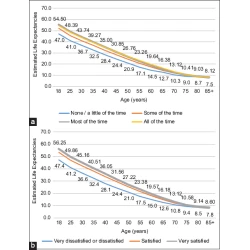
Results: Life expectancies at age 18 among adults with high levels of happiness and life satisfaction were, respectively, 7.5 and 8.9 years higher compared to those with low levels of happiness and life satisfaction. In Cox models with 14 years of mortality follow-up, all-cause mortality risk was 82% higher (hazard ratio [HR]=1.82; 95% CI=1.59,2.08) in adults with little or no happiness, controlling for age, and 36% higher (HR=1.36; 95% CI=1.17,1.57) in adults with little/no happiness, controlling for sociodemographic, behavioral and health characteristics, when compared with adults reporting happiness all of the time. Mortality risk was 107% higher (HR=2.07; 95% CI=1.80,2.38) in adults who were very dissatisfied with their life, controlling for age, and 39% higher (HR=1.39; 95% CI=1.20,1.60) in adults who were very dissatisfied, controlling for all covariates, when compared with adults who were very satisfied.
Conclusions and Global Health Implications: Adults with higher happiness and life satisfaction levels had significantly higher life expectancy and lower all-cause mortality risks than those with lower happiness and satisfaction levels. These findings underscore the significance of addressing subjective well-being in the population as a strategy for reducing all-cause mortality.
Downloads
Most read articles by the same author(s)
- Gopal K. Singh, Gem P. Daus, Michelle Allender, Christine T. Ramey, Elijah K. Martin, Chrisp Perry, Andrew A. De Los Reyes, Ivy P. Vedamuthu, Social Determinants of Health in the United States: Addressing Major Health Inequality Trends for the Nation, 1935-2016 , International Journal of Maternal and Child Health and AIDS: Vol. 6 No. 2 (2017): International Journal of Maternal and Child Health and AIDS
- Gopal K. Singh, Jihong Liu, Health Improvements Have Been More Rapid and Widespread in China than in India: A Comparative Analysis of Health and Socioeconomic Trends from 1960 to 2011 , International Journal of Maternal and Child Health and AIDS: Vol. 1 No. 1 (2012): International Journal of Maternal and Child Health and AIDS
- Gopal K. Singh, Romuladus E. Azuine, Mohammad Siahpush, Global Inequalities in Cervical Cancer Incidence and Mortality are Linked to Deprivation, Low Socioeconomic Status, and Human Development , International Journal of Maternal and Child Health and AIDS: Vol. 1 No. 1 (2012): International Journal of Maternal and Child Health and AIDS
- Hyunjung Lee, Gopal K. Singh, Monthly Trends in Drug Overdose Mortality among Youth Aged 15-34 Years in the United States, 2018-2021: Measuring the Impact of the COVID-19 Pandemic , International Journal of Maternal and Child Health and AIDS: Vol. 11 No. 2 (2022): International Journal of Maternal and Child Health and AIDS
- Hyunjung Lee, Gopal K. Singh, Psychological Distress and Heart Disease Mortality in the United States: Results from the 1997-2014 NHIS-NDI Record Linkage Study , International Journal of Maternal and Child Health and AIDS: Vol. 9 No. 3 (2020): International Journal of Maternal and Child Health and AIDS
- Romuladus E. Azuine, Janna Murray, Noor Alsafi, Gopal K. Singh, Exclusive Breastfeeding and Under-Five Mortality, 2006-2014: A Cross-National Analysis of 57 Low- and-Middle Income Countries , International Journal of Maternal and Child Health and AIDS: Vol. 4 No. 1 (2015): International Journal of Maternal and Child Health and AIDS
- Gopal K. Singh, Anagha Lokhande, Romuladus E. Azuine, Global Inequalities in Youth Mortality, 2007-2012 , International Journal of Maternal and Child Health and AIDS: Vol. 3 No. 1 (2015): International Journal of Maternal and Child Health and AIDS
- Hyunjung Lee, Gopal K. Singh, Contributions of Socioeconomic, Demographic, and Behavioral Risk Factors to All-Cause Mortality Disparities by Psychological Distress in the United States: A Blinder-Oaxaca Decomposition Analysis of Longitudinal Data , International Journal of Maternal and Child Health and AIDS: Vol. 11 No. 1 (2022): International Journal of Maternal and Child Health and AIDS
- Romuladus E. Azuine, Sussan E. Ekejiuba, Gopal K. Singh, Magnus A. Azuine, Ebola Virus Disease Epidemic: What Can the World Learn and Not Learn from West Africa? , International Journal of Maternal and Child Health and AIDS: Vol. 3 No. 1 (2015): International Journal of Maternal and Child Health and AIDS
- Raees A. Shaikh, Mohammad Siahpush, Gopal K. Singh, Melissa Tibbits, Socioeconomic Status, Smoking, Alcohol use, Physical Activity, and Dietary Behavior as Determinants of Obesity and Body Mass Index in the United States: Findings from the National Health Interview Survey , International Journal of Maternal and Child Health and AIDS: Vol. 4 No. 1 (2015): International Journal of Maternal and Child Health and AIDS
Similar Articles
- Maria Vigil-Mallette, Daryle Pickens, Julliet Ogu, Deepa Dongarwar, Elizabeth Onugha, Hamisu M Salihu, Fifth Annual Summer Research Summit on Health Equity Organized by the Center of Excellence in Health Equity, Training and Research, Baylor College of Medicine, Houston, Texas 77030, USA on May 17, 2022 , Vol. 11 No. S2 (2022): International Journal of Maternal and Child Health and AIDS
- Gopal K. Singh, Hyunjung Lee, Marked Disparities in Life Expectancy by Education, Poverty Level, Occupation, and Housing Tenure in the United States, 1997-2014 , Vol. 10 No. 1 (2021): International Journal of Maternal and Child Health and AIDS
- Gopal K. Singh, Gem P. Daus, Michelle Allender, Christine T. Ramey, Elijah K. Martin, Chrisp Perry, Andrew A. De Los Reyes, Ivy P. Vedamuthu, Social Determinants of Health in the United States: Addressing Major Health Inequality Trends for the Nation, 1935-2016 , Vol. 6 No. 2 (2017): International Journal of Maternal and Child Health and AIDS
- Gopal K. Singh, Hyunjung Lee, Lyoung Hee Kim, Housing and Inequalities in US Life Expectancy, Child and Youth Mortality, and All-Cause and Cause-Specific Mortality, 1979-2020: Results from the National Longitudinal Mortality Study and the National Vital Statistics System , Vol. 12 No. 2 (2023): International Journal of Maternal and Child Health and AIDS
- Gopal K. Singh, Mohammad Siahpush, Romuladus E. Azuine, Shanita D. Williams, Widening Socioeconomic and Racial Disparities in Cardiovascular Disease Mortality in the United States, 1969-2013 , Vol. 3 No. 2 (2015): International Journal of Maternal and Child Health and AIDS
- Gopal K. Singh, Stella M. Yu, Infant Mortality in the United States, 1915-2017: Large Social Inequalities have Persisted for Over a Century , Vol. 8 No. 1 (2019): International Journal of Maternal and Child Health and AIDS
- Gopal K. Singh, Mohammad Siahpush, Romuladus E. Azuine, Shanita D. Williams, Increasing Area Deprivation and Socioeconomic Inequalities in Heart Disease, Stroke, and Cardiovascular Disease Mortality Among Working Age Populations, United States, 1969-2011 , Vol. 3 No. 2 (2015): International Journal of Maternal and Child Health and AIDS
- Gopal K. Singh, Trends and Social Inequalities in Maternal Mortality in the United States, 1969-2018 , Vol. 10 No. 1 (2021): International Journal of Maternal and Child Health and AIDS
- Gopal K. Singh, Romuladus E. Azuine, Mohammad Siahpush, Shanita D. Williams, Widening Geographical Disparities in Cardiovascular Disease Mortality in the United States, 1969-2011 , Vol. 3 No. 2 (2015): International Journal of Maternal and Child Health and AIDS
- Gopal K. Singh, Jihong Liu, Health Improvements Have Been More Rapid and Widespread in China than in India: A Comparative Analysis of Health and Socioeconomic Trends from 1960 to 2011 , Vol. 1 No. 1 (2012): International Journal of Maternal and Child Health and AIDS
You may also start an advanced similarity search for this article.
Published
How to Cite
Issue
Section
License
Copyright © 2020 Hyunjung Lee, Gopal K. Singh. Published by Global Health and Education Projects, Inc., USA.

This is an open-access article distributed under the terms of the Creative Commons Attribution-NonCommercial-ShareAlike 4.0 International License , which permits others to remix, transform, and build upon the work non-commercially, provided the original author is credited and the new creations are licensed under the same terms.