
Impact of a Maternal Prevention of Mother-to-child Transmission of HIV (PMTCT) Intervention on HIV-exposed Infants in Uganda
DOI:
https://doi.org/10.21106/ijma.380Keywords:
- Prevention of maternal to child transmission of HIV,
- HIV,
- Nevirapine,
- Antiretroviral therapy prophylaxis,
- Early infant diagnosis,
- HIV-exposed infants
Abstract
Background: Uganda has successfully reduced pediatric HIV infections through prevention of mother-to-child transmission of HIV (PMTCT) programs, yet little is known about adherence to infant-specific components of interventions. We hypothesized that infants born to mothers receiving the WiseMama (WM) electronic drug monitoring (EDM)-based adherence intervention would have increased uptake of six-week post-natal nevirapine (NVP) infant prophylaxis and better adherence to six-week early infant diagnosis (EID) HIV testing.
Methods: At two sites in Uganda, the Wise Infant Study (WIN) prospectively followed an infant cohort. Infants were born to women enrolled in an RCT testing the effect of real-time reminders delivered via EDM on maternal adherence to antiretroviral therapy. We assessed intrapartum and discharge receipt of NVP prophylaxis using pharmacy and infant HIV DNA testing laboratory data.
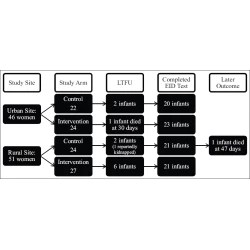
Results: Of 121 women eligible for WIN, 97 (80%) consented and enrolled; 46 had been randomized to control and 51 to intervention. There were no differences in receipt of a six-week NVP supply (control 87%, intervention 82%, p = 0.53). Receipt of any NVP prophylaxis did not vary by delivery location (p = 0.35), and although 12% of infants were delivered at non-study health facilities, they were not less likely to receive NVP at discharge (p = 0.37). Among infants with a completed HIV test, there was no difference in mean time to first test (control 52 days (SD 18), intervention 51 days (SD 15), p = 0.86). Only one infant, in the control group, tested positive for HIV.
Conclusion and Global Health Implications: We found no significant differences in adherence to infant PMTCT practices between intervention and control infants with relatively high rates of NVP receipt albeit with suboptimal adherence to six-week EID testing. Further work is needed to ensure improved access, uptake, and follow-up of HIV-exposed infants in the Option B+ era.
Downloads
Similar Articles
- Roger J. Chin, Domrongphol Sangmanee, Lisa Piergallini, PEPFAR Funding and Reduction in HIV Infection Rates in 12 Focus Sub-Saharan African Countries: A Quantitative Analysis , Vol. 3 No. 2 (2015): International Journal of Maternal and Child Health and AIDS
- Yifru Berhan, Sinteyehu Abeba, Thirty Years of United Nations Inter-Agency Working Group’s Global, Regional, and National Maternal Mortality Estimates Revisited , Vol. 13 No. Continuous (2024): International Journal of Maternal and Child Health and AIDS
- Olawunmi R. Rabiu, Hannah Dada-Adegbola, Catherine O. Falade, Olatunbosun G. Arinola, Alexander B. Odaibo, Olusegun G. Ademowo, Malaria, Helminth Infections and Clinical Status Among HIV-Infected Pregnant Women , Vol. 10 No. 1 (2021): International Journal of Maternal and Child Health and AIDS
- Jaleah D. Rutledge, Alexis Kiyanda, Christina Jean-Louis, Elizabeth Raskin, Joanne Gaillard, Morgan Maxwell, Tynetta Smith, Trace Kershaw, Jasmine Abrams, Recommendations for Integrating Traditional Birth Attendants to Improve Maternal Health Outcomes in Low- and Middle-Income Countries , Vol. 13 No. Continuous (2024): International Journal of Maternal and Child Health and AIDS
- Prakash R Ganesh, Rachel Mernoff, Renske Dikkers, William Nundwe, Rachel Pope, A Comparison of Postoperative Surgical Outcomes among Women Undergoing Obstetric Fistula Repair with and without HIV , Vol. 10 No. 2 (2021): International Journal of Maternal and Child Health and AIDS
- Ornella Sybile D. Kouanfack, Charles Kouanfack, Serges Clotaire Billong, Samuel N. Cumber, Claude N. Nkfusai, Fala Bede, Emerson Wepngong, Chombong Hubert, Georges Nguefack-Tsague, Madeleine N. Singwe, Epidemiology of Opportunistic Infections in HIV Infected Patients on Treatment in Accredited HIV Treatment Centers in Cameroon , Vol. 8 No. 2 (2019): International Journal of Maternal and Child Health and AIDS
- Musawenkosi H L Mabaso, Thoko Ndaba, Zilungile L Mkhize-Kwitshana, Overview of Maternal, Neonatal and Child Deaths in South Africa: Challenges, Opportunities, Progress and Future Prospects , Vol. 2 No. 2 (2014): International Journal of Maternal and Child Health and AIDS
- Barbara Burmen, Gregory Kurtzman, Anthony A Olashore, Leyla Baghirova Busang, Ohemaa Poku, Phenyo Morakanyane, Ontibile Tshume, Onkemetse Phoi, Mogomotsi Matshaba, Elizabeth D Lowenthal, Knashawn H Morales, Merrian J Brooks, HIV Virologic Suppression and Mental Well-being in Adolescents and Young Adults Living with HIV , Vol. 14 No. Continuous (2025): International Journal of Maternal and Child Health and AIDS
- Hamisu M. Salihu, Deepa Dongarwar, Toi B. Harris, Third Annual Summer Research Summit on Health Equity Organized by the Center of Excellence in Health Equity, Training and Research, Baylor College of Medicine, Houston, Texas 77030, USA on June 9, 2020: ABSTRACT: Advancing Health Equity Through Innovation , Vol. 9 No. S3 (2020): International Journal of Maternal and Child Health and AIDS
- Ndidiamaka Amutah-Onukagha, Monica Rodriguez, Ijeoma Opara, Michelle Gardner, Maame Araba Assan, Rodney Hammond, Jesus Plata, Kimberly Pierre, Ehsan Farag, Progresses and challenges of utilizing traditional birth attendants in maternal and child health in Nigeria , Vol. 6 No. 2 (2017): International Journal of Maternal and Child Health and AIDS
<< < 4 5 6 7 8 9 10 11 12 13 > >>
You may also start an advanced similarity search for this article.
Published
How to Cite
Issue
Section
License
Copyright © 2020 Anays Murillo, Mary Bachman DeSilva, Lora L. Sabin, Nafisa Halim, Harriet Chemusto, Philip Aroda, Julia Gasuza, Davidson H. Hamer, Anna Larson Williams, Barbara Mukasa, Lisa J. Messersmith, Rachael Bonawitz. Published by Global Health and Education Projects, Inc., USA.

This is an open-access article distributed under the terms of the Creative Commons Attribution-NonCommercial-ShareAlike 4.0 International License , which permits others to remix, transform, and build upon the work non-commercially, provided the original author is credited and the new creations are licensed under the same terms.