
Improving HIV Prevention for Key Populations in Nigeria: Insights on Access, Barriers, Stigma, and Service Utilization
DOI:
https://doi.org/10.25259/IJMA_49_2024Keywords:
- Health Services Accessibility,
- HIV Seroprevalence,
- Key Populations,
- Population Groups,
- Willingness to Access HIV Services
Abstract
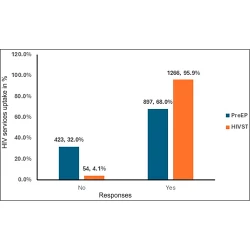
Background and Objective: Human immunodeficiency virus and acquired immunodeficiency syndrome (HIV/AIDS) remains a significant public health challenge globally, with key populations (KPs) such as female sex workers (FSWs), men who have sex with men (MSM), and people who inject drugs (PWIDs) being disproportionately affected. Despite the availability of various HIV prevention services, including pre-exposure prophylaxis (PrEP) and community-based antiretroviral therapy (ART), the willingness of KPs to access these services remains a critical concern. This study aims to assess the prevalence of HIV and the willingness to access HIV preventive services among KPs in three selected local government areas (LGAs) in Nigeria. Methods: A cross-sectional study was conducted in 2023 across three LGAs, Gwale, Fagge, and Tarauni, in Kano State, Nigeria, using a snowball sampling technique. A total of 1,320 participants, recruited from brothels and nightclubs, were tested for HIV using self-test kits. Willingness to access HIV services was assessed using a structured questionnaire. Data were analyzed using descriptive statistics and binary logistic regression. Results: The overall HIV prevalence among KPs was 10.8%. MSM and PWIDs exhibited higher HIV prevalence rates compared to FSWs. Willingness to access HIV preventive services was recorded at 57.7%, with significant influences from geographical location and sexual practices. Participants from Tarauni were more willing to access services, and those engaging in vaginal sex were more likely to seek preventive services. HIV self-testing had a high uptake of 95.9%, while PrEP uptake was 68.0%. Major barriers included stigma, lack of comprehensive services, and limited knowledge of service providers. Conclusion and Global Health Implications: This study highlights the critical need for targeted interventions addressing the specific barriers faced by KPs in these regions. Enhancing service accessibility and addressing stigma is essential for reducing HIV transmission and achieving epidemic control in Nigeria by 2030.
Downloads
Most read articles by the same author(s)
- Bartholomew Boniface Ochonye, Paul Umoh, Olaniyi Felix Sanni, Abiye Kalaiwo, Roger Abang, Agboola Oguntonade, Paul Amechi, Godwin Emmanuel, Pre-Exposure Prophylaxis and HIV Prevention Among Key Populations in Nigeria , International Journal of Maternal and Child Health and AIDS: Vol. 13 No. Continuous (2024): International Journal of Maternal and Child Health and AIDS
- Chidimma Ezenwa Anyanwu, Kwasi Torpey, Olaiya Paul Abiodun, Olaniyi Felix Sanni, Ifeanyi Donald Anyanwu, Variations in the Prevalence of Female Genital Mutilation Among Reproductive-aged Women in Nigeria Across Three Generations , International Journal of Maternal and Child Health and AIDS: Vol. 11 No. 2 (2022): International Journal of Maternal and Child Health and AIDS
Similar Articles
- Md Nazrul Islam Mondai, Md Monzur Morshad Nasir Ullah, Md Rafiqul Islam, Md Shafiur Rahman, Md Nuruzzaman Khan, Kazi Mohiuddin Ahmed, Mohammad Shariful Islam, Sociodemographic and Health Determinants of Inequalities in Life Expectancy in Least Developed Countries , Vol. 4 No. 1 (2015): International Journal of Maternal and Child Health and AIDS
- Janice Katherine Kopinak, Mental Health in Developing Countries: Challenges and Opportunities in Introducing Western Mental Health System in Uganda , Vol. 3 No. 1 (2015): International Journal of Maternal and Child Health and AIDS
- Nnennaya N. Kalu-Umeh, Mohammed N. Sambo N. Sambo, Suleiman H. Idris, Abubakar M. Kurfi, Costs and Patterns of Financing Maternal Health Care Services in Rural Communities in Northern Nigeria: Evidence for Designing National Fee Exemption Policy , Vol. 2 No. 1 (2013): International Journal of Maternal and Child Health and AIDS
- Musawenkosi H L Mabaso, Thoko Ndaba, Zilungile L Mkhize-Kwitshana, Overview of Maternal, Neonatal and Child Deaths in South Africa: Challenges, Opportunities, Progress and Future Prospects , Vol. 2 No. 2 (2014): International Journal of Maternal and Child Health and AIDS
- Jaleah D. Rutledge, Alexis Kiyanda, Christina Jean-Louis, Elizabeth Raskin, Joanne Gaillard, Morgan Maxwell, Tynetta Smith, Trace Kershaw, Jasmine Abrams, Recommendations for Integrating Traditional Birth Attendants to Improve Maternal Health Outcomes in Low- and Middle-Income Countries , Vol. 13 No. Continuous (2024): International Journal of Maternal and Child Health and AIDS
- May Soe Aung, Myint Moh Soe, Hla Hla Win, Kyaw Swa Mya, Assessing the Impact of an Intervention on Caregivers’ Awareness and Completion of Continuum of Care Among Pregnant Women , Vol. 13 No. Continuous (2024): International Journal of Maternal and Child Health and AIDS
- Fatima M. Damagum, Zainab D. Ahmed, Rabiu I. Jalo, Hamisu M. Salihu, C. William Wester, Muktar H. Aliyu, Adapted Counseling Care Model for Management of Female Sexual Dysfunction Among Women Living With and Without HIV , Vol. 13 No. Continuous (2024): International Journal of Maternal and Child Health and AIDS
- Anays Murillo, Mary Bachman DeSilva, Lora L. Sabin, Nafisa Halim, Harriet Chemusto, Philip Aroda, Julia Gasuza, Davidson H. Hamer, Anna Larson Williams, Barbara Mukasa, Lisa J. Messersmith, Rachael Bonawitz, Impact of a Maternal Prevention of Mother-to-child Transmission of HIV (PMTCT) Intervention on HIV-exposed Infants in Uganda , Vol. 9 No. 3 (2020): International Journal of Maternal and Child Health and AIDS
- Anastasia Y. Bongajum, Pascal Foumane, Charlotte O. Moussi, Noel Vogue, Hycinth S. Banseka, Jujlius M. Nwobegahay, Martina L. Baye, Strengthening Maternal Death Surveillance Systems for Evidence-Based Decision Making in Sub-Saharan Africa: The Case of the Center Region in Cameroon , Vol. 10 No. 2 (2021): International Journal of Maternal and Child Health and AIDS
- Gopal K. Singh, Mohammad Siahpush, Romuladus E. Azuine, Shanita D. Williams, Increasing Area Deprivation and Socioeconomic Inequalities in Heart Disease, Stroke, and Cardiovascular Disease Mortality Among Working Age Populations, United States, 1969-2011 , Vol. 3 No. 2 (2015): International Journal of Maternal and Child Health and AIDS
<< < 4 5 6 7 8 9 10 11 12 13 > >>
You may also start an advanced similarity search for this article.
Published
How to Cite
Issue
Section
License
Copyright © 2025 Godwin Omokhagbo Emmanuel, Olaniyi Felix Sanni, Abang Roger, Paul Umoh, Ochonye Bartholomew Boniface, Amechi Paul, Ismaeel Mohammed Yahaya, Agie Muhmmad Auwal. Published by Global Health and Education Projects, Inc., USA.

This is an open-access article distributed under the terms of the Creative Commons Attribution-NonCommercial-ShareAlike 4.0 International License , which permits others to remix, transform, and build upon the work non-commercially, provided the original author is credited and the new creations are licensed under the same terms.