
A Novel Combined Mother-Infant Clinic to Optimize Post-Partum Maternal Retention, Service Utilization, and Linkage to Services in HIV Care in Rural Rwanda
DOI:
https://doi.org/10.21106/ijma.186Keywords:
- HIV,
- Integrated Clinic,
- Combined Clinic,
- Antiretroviral Therapy,
- Post-partum Retention,
- Linkages,
- ART,
- PMTCT,
- Option B+,
- Africa
Abstract
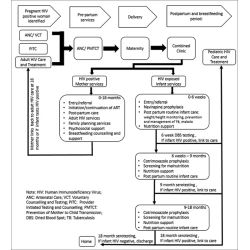
Despite recent improvements in accessibility of services to prevent mother-to-child transmission of HIV, maternal retention in HIV care remains a challenge in the post-partum period. This study assessed service utilization, program retention, and linkage to routine services, as well as clinical outcomes for mothers and infants, following implementation of an integrated mother-infant clinic in rural Rwanda.
Methods:We conducted a retrospective cohort study of all HIV-positive mothers and their infants enrolled in the integrated clinics in two rural districts between July 1, 2012, and June 30, 2013. At 18 months post-partum, data on mother-infant service utilization and program outcomes were reported.
Results:Of the 185 mother-infant pairs in the clinics, 98.4% of mothers were on antiretroviral therapy (ART) and 30.3% used modern contraception at enrollment. At 18 months post-partum, 98.4% of mothers were retained and linked back to adult HIV program. All mothers were on ART and 72.0% on modern contraception. For infants, 93.0% completed follow-up. Two (1.1%) infants tested HIV positive.
Conclusion and Global Health Implication:An integrated clinic was successfully implemented in rural Rwanda with high mother retention in care and low mother to child HIV transmission rates. This model of integration of services may contribute to improved mother-infant retention in care during post-partum period and should be considered as one approach to addressing this challenge in similar settings.
Downloads
Similar Articles
- Elangovan Arumugam, Joseph K. David, Santhakumar Aridoss, Nagaraj Jaganathasamy, Malathi Mathiyazhakan, Ganesh Balasubramanian, Manikandan Natesan, VM, Padmapriya, BK Kirubakaran, Sanjay Patel, Pradeep Kumar, Shobini Rajan, An Analysis of Levels and Trends in HIV Prevalence Among Pregnant Women Attending Antenatal Clinics in Karnataka, South India, 2003-2019 , Vol. 10 No. 2 (2021): International Journal of Maternal and Child Health and AIDS
- Fekadu Mazengia Alemu, Alemayehu Worku Yalew, Mesganaw Fantahun, Eta Ebasi Ashu, Antiretroviral Therapy and Pregnancy Outcomes in Developing Countries: A Systematic Review , Vol. 3 No. 1 (2015): International Journal of Maternal and Child Health and AIDS
- Elizabeth Armstrong-Mensah, Ato Kwamena Tetteh, Seung Choi, Utilization of Rapid Diagnostic Testing in sub-Saharan Africa: Challenges and Effects on HIV Prevention , Vol. 10 No. 1 (2021): International Journal of Maternal and Child Health and AIDS
- George Chidi Anwuri, Michael S. Dunn, Frederick Schulze, Determinants of Voluntary HIV/AIDS Counseling and Testing among Community College Students in the United States , Vol. 6 No. 2 (2017): International Journal of Maternal and Child Health and AIDS
- Michelle Berlacher, Timothy Mercer, Edith O. Apondi, Winfred Mwangi, Edwin Were, Megan S. McHenry, Integrating Prevention of Mother-to-Child Transmission of HIV Care into General Maternal Child Health Care in Western Kenya , Vol. 10 No. 1 (2021): International Journal of Maternal and Child Health and AIDS
- Ebelechuku F. Ugochukwu, Chinyere U. Onubogu, Emeka S. Edokwe, Uchenna Ekwochi, Kenneth N. Okeke, Esther N. Umeadi, Stanley K. Onah, A Review and Analysis of Outcomes from Prevention of Mother-toChild Transmission of HIV Infant Follow-up Services at a Pediatric Infectious Diseases Unit of a Major Tertiary Hospital in Nigeria: 2007-2020 , Vol. 10 No. 2 (2021): International Journal of Maternal and Child Health and AIDS
- Agnes Napyo, James K Tumwine, David Mukunya, Josephine Tumuhamye, Anna Agnes Ojok Arach, Grace Ndeezi, Paul Waako, Thorkild Tylleskär, Detectable HIV-RNA Viral Load Among HIV-Infected Pregnant Women on Treatment in Northern Uganda , Vol. 9 No. 2 (2020): International Journal of Maternal and Child Health and AIDS
- Rachael Bonawitz, Kathleen Lucy McGlasson, Jeanette L. Kaiser, Thandiwe Ngoma, Jody Lori, Carol Boyd, Godfrey Biemba, Davidson H. Hamer, Nancy A. Scott, Maternity Waiting Home Use by HIV-positive Pregnant Women in Zambia: Opportunity for Improved Prevention of Maternal to Child Transmission of HIV , Vol. 8 No. 1 (2019): International Journal of Maternal and Child Health and AIDS
- Presley Chick Tayong, Herbert Afegenwi Mbunkah, Raphael Awah Abong, Sumelong Sharon Dione Akomoneh, Raoul Tuekam Kayo, Elvis Achondou Akomoneh, Incidence of Mother-to-Child Transmission of HIV and Associated Factors in Postpartum Women in Cameroon , Vol. 14 No. Continuous (2025): International Journal of Maternal and Child Health and AIDS
- Esum Mathias Eyong, Nwana Yvette Ngwe, Claude Ngwayu Nfuksai, Loveline Lum Niba, Akoachere Jane-Francis, Prevalence of Occupational Exposure to HIV and Factors Associated with Compliance with Post-Exposure Prophylaxis Among Health Workers of the Biyem-Assi, Buea, and Limbe Health Districts of Cameroon Maternal and Child Health and AIDS , Vol. 11 No. 1 (2022): International Journal of Maternal and Child Health and AIDS
<< < 1 2 3 4 5 6 7 8 9 10 > >>
You may also start an advanced similarity search for this article.
Published
How to Cite
Issue
Section
License
Copyright © 2017 Neza Guillaine, Wilberforce Mwizerwa, Jackline Odhiambo, Bethany L. Hedt-Gauthier, Lisa R. Hirschhorn, Placidie Mugwaneza, Jean Paul Umugisha, Felix Rwabukwisi Cyamatare, Christine Mutaganzwa, Neil Gupta. Published by Global Health and Education Projects, Inc., USA.

This is an open-access article distributed under the terms of the Creative Commons Attribution-NonCommercial-ShareAlike 4.0 International License , which permits others to remix, transform, and build upon the work non-commercially, provided the original author is credited and the new creations are licensed under the same terms.