
A Systematic Review of Interventions to Reduce Maternal Mortality among HIV-Infected Pregnant and Postpartum Women
DOI:
https://doi.org/10.21106/ijma.66Keywords:
- Maternal mortality,
- HIV,
- Pregnancy,
- Postpartum,
- HIV-related interventions Antiretroviral therapy,
- Antiretroviral therapy,
- Systematic review
Abstract
In high-prevalence populations, HIV-related maternal mortality is high with increased mortality found among HIV-infected pregnant and postpartum women compared to their uninfected peers. The scale-up of HIV-related treatment options and broader reach of programming for HIV-infected pregnant and postpartum women is likely to have decreased maternal mortality. This systematic review synthesized evidence on interventions that have directly reduced mortality among this population.
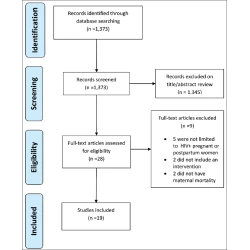
Methods:Studies published between January 1,2003 and November 30, 2014 were searched using PubMed. Of the 1,373 records screened, 19 were included in the analysis.
Results:Interventions identified through the review include antiretroviral therapy (ART), micronutrients (multivitamins, vitamin A, and selenium), and antibiotics. ART during pregnancy was shown to reduce mortality. Timing of ART initiation, duration of treatment, HIV disease status, and ART discontinuation after pregnancy influence mortality reduction. Incident pregnancy in women already on ART for their health appears not to have adverse consequences for the mother. Multivitamin use was shown to reduce disease progression while other micronutrients and antibiotics had no beneficial effect on maternal mortality.
Conclusions:ART was the only intervention identified that decreased death in HIV-infected pregnant and postpartum women. The findings support global trends in encouraging initiation of lifelong ART for all HIV-infected pregnant and breastfeeding women (Option B+), regardless of their CD4+ count, as an important step in ensuring appropriate care and treatment.
Global Health Implications:Maternal mortality is a rare event that highlights challenges in measuring the impact of interventions on mortality. Developing effective patient-centered interventions to reduce maternal morbidity and mortality, as well as corresponding evaluation measures of their impact, requires further attention by policy makers, program managers, and researchers.
Downloads
Most read articles by the same author(s)
- Brianna L. Smith, Sara Zizzo, Anouk Amzel, Sarah Wiant, Molly C. Pezzulo, Sarah Konopka, Rachel Golin, Alexandra C. Vrazo, Integration of Neonatal and Child Health Interventions with Pediatric HIV Interventions in Global Health , International Journal of Maternal and Child Health and AIDS: Vol. 7 No. 1 (2018): International Journal of Maternal and Child Health and AIDS
Similar Articles
- Kamukwamba Mwale, Seter Siziya, Intestinal Infestations in Under-Five Children in Zambia , Vol. 4 No. 2 (2015): International Journal of Maternal and Child Health and AIDS
- Foluke A. Olatona, Oyetola O. Oloruntola, Oluwafunmilayo F. Adeniyi, Eyitope O. Amu, Association Between Breakfast Consumption and Anthropometrically Determined Nutritional Status of Secondary-School Adolescents in Lagos, Southwest Nigeria , Vol. 11 No. 1 (2022): International Journal of Maternal and Child Health and AIDS
- Gopal K. Singh, Hyunjung Lee, Romuladus E. Azuine, Marked Disparities in COVID-19 Vaccination among US Children and Adolescents by Racial/Ethnic, Socioeconomic, Geographic, and Health Characteristics, United States, December 2021 – April 2022 , Vol. 11 No. 2 (2022): International Journal of Maternal and Child Health and AIDS
- Liye Wang, Deepa Dongarwar, Hamisu M. Salihu, Temporal Trends in the Rates of Singletons, Twins and Higher-order Multiple Births Over Five Decades Across Racial Groups in the United States , Vol. 9 No. 3 (2020): International Journal of Maternal and Child Health and AIDS
- Sahra Ibrahimi, Korede K. Yusuf, Deepa Dongarwar, Sitratullah Olawunmi Maiyegun, Chioma Ikedionwu, Hamisu M. Salihu, COVID-19 Devastation of African American Families: Impact on Mental Health and the Consequence of Systemic Racism , Vol. 9 No. 3 (2020): International Journal of Maternal and Child Health and AIDS
- Kenneth N. Opara, Rebecca T. Akomalafe, Nsima I. Udoidung, Udeme U. Afia, Clement A. Yaro, Bassey E. Bassey, Urogenital Schistosomiasis among Primary School Children in Rural Communities in Obudu, Southern Nigeria , Vol. 10 No. 1 (2021): International Journal of Maternal and Child Health and AIDS
- Fatimah Isma’il Tsiga-Ahmed, Taiwo Gboluwaga Amole, Baba Maiyaki Musa, Aishatu Muhammad Nalado, Omeiza Baba Agoyi, Hadiza Shehu Galadanci, Hamisu M. Salihu, COVID 19: Evaluating the Knowledge, Attitude and Preventive Practices of Healthcare Workers in Northern Nigeria , Vol. 10 No. 1 (2021): International Journal of Maternal and Child Health and AIDS
- Trevor D. Hadley, Rowland W. Pettit, Tahir Malik, Amelia A. Khoei, Hamisu M. Salihu, Artificial Intelligence in Global Health —A Framework and Strategy for Adoption and Sustainability , Vol. 9 No. 1 (2020): International Journal of Maternal and Child Health and AIDS
- Romuladus E. Azuine, Sussan E. Ekejiuba, Gopal K. Singh, Magnus A. Azuine, Ebola Virus Disease Epidemic: What Can the World Learn and Not Learn from West Africa? , Vol. 3 No. 1 (2015): International Journal of Maternal and Child Health and AIDS
- Arshiya Khan, Adarshlata Singh, Sugat Ambadas Jawade, Yash Kashikar, Extensive Intertrigo and Irritant Contact Dermatitis of Groins in Pregnant Female Due to Overuse of Feminine Hygiene Products , Vol. 13 No. Continuous (2024): International Journal of Maternal and Child Health and AIDS
<< < 24 25 26 27 28 29 30 > >>
You may also start an advanced similarity search for this article.
Published
How to Cite
Issue
Section
License
Copyright © 2015 Sara A. Holtz, Rudi Thetard, Sarah N. Konopka, Jennifer Albertini, Anouk Amzel, Karen P. Fogg. Published by Global Health and Education Projects, Inc., USA.

This is an open-access article distributed under the terms of the Creative Commons Attribution-NonCommercial-ShareAlike 4.0 International License , which permits others to remix, transform, and build upon the work non-commercially, provided the original author is credited and the new creations are licensed under the same terms.