
A Systematic Review of Interventions to Reduce Maternal Mortality among HIV-Infected Pregnant and Postpartum Women
DOI:
https://doi.org/10.21106/ijma.66Keywords:
- Maternal mortality,
- HIV,
- Pregnancy,
- Postpartum,
- HIV-related interventions Antiretroviral therapy,
- Antiretroviral therapy,
- Systematic review
Abstract
In high-prevalence populations, HIV-related maternal mortality is high with increased mortality found among HIV-infected pregnant and postpartum women compared to their uninfected peers. The scale-up of HIV-related treatment options and broader reach of programming for HIV-infected pregnant and postpartum women is likely to have decreased maternal mortality. This systematic review synthesized evidence on interventions that have directly reduced mortality among this population.
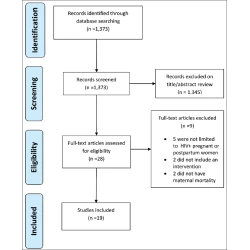
Methods:Studies published between January 1,2003 and November 30, 2014 were searched using PubMed. Of the 1,373 records screened, 19 were included in the analysis.
Results:Interventions identified through the review include antiretroviral therapy (ART), micronutrients (multivitamins, vitamin A, and selenium), and antibiotics. ART during pregnancy was shown to reduce mortality. Timing of ART initiation, duration of treatment, HIV disease status, and ART discontinuation after pregnancy influence mortality reduction. Incident pregnancy in women already on ART for their health appears not to have adverse consequences for the mother. Multivitamin use was shown to reduce disease progression while other micronutrients and antibiotics had no beneficial effect on maternal mortality.
Conclusions:ART was the only intervention identified that decreased death in HIV-infected pregnant and postpartum women. The findings support global trends in encouraging initiation of lifelong ART for all HIV-infected pregnant and breastfeeding women (Option B+), regardless of their CD4+ count, as an important step in ensuring appropriate care and treatment.
Global Health Implications:Maternal mortality is a rare event that highlights challenges in measuring the impact of interventions on mortality. Developing effective patient-centered interventions to reduce maternal morbidity and mortality, as well as corresponding evaluation measures of their impact, requires further attention by policy makers, program managers, and researchers.
Downloads
Most read articles by the same author(s)
- Brianna L. Smith, Sara Zizzo, Anouk Amzel, Sarah Wiant, Molly C. Pezzulo, Sarah Konopka, Rachel Golin, Alexandra C. Vrazo, Integration of Neonatal and Child Health Interventions with Pediatric HIV Interventions in Global Health , International Journal of Maternal and Child Health and AIDS: Vol. 7 No. 1 (2018): International Journal of Maternal and Child Health and AIDS
Similar Articles
- Amina P. Alio, Candace Sibley, Halimah S. Ouedraogo, Stephaun E. Wallace, Steven Wakefield, Damon L. Humes, Sheldon D. Fields, Michael C. Keefer, House Ball Community Leaders’ Perceptions of HIV and HIV Vaccine Research , Vol. 9 No. 1 (2020): International Journal of Maternal and Child Health and AIDS
- Deepa Dongarwar, Toi B. Harris, Hamisu M. Salihu, Fourth Annual Summer Research Summit on Health Equity Organized by the Center of Excellence in Health Equity, Training and Research, Baylor College of Medicine, Houston, Texas 77030, USA on May 20, 2021 , Vol. 10 No. S3 (2021): International Journal of Maternal and Child Health and AIDS
- Hadiza Galadanci, Deepa Dongarwar, Wolfgang Künzel, Oladapo Shittu, Murtala Yusuf, Sadiq Abdurrahman, Dolapo Lufadeju, Hamisu M. Salihu, Cesarean Section and Maternal-fetal Mortality Rates in Nigeria: An Ecological Lens into the Last Decade , Vol. 9 No. 1 (2020): International Journal of Maternal and Child Health and AIDS
- Linda Aurpibul, Fuanglada Tongprasert, Uraiwan Wichasilp, Arunrat Tangmunkongvorakul, Depressive Symptoms Associated with Low Quality of Life Among Pregnant and Postpartum Women Living with HIV in Chiang Mai, Thailand , Vol. 9 No. 3 (2020): International Journal of Maternal and Child Health and AIDS
- Katherine Magerko, John Humphrey, Julia Songok, Beverly Musick, Joy Marsha Alera, Bett Kipchumba, Wycliffe Kosgei, Winfred Mwangi, Ziyi Yang, Kara Wools-Kaloustian, Megan McHenry, Impact of Maternal Viral Suppression on Growth Patterns for HIV-Exposed Uninfected Infants in Kenya , Vol. 13 No. Continuous (2024): International Journal of Maternal and Child Health and AIDS
- María Isabel Roldós, Phaedra Corso, Justin Ingels, How much are Ecuadorians Willing to Pay to Reduce Maternal Mortality? Results from a Pilot Study on Contingent Valuation , Vol. 6 No. 1 (2017): International Journal of Maternal and Child Health and AIDS
- Manpreet Singh Khurmi, Felix Sayinzoga, Atakilt Berhe, Tatien Bucyana, Assumpta Kayinamura Mwali, Emmanuel Manzi, Maharajan Muthu, Newborn Survival Case Study in Rwanda - Bottleneck Analysis and Projections in Key Maternal and Child Mortality Rates Using Lives Saved Tool (LiST) , Vol. 6 No. 2 (2017): International Journal of Maternal and Child Health and AIDS
- Michelle Berlacher, Timothy Mercer, Edith O. Apondi, Winfred Mwangi, Edwin Were, Megan S. McHenry, Integrating Prevention of Mother-to-Child Transmission of HIV Care into General Maternal Child Health Care in Western Kenya , Vol. 10 No. 1 (2021): International Journal of Maternal and Child Health and AIDS
- Amina Abdullahi, Hassan Adam Murtala, Aisha Adam Abdullahi, Amina Aminu, Muktar H. Aliyu, Sani H. Aliyu, Ololade D. Adeyemi, Deepa Dongarwar, Jordi B. Torrelles, Gambo Aliyu, Hamisu M. Salihu, Drivers of Human Immunodeficiency Virus among Pregnant Women in Conflict and Non-conflict Zones of Nigeria , Vol. 14 No. Continuous (2025): International Journal of Maternal and Child Health and AIDS
- Hyacinthe Zamané, Hyacinthe Euvrard Sow, Dantola Paul Kain, Brice Wilfried Bicaba, Sibraogo Kiemtoré, Issaka Yameogo, Blandine Bonané-Thieba, Mamadou Sawadogo, Maternal Mortality at the Dori Regional Hospital in Northern Burkina Faso, 2014-2016 , Vol. 7 No. 2 (2018): International Journal of Maternal and Child Health and AIDS
<< < 3 4 5 6 7 8 9 10 11 12 > >>
You may also start an advanced similarity search for this article.
Published
How to Cite
Issue
Section
License
Copyright © 2015 Sara A. Holtz, Rudi Thetard, Sarah N. Konopka, Jennifer Albertini, Anouk Amzel, Karen P. Fogg. Published by Global Health and Education Projects, Inc., USA.

This is an open-access article distributed under the terms of the Creative Commons Attribution-NonCommercial-ShareAlike 4.0 International License , which permits others to remix, transform, and build upon the work non-commercially, provided the original author is credited and the new creations are licensed under the same terms.