
Global Health Donor Presence, Variations in HIV/AIDS Prevalence, and External Resources for Health in Developing Countries in Africa and Asia
DOI:
https://doi.org/10.21106/ijma.24Keywords:
- Global health,
- Donor presence,
- Donor coordination,
- Developing countries,
- Africa,
- Asia,
- HIV/AIDS,
- Global health conceptual framework
Abstract
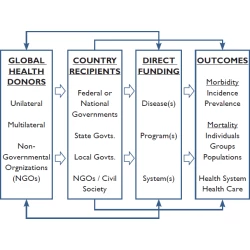
Objective: The presence of multiple global health aid organizations in donor recipient countries at any point in time has led to arguments for and against aid coordination and aid pluralism. Little data, however, exist to empirically demonstrate the relationship between donor presence and longitudinal disease outcomes in donor-recipient countries. We examined the association between global health donor presence and changes in HIV/AIDS prevalence in 14 developing countries: 12 in Africa (Ethiopia, Kenya, Tanzania, Malawi, Zimbabwe, Mozambique, Rwanda, South Africa, Uganda, Zambia, Burkina Faso and Mali) and compared them with two developing countries in Asia (India and Vietnam). Methods: To conduct our analyses, we conceptualized a framework for examining global health donor presence and disease outcomes. Donor presence data were derived from Mapping the Donor Landscape in Global Health: HIV/AIDS, a report published by the Kaiser Family Foundation, Washington, DC, USA. HIV/AIDS prevalence data were obtained and analyzed from the World Health Statistics and the Demographic and Health Surveys. Percent changes in national HIV/AIDS prevalence between 2009 and 2011 in the 14 developing countries were computed and correlation coefficients between donor presence and prevalence changes were calculated. Results: Between 2009 and 2011, HIV/AIDS prevalence decreased in all but one of the 14 developing countries with the presence of 21 or more global health donors. There was about 40% overall reduction in HIV/AIDS prevalence across the 14 countries in our analyses. South Africa recorded the most reduction in HIV/AIDS prevalence (-6.7%) followed by Zambia (-6.3, %), and Mozambique (-5.7%). Ethiopia was the only country without a reduction in HIV/AIDS prevalence (+0.1%). A correlation coefficient of 0.43 implied greater reductions in HIV/AIDS prevalence associated with increased donor presence. Conclusions and Public Health Implications: Our study shows a correlation between donor presence and HIV/AIDS disease burden in 14 donor-recipient countries. Our findings indicate that increased donor presence yields quantifiable reduction in global health disease burden. Further research is needed to demonstrate whether these gains can be observed in other global health disease outcomes.
Downloads
Similar Articles
- Charles Chibuisi Ehiemere, Ishaku Adamu Akyala, Bisayo Adetuyi Ogundipe, Chukwuebuka Clement Nri-Ezedi, Peter Joseph Anzaku, Waryit Esther Yonah, Efe Mary Imokhai, Isaac Onyebuchi Okohu, Idowu Olapemi Makinde, Ngozi Miriam Chimzobam-Nnalue, Beyond Access: Behavior Change and Gendered Realities in the Adoption of Digital Health Tools for Maternal, Newborn, and Child Health in Nigeria , Vol. 15 (2026): International Journal of Maternal and Child Health and AIDS
- Wah Wah Myint, Human Immunodeficiency Virus (HIV) Knowledge and Stigma: Findings from a Cross-sectional Survey , Vol. 15 (2026): International Journal of Maternal and Child Health and AIDS
- Maria Vigil-Mallette, Daryle Pickens, Julliet Ogu, Deepa Dongarwar, Elizabeth Onugha, Hamisu M Salihu, Fifth Annual Summer Research Summit on Health Equity Organized by the Center of Excellence in Health Equity, Training and Research, Baylor College of Medicine, Houston, Texas 77030, USA on May 17, 2022 , Vol. 11 No. S2 (2022): International Journal of Maternal and Child Health and AIDS
- Amol Jamkhande, Bhagyashree P. Agre, Neelam Gavali, Anjali Rajesh Gaikwad, Sanpreet Singh Sachdev, Association Between Maternal Periodontitis and Preterm Low Birth Weight in Indian Populations: A Literature Review , Vol. 15 (2026): International Journal of Maternal and Child Health and AIDS
- Margaret Omowaleola Akinwaare, Jonah Musa, Chizoma Millicent Ndikom, Determinants of Digitalized Antenatal Education Use among Pregnant Women Living with Human Immunodeficiency Virus in Nigeria , Vol. 15 (2026): International Journal of Maternal and Child Health and AIDS
- Ernest Tambo, Chidiebere E. Ugwu, Yayi Guan, Ding Wei, Xiao-Ning, Zhou Xiao-Nong, China-Africa Health Development Initiatives: Benefits and Implications for Shaping Innovative and Evidence-informed National Health Policies and Programs in Sub-saharan African Countries , Vol. 5 No. 2 (2016): International Journal of Maternal and Child Health and AIDS
- Océane J. Parker, Duc Minh Duong, Thuy Thu Nguyen, Vui Thi Le, Utilization of Sexual and Reproductive Healthcare Services Among Young Women in Two Districts of Hanoi, Vietnam , Vol. 15 (2026): International Journal of Maternal and Child Health and AIDS
- Kolawole A. Fasakin, Christopher T. Omisakin, Idowu O. Adebara, Wasiu A. Ajetunmobi, Adebayo A. Adeniyi, Ayodele J. Esan, Olufunke B. Bolaji, Oluwafemi D. Ajayi, Abayomi J. Afe, Assessment of PMTCT Success Rates Based on Antiretroviral Interventions and Feeding Options: A Prospective Cohort Study , Vol. 7 No. 2 (2018): International Journal of Maternal and Child Health and AIDS
- Sorochi H. Iloanusi, Osaro O. Mgbere, Susan. M. Abughosh, Ekere J. Essien, HIV Non-Occupational Post Exposure Prophylaxis in Nigeria: A Systematic Review of Research Evidence and Practice , Vol. 8 No. 2 (2019): International Journal of Maternal and Child Health and AIDS
- Deepa Dongarwar, Toi B. Harris, Hamisu M. Salihu, Fourth Annual Summer Research Summit on Health Equity Organized by the Center of Excellence in Health Equity, Training and Research, Baylor College of Medicine, Houston, Texas 77030, USA on May 20, 2021 , Vol. 10 No. S3 (2021): International Journal of Maternal and Child Health and AIDS
You may also start an advanced similarity search for this article.
Published
How to Cite
Issue
Section
License
Copyright © 2015 Romuladus Emeka Azuine, Gopal K Singh, Sussan E Ekejiuba, Eta Ashu, Magnus A Azuine. Published by Global Health and Education Projects, Inc., USA.

This is an open-access article distributed under the terms of the Creative Commons Attribution-NonCommercial-ShareAlike 4.0 International License , which permits others to remix, transform, and build upon the work non-commercially, provided the original author is credited and the new creations are licensed under the same terms.