
Beyond Access: Behavior Change and Gendered Realities in the Adoption of Digital Health Tools for Maternal, Newborn, and Child Health in Nigeria
DOI:
https://doi.org/10.21106/IJMA_45_2025Keywords:
- Behavior Change,
- Digital Health,
- Gender,
- Health-Seeking Behavior,
- Maternal and Child Health,
- Nigeria,
- Technology adoption
Abstract
Background and Objective: Digital health innovations are increasingly being deployed to improve maternal, newborn, and child health (MNCH) outcomes in Nigeria. However, their adoption and effectiveness are influenced not only by technological access and infrastructure but also by behavioral factors, gender norms, and cultural contexts that shape user engagement and health-seeking behaviors.
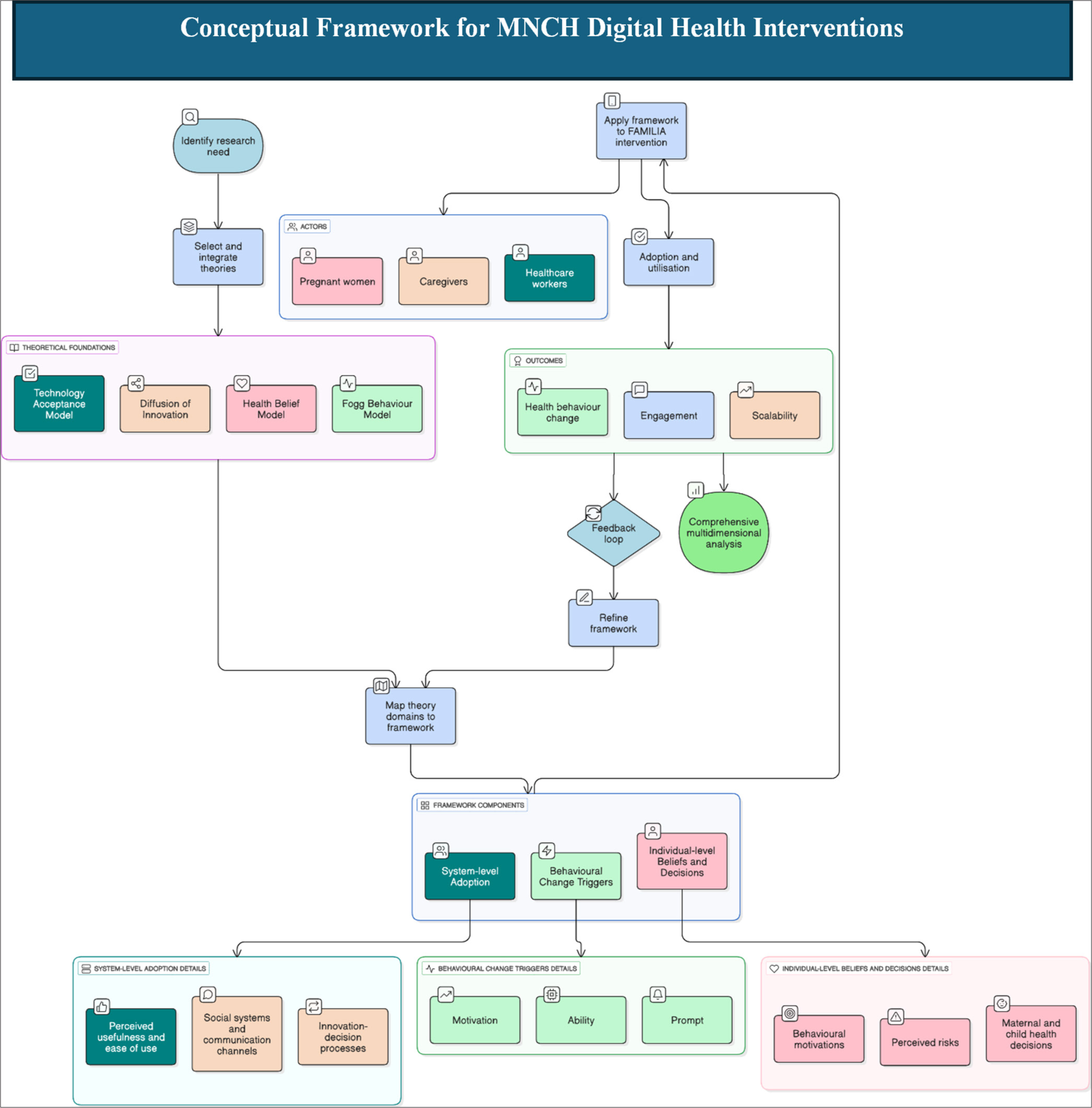
Methods: A narrative review was conducted using PubMed, Web of Science, Scopus, and African Journals Online, covering studies published between 2015 and 2025. From an initial pool of records, 46 studies met the inclusion criteria following screening. This review synthesized empirical studies, program evaluations, and behavioral frameworks, such as the Fogg Behavior Model and Health Belief Model, to examine how gender dynamics, social hierarchies, and behavioral readiness shape digital MNCH adoption.
Results: The findings reveal that digital literacy gaps, gendered power relations, sociocultural beliefs, and intrahousehold decision-making processes significantly affect technology uptake. Interventions that incorporated voice-based content, local languages, and male-inclusive engagement strategies demonstrated higher levels of acceptance and retention in the target population. Behaviorally informed designs, culturally tailored messaging, and the involvement of trusted intermediaries, such as community health workers, were critical success factors.
Conclusion and Global Health Implications: Effective digital health interventions must move beyond mere technical provision to integrate behavioral science and gender responsiveness into their design and delivery. Approaches that prioritize the lived realities of users, particularly women’s agency within household decisionmaking, are more likely to achieve equitable and sustainable MNCH outcomes. Policy and program developers should prioritize human-centered, behaviorally intelligent, and gender-transformative digital health models, while future interventions must integrate cultural adaptability, motivational triggers, and inclusive engagement strategies to enhance digital MNCH impact.
Downloads
Similar Articles
- Deepa Dongarwar, Anjali Aggarwal, Kenneth Barning, Hamisu Mohammed Salihu, Stillbirths among Advanced Maternal Age Women in the United States: 2003-2017 , Vol. 9 No. 1 (2020): International Journal of Maternal and Child Health and AIDS
- Stephen Stephen, Chiwoneso Gwyneth Elizabeth Muchaneta-Kubara, Marshall Wesley Munjoma, Gibson Mandozana, Evaluation of Cortez OneStep Chlamydia Rapicard™ Insta Test for the Detection of Chlamydia trachomatis in Pregnant Women at Mbare Polyclinic in Harare, Zimbabwe , Vol. 6 No. 1 (2017): International Journal of Maternal and Child Health and AIDS
- Oluwasola Stephen Ayosanmi, Lorette Oden, Titilope Ayosanmi, Babatunde Y. Alli, Mei Wen Wen, Jamie Johnson, Acceptability of HIV Screening in a Sample of International Students in the United States , Vol. 9 No. 3 (2020): International Journal of Maternal and Child Health and AIDS
- Margaret A. Winker, Lorraine E. Ferris, Promoting Global Health , Vol. 4 No. 1 (2015): International Journal of Maternal and Child Health and AIDS
- Anne Esther Njom Nlend, Mpox and Breastfeeding in Sub-Saharan Africa: Clinical, Program, and Policy Recommendations , Vol. 14 No. Continuous (2025): International Journal of Maternal and Child Health and AIDS
- Deepa Dongarwar, Hamisu M. Salihu, COVID-19 Pandemic: Marked Global Disparities in Fatalities According to Geographic Location and Universal Health Care , Vol. 9 No. 2 (2020): International Journal of Maternal and Child Health and AIDS
- Lucien Honoré Etame Sone, Roger Ahouga Voufo, Henriette Thérèse Dimodi, Michel Kengne, Cédric Gueguim, Nnanga Ngah, Julius Oben, Judith Laure Ngondi, Prevalence and Identification of Serum Markers Associated with Vertical Transmission of Hepatitis B in Pregnant Women in Yaounde, Cameroon , Vol. 6 No. 1 (2017): International Journal of Maternal and Child Health and AIDS
- Taranpreet Kaur, Kalpana Kumari, Priyanka Rai, Vandana Gupta, Sarika Pandey, Vineeta, Shweta Saini, A Comparative Study of Oral Nifedipine and Intravenous Labetalol for Acute Hypertensive Management in Pregnancy: Assessing Feto-Maternal Outcomes in a Hospital-based Randomized Control Trial , Vol. 13 No. Continuous (2024): International Journal of Maternal and Child Health and AIDS
- Hyunjung Lee, Gopal K. Singh, Monthly Trends in Drug Overdose Mortality among Youth Aged 15-34 Years in the United States, 2018-2021: Measuring the Impact of the COVID-19 Pandemic , Vol. 11 No. 2 (2022): International Journal of Maternal and Child Health and AIDS
- Kamukwamba Mwale, Seter Siziya, Intestinal Infestations in Under-Five Children in Zambia , Vol. 4 No. 2 (2015): International Journal of Maternal and Child Health and AIDS
<< < 23 24 25 26 27 28 29 30 31 > >>
You may also start an advanced similarity search for this article.
Published
How to Cite
Issue
Section
License
Copyright © 2026 Charles Chibuisi Ehiemere, Ishaku Adamu Akyala, Bisayo Adetuyi Ogundipe, Chukwuebuka Clement Nri-Ezedi, Peter Joseph Anzaku, Waryit Esther Yonah, Efe Mary Imokhai, Isaac Onyebuchi Okohu, Idowu Olapemi Makinde, Ngozi Miriam Chimzobam-Nnalue. Published by Global Health and Education Projects, Inc., USA.

This is an open-access article distributed under the terms of the Creative Commons Attribution-NonCommercial-ShareAlike 4.0 International License , which permits others to remix, transform, and build upon the work non-commercially, provided the original author is credited and the new creations are licensed under the same terms.