
Birth Preparedness Plans and Status Disclosure Among Pregnant Women Living with HIV Who are Receiving Antiretroviral Therapy in Ibadan, Southwest, Nigeria
DOI:
https://doi.org/10.21106/ijma.613Keywords:
- HIV,
- PMTCT,
- Pregnancy,
- Maternal Health,
- Antenatal Care
Abstract
Promoting the maternal health of pregnant women who are living with human immunodeficiency virus (HIV; [PWLH]) is key to reducing maternal mortality and morbidity. Thus, inadequate birth preparedness plans, non-institutional delivery, and status concealment among PWLH contribute to the spread of HIV infection and threaten the prevention of mother-to-child transmission (PMTCT). Therefore, this study aimed to assess the birth preparedness plan and status disclosure among PWLH, as well as the prevalence of HIV infection among pregnant women.
Methods:The study adopted a descriptive cross-sectional research design; a quantitative approach was used for data collection. Three healthcare facilities that represented the three levels of healthcare institutions and referral centers for the care of PWLH in the Ibadan metropolis were selected for the recruitment process. A validated questionnaire was used to collect data from 77 participants within the targeted population. Ethical approval was obtained prior to the commencement of data collection.
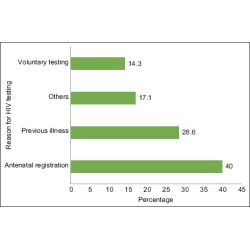
Results:The prevalence rate of HIV infection among the participants was 3.7%. Only 37.1% of the participants had a birth preparedness plan. A total of 40% of the participants tested for HIV, because testing was compulsory for antenatal registration. Only 7.1% of the participants had their status disclosed to their partners. Although 90% of the participants proposed delivering their babies in a hospital, only 80% of these participants had their status known in their proposed place of birth.
Conclusion and Global Health Implications:The prevalence of HIV infection among pregnant women is very low, which is an indication of improved maternal health. However, the level of birth preparedness plan and status disclosure to partners are equally low, and these factors can hinder PMTCT. Institutional delivery should be encouraged among all PWLH, and their HIV status must be disclosed at their place of birth.
Downloads
Most read articles by the same author(s)
- Margaret Omowaleola Akinwaare, Jonah Musa, Chizoma Millicent Ndikom, Determinants of Digitalized Antenatal Education Use among Pregnant Women Living with Human Immunodeficiency Virus in Nigeria , International Journal of Maternal and Child Health and AIDS: Vol. 15 (2026): International Journal of Maternal and Child Health and AIDS
Similar Articles
- Elizabeth Armstrong-Mensah, David-Praise Ebiringa, Kaleb Whitfield, Jake Coldiron, Genital Chlamydia Trachomatis Infection: Prevalence, Risk Factors and Adverse Pregnancy and Birth Outcomes in Children and Women in sub-Saharan Africa , Vol. 10 No. 2 (2021): International Journal of Maternal and Child Health and AIDS
- Anne Esther Njom Nlend, Pascal Avenec, Jeannette Epée Ngoué, Arsène B. Sandie, Morbidity and Mortality of HIV-Exposed Uninfected Infants in a Tertiary Referral Facility in Yaoundé, Cameroon , Vol. 12 No. 2 (2023): International Journal of Maternal and Child Health and AIDS
- Mousumi Datta, Shamima Yasmin, Rahul Biswas, Immunization Status, Immunization Coverage, and Factors Associated with Immunization Service Utilization Among HIV-Exposed and HIV-Infected Children in India , Vol. 13 No. Continuous (2024): International Journal of Maternal and Child Health and AIDS
- Charles Kouanfack, Hermine Meli, Samuel N. Cumber, Fala Bede, Claude N. Nkfusai, Patience Y. Ijang, Emerson Wepngong, Olga Yvonne M. Bassong, Benjamin-Alexandre Nkoum, Non-Occupational HIV Post-exposure Prophylaxis: A 10-Year Retrospective Review of Data Following Sexual Exposure From Yaounde Central Hospital, Cameroon , Vol. 8 No. 2 (2019): International Journal of Maternal and Child Health and AIDS
- Hyacinthe Zamané, Hyacinthe Euvrard Sow, Dantola Paul Kain, Brice Wilfried Bicaba, Sibraogo Kiemtoré, Issaka Yameogo, Blandine Bonané-Thieba, Mamadou Sawadogo, Maternal Mortality at the Dori Regional Hospital in Northern Burkina Faso, 2014-2016 , Vol. 7 No. 2 (2018): International Journal of Maternal and Child Health and AIDS
- Maame Aba Coleman, Deepa Dongarwar, Jessica Ramirez, Mei-Li Laracuente, Chelsea Livingston, Julliet Ogu, Racquel Lyn, Arabella Hall, Sylvia Adu-Gyamfi, Hamisu M. Salihu, Factors Impacting Vaccine Uptake during Pregnancy: A Retrospective Analysis , Vol. 11 No. 2 (2022): International Journal of Maternal and Child Health and AIDS
- Veronicah A. Wechuli, Monicah W. Karara, Allan T. Wafula, Godfrey W. Mayoka, Impact of COVID-19 on the Utilization of Maternal and Child Health Services at a Regional Referral Hospital in Kenya , Vol. 13 No. Continuous (2024): International Journal of Maternal and Child Health and AIDS
- Samantha A. Slinkard, Jennifer R. Pharr, Tamara Bruno, Dina Patel, Amaka Ogidi, Michael Obiefune, Echezona E. Ezeanolue, Determinants of Infant Mortality in Southeast Nigeria: Results from the Healthy Beginning Initiative, 2013-2014 , Vol. 7 No. 1 (2018): International Journal of Maternal and Child Health and AIDS
- Johnbull Egharevba, Jennifer Pharr, Brian van Wyk, Echezona Ezeanolue, Factors Influencing the Choice of Child Delivery Location among Women Attending Antenatal Care Services and Immunization Clinic in Southeastern Nigeria , Vol. 6 No. 1 (2017): International Journal of Maternal and Child Health and AIDS
- Romuladus E. Azuine, Janna Murray, Noor Alsafi, Gopal K. Singh, Exclusive Breastfeeding and Under-Five Mortality, 2006-2014: A Cross-National Analysis of 57 Low- and-Middle Income Countries , Vol. 4 No. 1 (2015): International Journal of Maternal and Child Health and AIDS
<< < 9 10 11 12 13 14 15 16 17 18 > >>
You may also start an advanced similarity search for this article.
Published
How to Cite
Issue
Section
License
Copyright © 2024 Margaret Omowaleola Akinwaare, Funmilayo A. Okanlawon, Monisola A. Popoola, Omotayo O. Adetunji. Published by Global Health and Education Projects, Inc., USA.

This is an open-access article distributed under the terms of the Creative Commons Attribution-NonCommercial-ShareAlike 4.0 International License , which permits others to remix, transform, and build upon the work non-commercially, provided the original author is credited and the new creations are licensed under the same terms.