
Marked Disparities in Life Expectancy by Education, Poverty Level, Occupation, and Housing Tenure in the United States, 1997-2014
DOI:
https://doi.org/10.21106/ijma.402Keywords:
- Life expectancy,
- Education,
- Poverty,
- Occupation,
- Housing Tenure,
- Social determinants,
- Longitudinal
Abstract
Socioeconomic disparities in life expectancy in the United States (US) are marked and have widened over time. However, there is limited research using individual-level socioeconomic variables as such information is generally lacking or unreliable in vital records used for life table construction. Using longitudinal cohort data, we computed life expectancy for US adults by social determinants such as education, income/poverty level, occupation, and housing tenure.
Methods:We analyzed the 1997-2014 National Health Interview Survey prospectively linked to mortality records in the National Death Index (N=1,146,271). Standard life table methodologies were used to compute life expectancy and other life table functions at various ages according to socioeconomic variables stratified by sex and race/ethnicity.
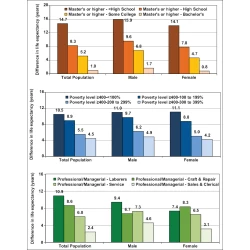
Results:Adults with at least a Master’s degree had 14.7 years higher life expectancy at age 18 than those with less than a high school education and 8.3 years higher life expectancy than those with a high school education. Poverty was inversely related to life expectancy. Individuals living in poverty had 10.5 years lower life expectancy at age 18 than those with incomes ≥400% of the poverty threshold. Laborers and those employed in craft and repair occupations had, respectively, 10.9 years and 8.6 years lower life expectancy at age 18 than those with professional and managerial occupations. Male and female renters had, respectively, 4.0 years and 4.6 years lower life expectancy at age 18 than homeowners. Women in the most advantaged socioeconomic group outlived men in the most disadvantaged group by 23.5 years at age 18.
Conclusions and Global Health Implications:Marked socioeconomic gradients in US life expectancy were found across all sex and racial/ethnic groups. Adults with lower education, higher poverty levels, in manual occupations, and with rental housing had substantially lower life expectancy compared to their counterparts with higher socioeconomic position.
Downloads
Most read articles by the same author(s)
- Gopal K. Singh, Hyunjung Lee, Lyoung Hee Kim, Shanita D. Williams, Social Determinants of Health Among American Indians and Alaska Natives and Tribal Communities: Comparison with Other Major Racial and Ethnic Groups in the United States, 1990–2022 , International Journal of Maternal and Child Health and AIDS: Vol. 13 No. Continuous (2024): International Journal of Maternal and Child Health and AIDS
- Hyunjung Lee, Gopal K. Singh, Psychological Distress and Heart Disease Mortality in the United States: Results from the 1997-2014 NHIS-NDI Record Linkage Study , International Journal of Maternal and Child Health and AIDS: Vol. 9 No. 3 (2020): International Journal of Maternal and Child Health and AIDS
- Gopal K. Singh, Hyunjung Lee, Trends and Racial/Ethnic, Socioeconomic, and Geographic Disparities in Maternal Mortality from Indirect Obstetric Causes in the United States, 1999-2017 , International Journal of Maternal and Child Health and AIDS: Vol. 10 No. 1 (2021): International Journal of Maternal and Child Health and AIDS
- Hyunjung Lee, Gopal K. Singh, Contributions of Socioeconomic, Demographic, and Behavioral Risk Factors to All-Cause Mortality Disparities by Psychological Distress in the United States: A Blinder-Oaxaca Decomposition Analysis of Longitudinal Data , International Journal of Maternal and Child Health and AIDS: Vol. 11 No. 1 (2022): International Journal of Maternal and Child Health and AIDS
- Gopal K. Singh, Hyunjung Lee, Lyoung Hee Kim, Housing and Inequalities in US Life Expectancy, Child and Youth Mortality, and All-Cause and Cause-Specific Mortality, 1979-2020: Results from the National Longitudinal Mortality Study and the National Vital Statistics System , International Journal of Maternal and Child Health and AIDS: Vol. 12 No. 2 (2023): International Journal of Maternal and Child Health and AIDS
- Gopal K. Singh, Hyunjung Lee, Romuladus E. Azuine, Marked Disparities in COVID-19 Vaccination among US Children and Adolescents by Racial/Ethnic, Socioeconomic, Geographic, and Health Characteristics, United States, December 2021 – April 2022 , International Journal of Maternal and Child Health and AIDS: Vol. 11 No. 2 (2022): International Journal of Maternal and Child Health and AIDS
Similar Articles
- Yifru Berhan, Sinteyehu Abeba, Thirty Years of United Nations Inter-Agency Working Group’s Global, Regional, and National Maternal Mortality Estimates Revisited , Vol. 13 No. Continuous (2024): International Journal of Maternal and Child Health and AIDS
- Sara Rushwan, Tesfaye Tufa, Metin Gülmezoglu, Feasibility, Acceptability, and Appropriate Use of Novel and Lesser-Used Medicines for Prevention and Treatment of Postpartum Hemorrhage: Evidence from Implementation Research , Vol. 13 No. S1 (2024): International Journal of Maternal and Child Health and AIDS
- Sara Rushwan, Fatu Forna, Ferid Abbas Abubeker, Tesfaye Tufa, Tieba Millogo, Miriam Nakalembe, Kwame Adu-Bonsaffoh, Francis L. Moses, Lester Chinery, Gilda Piaggio, Metin Gülmezoglu, Integrating Heat-Stable Carbetocin and Tranexamic Acid for Prevention and Management of Postpartum Hemorrhage in Sub-Saharan Africa: A Five-Country Pilot Implementation Study , Vol. 13 No. S1 (2024): International Journal of Maternal and Child Health and AIDS
- Daisy Ruto, Michael Muthamia, Edith Njeri, Freda Nyaga, Christine Muia, Morris Kiio, Jane Wausi, Introduction of Heat-Stable Carbetocin for Postpartum Hemorrhage Prevention in Public Sector Hospitals in Kenya: Provider Experience and Policy Insights , Vol. 13 No. S1 (2024): International Journal of Maternal and Child Health and AIDS
- Olatunde A. Amode, Omaye V. Negedu, Jessica T. Joseph, Uchenna Igbokwe Igbokwe, Olajumoke Adekeye, Damilola K. Oyedele, Hadiza Salele, Lola Ameyan, Kayode Afolabi, Olufunke Fasawe, Owens Wiwa, An Implementation Research Study on Uterotonics Use Patterns and Heat-stable Carbetocin Acceptability and Safety for Prevention of Postpartum Hemorrhage in Nigeria , Vol. 13 No. S1 (2024): International Journal of Maternal and Child Health and AIDS
- Faith D. Ihekweazu, Deepa Dongarwar, Hamisu M. Salihu, Richard Kellermayer, National Trends in Hospitalization, Surgical Resection, and Comorbidities in Pediatric Inflammatory Bowel Disease in the United States, 2002-2015 , Vol. 11 No. 1 (2022): International Journal of Maternal and Child Health and AIDS
- Deepa Dongarwar, Hamisu M. Salihu, COVID-19 Pandemic: Marked Global Disparities in Fatalities According to Geographic Location and Universal Health Care , Vol. 9 No. 2 (2020): International Journal of Maternal and Child Health and AIDS
- Hamisu M. Salihu, Global Reduction in HIV-related Maternal Mortality: ART as a Key Strategy , Vol. 4 No. 2 (2015): International Journal of Maternal and Child Health and AIDS
- Sara A. Holtz, Rudi Thetard, Sarah N. Konopka, Jennifer Albertini, Anouk Amzel, Karen P. Fogg, A Systematic Review of Interventions to Reduce Maternal Mortality among HIV-Infected Pregnant and Postpartum Women , Vol. 4 No. 2 (2015): International Journal of Maternal and Child Health and AIDS
- Rajesh Narwal, Lu Gram, Has the Rate of Reduction in Infant Mortality Increased in India Since the Launch of National Rural Health Mission? Analysis of Time Trends 2000-2009 with Projection to 2015 , Vol. 2 No. 1 (2013): International Journal of Maternal and Child Health and AIDS
<< < 23 24 25 26 27 28 29 30 > >>
You may also start an advanced similarity search for this article.
Published
How to Cite
Issue
Section
License
Copyright © 2020 Gopal K. Singh, Hyunjung Lee. Published by Global Health and Education Projects, Inc., USA.

This is an open-access article distributed under the terms of the Creative Commons Attribution-NonCommercial-ShareAlike 4.0 International License , which permits others to remix, transform, and build upon the work non-commercially, provided the original author is credited and the new creations are licensed under the same terms.