
Urogenital Schistosomiasis among Primary School Children in Rural Communities in Obudu, Southern Nigeria
DOI:
https://doi.org/10.21106/ijma.407Keywords:
- Schistosoma haematobium,
- Communities,
- Schools,
- Neglected tropical diseases,
- School-aged children,
- Parasitology,
- Chemotherapy,
- Proteinuria,
- Hematuria,
- Obudu,
- Cross River State,
- Nigeria
Abstract
Schistosomiasis is a Neglected Tropical Disease (NTD) that constitutes a public health problem in Sub-Saharan Africa (SSA), including Nigeria. There is need for updated information on the extent of the disease burden at community level to facilitate effective prioritization and monitoring of the disease.
Methods:A cross-sectional study was conducted among school-aged children in Obudu Local Government Area (LGA), one of the 18 LGAs in Cross River State, Southern Nigeria. Seven schools from seven communities were randomly selected for this study. A total of 1,113 urine samples obtained from school-aged children were screened for Schistosoma haematobium (S. haematobium) eggs using standard parasitological method of diagnosis. Proteinuria and hematuria were evaluated using reagent test strips.
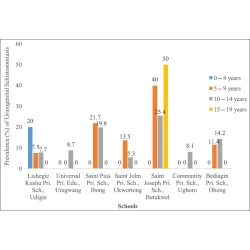
Results:In this study, 153 (13.7%) children were infected with S. haematobium. More males (86 or 14.7%) were infected than females (67 or 12.7%); the differences were not statistically significant. The overall geometric mean intensity of infection was 13.3 eggs/10ml of urine. Females (13.69 eggs/10ml of urine) had the highest intensity of infection than males (12.91eggs/10ml of urine). Prevalence of hematuria was 152 (13.7%) (95% C.I. = 10.649 – 18.751%) while the prevalence of proteinuria was 172 (15.5%) (95% C.I. = 5.162 – 38.712%). Prevalence of infection significantly (p<0.001) varied among the schools from 7.8% to 28.9%. Children aged 5-9 years old had the highest prevalence of infection 46 (17.1%). The prevalence of urogenital schistosomiasis was 28.9%, 20.5% and 13.2%, respectively, among Betukwel, Ibong, and Ohong communities.
Conclusion and Global Health Implications:Urinary schistosomiasis is still endemic in Obudu, Southern Nigeria but with decreased prevalence. Public health mitigation efforts such as mass chemotherapy, provision of safe water supply and sanitation facilities are recommended. Furthermore, health education should be encouraged within schools and communities.
Downloads
Similar Articles
- Charles Chibuisi Ehiemere, Ishaku Adamu Akyala, Bisayo Adetuyi Ogundipe, Chukwuebuka Clement Nri-Ezedi, Peter Joseph Anzaku, Waryit Esther Yonah, Efe Mary Imokhai, Isaac Onyebuchi Okohu, Idowu Olapemi Makinde, Ngozi Miriam Chimzobam-Nnalue, Beyond Access: Behavior Change and Gendered Realities in the Adoption of Digital Health Tools for Maternal, Newborn, and Child Health in Nigeria , Vol. 15 (2026): International Journal of Maternal and Child Health and AIDS
- Maria Vigil-Mallette, Daryle Pickens, Julliet Ogu, Deepa Dongarwar, Elizabeth Onugha, Hamisu M Salihu, Fifth Annual Summer Research Summit on Health Equity Organized by the Center of Excellence in Health Equity, Training and Research, Baylor College of Medicine, Houston, Texas 77030, USA on May 17, 2022 , Vol. 11 No. S2 (2022): International Journal of Maternal and Child Health and AIDS
- Muhammad Adamu Abbas, Hassan Adam Murtala, Fauziyya S. Abdullahi, Abubakar L. Yusuf, Aisha Adam Abdullahi, Amina Aminu, Aisha Mustapha, Eknath Naik, Hamisu M. Salihu, Intent to Receive Human Papillomavirus Vaccination among School-going Pre-teens and Adolescent Girls , Vol. 14 No. Continuous (2025): International Journal of Maternal and Child Health and AIDS
- Gopal K. Singh, Hyunjung Lee, Romuladus E. Azuine, Marked Disparities in COVID-19 Vaccination among US Children and Adolescents by Racial/Ethnic, Socioeconomic, Geographic, and Health Characteristics, United States, December 2021 – April 2022 , Vol. 11 No. 2 (2022): International Journal of Maternal and Child Health and AIDS
- Wah Wah Myint, Human Immunodeficiency Virus (HIV) Knowledge and Stigma: Findings from a Cross-sectional Survey , Vol. 15 (2026): International Journal of Maternal and Child Health and AIDS
- Oluwafunmilayo Funke Adeniyi, Gabriel T. Fagbenro, Foluke A. Olatona, Overweight and Obesity Among School-aged Children and Maternal Preventive Practices against Childhood Obesity in Select Local Government Areas of Lagos, Southwest, Nigeria , Vol. 8 No. 1 (2019): International Journal of Maternal and Child Health and AIDS
- Kenneth N. Opara, Nsima I. Udoidung, Dominic C. Opara, Okpok E. Okon, Evelyn U. Edosomwan, Anietie J. Udoh, The Impact of Intestinal Parasitic Infections on the Nutritional Status of Rural and Urban School-Aged Children in Nigeria , Vol. 1 No. 1 (2012): International Journal of Maternal and Child Health and AIDS
- Margaret Omowaleola Akinwaare, Jonah Musa, Chizoma Millicent Ndikom, Determinants of Digitalized Antenatal Education Use among Pregnant Women Living with Human Immunodeficiency Virus in Nigeria , Vol. 15 (2026): International Journal of Maternal and Child Health and AIDS
- Innocent Anayochukwu Ugwu, Calistus Obiora Nevo, Malachy Nwaeze Ezenwaeze, Antenatal Care Utilization and Delivery Location: Evidence from Postpartum Women in Enugu, South East Nigeria , Vol. 15 (2026): International Journal of Maternal and Child Health and AIDS
- Faith Iretioluwa Olaniyi, Ayodele Ebenezer Owolabi, Gideon Temitope Olowe, Ololade Daniella Olunloyo, Eric Anuoluwapo Ogunleye, Ifeoluwapo Oluwafunke Kolawole, Perception, Pattern of Use, and Determinants of Family Planning Uptake Among Women of Childbearing Age in Ibadan, South West Nigeria , Vol. 15 (2026): International Journal of Maternal and Child Health and AIDS
You may also start an advanced similarity search for this article.
Published
How to Cite
Issue
Section
License
Copyright © 2021 Kenneth N. Opara, Rebecca T. Akomalafe, Nsima I. Udoidung, Udeme U. Afia, Clement A. Yaro, Bassey E. Bassey. Published by Global Health and Education Projects, Inc., USA.

This is an open-access article distributed under the terms of the Creative Commons Attribution-NonCommercial-ShareAlike 4.0 International License , which permits others to remix, transform, and build upon the work non-commercially, provided the original author is credited and the new creations are licensed under the same terms.