
Utilization, Predictors and Gaps in the Continuum of Care for Maternal and Newborn Health in Ghana
DOI:
https://doi.org/10.21106/ijma.425Keywords:
- Continuum-of-care,
- Antenatal care,
- Skilled birth attendance,
- Postnatal care,
- Maternal health services,
- Maternal health,
- Newborn health,
- Ghana
Abstract
Background: Continuum-of-care (CoC) throughout pregnancy, childbirth and the postnatal period is essential for the health and survival of mothers and their babies. This study assesses the utilization, predictors, and gaps in the continuum of maternal and newborn health (MNH) services in Eastern Ghana.
Methods: A retrospective cross-sectional survey was conducted to assess utilization of MNH services and their determinants in the East Akim Municipality of Ghana. Three hundred and ten (310) mothers aged 15- 49 years were sampled from 4 communities (3 rural; 1 urban) in the municipality using stratified sampling methodology. Logistic regression models were fitted to determine the likelihood of utilizing skilled birth attendance (SBA) and postnatal care (PNC) after antenatal care (ANC).
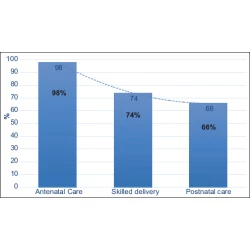
Results: Sixty-six percent (66%) of mothers surveyed received the full complement of MNH services (ANC, SBA, PNC) for their most-recent birth. While 98% of mothers made at least one ANC visit with 83.5% receiving the World Health Organization-recommended 4+ visits, only 74% accessed SBA indicating a 24% attrition in the CoC from ANC to SBA, and an 8% attrition from SBA to PNC. About 86% of mothers accessed PNC within 42 days postpartum. Distance to health facility, urban residence, and exposure to media information were strong predictors of the full complement of MNH continuumof-care utilization.
Conclusion and Global Health Implications: The study found a remarkable utilization of MNH services in East Akim with significant attrition along the continuum-of-care. Efforts to enhance utilization of the MNH continuum-of-care should focus on increasing access to SBA in particular, through equitable distribution of MNH services in hard-to-reach areas and innovative communication approaches for reducing attrition at each level of the continuum-of-care. Evidence from this study can inform strategies for achieving universal access and utilization of the MNH continuum-of-care towards global goals and improved health outcomes in Ghana and other countries.
Downloads
Similar Articles
- Chidimma Ezenwa Anyanwu, Kwasi Torpey, Olaiya Paul Abiodun, Olaniyi Felix Sanni, Ifeanyi Donald Anyanwu, Variations in the Prevalence of Female Genital Mutilation Among Reproductive-aged Women in Nigeria Across Three Generations , Vol. 11 No. 2 (2022): International Journal of Maternal and Child Health and AIDS
- Elizabeth Armstrong-Mensah, Ato Kwamena Tetteh, Seung Choi, Utilization of Rapid Diagnostic Testing in sub-Saharan Africa: Challenges and Effects on HIV Prevention , Vol. 10 No. 1 (2021): International Journal of Maternal and Child Health and AIDS
- Zenab I. Yusuf, Deepa Dongarwar, Rafeek A. Yusuf, Hamisu M. Salihu, Oral Health Problems among Children with Neurodevelopmental Disorders in the United States , Vol. 9 No. 1 (2020): International Journal of Maternal and Child Health and AIDS
- Ashu Michael Agbor, Karpal Singh Sohal, Nguitewou Loith Nguimfack, Elvis Tarkang, Enow O’rock George, Sudeshni Naidoo, Oral Manifestations of HIV Infection and Dental Health Needs of Children with HIV Attending HIV Treatment Clinics in Western Cameroon , Vol. 13 No. Continuous (2024): International Journal of Maternal and Child Health and AIDS
- Taranpreet Kaur, Kalpana Kumari, Priyanka Rai, Vandana Gupta, Sarika Pandey, Vineeta, Shweta Saini, A Comparative Study of Oral Nifedipine and Intravenous Labetalol for Acute Hypertensive Management in Pregnancy: Assessing Feto-Maternal Outcomes in a Hospital-based Randomized Control Trial , Vol. 13 No. Continuous (2024): International Journal of Maternal and Child Health and AIDS
- Ahmed Zohirul Islam, Nazrul Islam Mondal, Laily Khatun, Mosiur Rahman, Rafiqul Islam, Golam Mostofa, Nazrul Hoque, Prevalence and Determinants of Contraceptive use among Employed and Unemployed Women in Bangladesh , Vol. 5 No. 2 (2016): International Journal of Maternal and Child Health and AIDS
- Amina Abdullahi, Hassan Adam Murtala, Aisha Adam Abdullahi, Amina Aminu, Muktar H. Aliyu, Sani H. Aliyu, Ololade D. Adeyemi, Deepa Dongarwar, Jordi B. Torrelles, Gambo Aliyu, Hamisu M. Salihu, Drivers of Human Immunodeficiency Virus among Pregnant Women in Conflict and Non-conflict Zones of Nigeria , Vol. 14 No. Continuous (2025): International Journal of Maternal and Child Health and AIDS
- Trevor D. Hadley, Rowland W. Pettit, Tahir Malik, Amelia A. Khoei, Hamisu M. Salihu, Artificial Intelligence in Global Health —A Framework and Strategy for Adoption and Sustainability , Vol. 9 No. 1 (2020): International Journal of Maternal and Child Health and AIDS
- Ornella Sybile D. Kouanfack, Charles Kouanfack, Serges Clotaire Billong, Samuel N. Cumber, Claude N. Nkfusai, Fala Bede, Emerson Wepngong, Chombong Hubert, Georges Nguefack-Tsague, Madeleine N. Singwe, Epidemiology of Opportunistic Infections in HIV Infected Patients on Treatment in Accredited HIV Treatment Centers in Cameroon , Vol. 8 No. 2 (2019): International Journal of Maternal and Child Health and AIDS
- Jahron P Marriott, José G Pérez-Ramos Pérez-Ramos, Song Hoa Choi, Gersandre Gonsalves-Domond, Beatrice Aladin, Monica Barbosu, Cheryl Smith, Timothy Dye, Assessing Training Interests of Latin American and Caribbean Immigrant-serving HIV/AIDS, STD, and Hepatitis C Providers in New York State, United States , Vol. 9 No. 2 (2020): International Journal of Maternal and Child Health and AIDS
<< < 18 19 20 21 22 23 24 25 26 27 > >>
You may also start an advanced similarity search for this article.
Published
How to Cite
Issue
Section
License
Copyright © 2021 Juliana Y. Enos, Richard D. Amoako, Innocent K. Doku. Published by Global Health and Education Projects, Inc., USA.

This is an open-access article distributed under the terms of the Creative Commons Attribution-NonCommercial-ShareAlike 4.0 International License , which permits others to remix, transform, and build upon the work non-commercially, provided the original author is credited and the new creations are licensed under the same terms.