
An Analysis of Levels and Trends in HIV Prevalence Among Pregnant Women Attending Antenatal Clinics in Karnataka, South India, 2003-2019
DOI:
https://doi.org/10.21106/ijma.520Keywords:
- HIV/AIDS,
- HIV Sentinel Surveillance,
- Pregnant Women,
- Prevalence,
- Trend,
- Karnataka
Abstract
Background and Objective: Periodic tracking of the trends and the levels of HIV prevalence at regional and district levels helps to strengthen a state’s HIV/AIDS response. HIV prevalence among pregnant women is crucial for the HIV prevalence estimation of the general population. Karnataka is one of the high HIV prevalence states in India. Probing regional and district levels and trends of HIV prevalence provides critical insights into districtlevel epidemic patterns. This paper analyzes the region- and district-wise levels and trends of HIV prevalence among pregnant women attending the antenatal clinics (ANC) from 2003 to 2019 in Karnataka, South India.
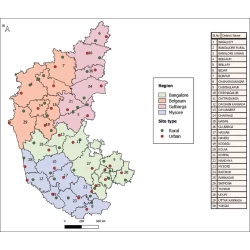
Methods: HIV prevalence data collected from pregnant women in Karnataka during HIV Sentinel Surveillance (HSS) between 2003 and 2019 was used for trend analysis. The consistent sites were grouped into four zones (Bangalore, Belgaum, Gulbarga and Mysore regions), totaling 60 sites, including 30 urban and 30 rural sites. Regional and district-level HIV prevalence was calculated; trend analysis using Chi-square trend test and spatial analysis using QGIS software was done. For the last three HSS rounds, HIV prevalence based on sociodemographic variables was calculated to understand the factors contributing to HIV positivity in each region.
Results: In total, 254,563 pregnant women were recruited. HIV prevalence in Karnataka was 0.22 (OR: 0.15 95% CI: 0.16 - 0.28) in 2019. The prevalence was 0.24, 0.32, 0.17 and 0.14 in Bangalore, Belgaum, Gulbarga, and Mysore regions, respectively. HIV prevalence had significantly (P< 0.05) declined in 26 districts.
Conclusion and Global Health Implications: HIV prevalence among pregnant women was comparatively higher in Bangalore and Belgaum regions. Analysis of contextual factors associated with the transmission risk and evidence-based targeted interventions will strengthen HIV management in Karnataka. Regionalized, disaggregated, sub-national analyses will help identify emerging pockets of infections, concentrated epidemic zones and contextual factors driving the disease transmission.
Downloads
Most read articles by the same author(s)
- Aridoss Santhakumar, Malathi Mathiyazhakan, Nagaraj Jaganathasamy, Balsubramanian Ganesh, N Manikandan, VM Padmapriya, Angel Monika, Joseph K David, Arvind Kumar, Elangovan Arumugam, Prevalence and Risk Factors Associated with HIV Infection among Pregnant Women in Odisha State, India , International Journal of Maternal and Child Health and AIDS: Vol. 9 No. 3 (2020): International Journal of Maternal and Child Health and AIDS
Similar Articles
- Wah Wah Myint, Human Immunodeficiency Virus (HIV) Knowledge and Stigma: Findings from a Cross-sectional Survey , Vol. 15 (2026): International Journal of Maternal and Child Health and AIDS
- Margaret Omowaleola Akinwaare, Jonah Musa, Chizoma Millicent Ndikom, Determinants of Digitalized Antenatal Education Use among Pregnant Women Living with Human Immunodeficiency Virus in Nigeria , Vol. 15 (2026): International Journal of Maternal and Child Health and AIDS
- Kolawole A. Fasakin, Christopher T. Omisakin, Idowu O. Adebara, Wasiu A. Ajetunmobi, Adebayo A. Adeniyi, Ayodele J. Esan, Olufunke B. Bolaji, Oluwafemi D. Ajayi, Abayomi J. Afe, Assessment of PMTCT Success Rates Based on Antiretroviral Interventions and Feeding Options: A Prospective Cohort Study , Vol. 7 No. 2 (2018): International Journal of Maternal and Child Health and AIDS
- Charles Chibuisi Ehiemere, Ishaku Adamu Akyala, Bisayo Adetuyi Ogundipe, Chukwuebuka Clement Nri-Ezedi, Peter Joseph Anzaku, Waryit Esther Yonah, Efe Mary Imokhai, Isaac Onyebuchi Okohu, Idowu Olapemi Makinde, Ngozi Miriam Chimzobam-Nnalue, Beyond Access: Behavior Change and Gendered Realities in the Adoption of Digital Health Tools for Maternal, Newborn, and Child Health in Nigeria , Vol. 15 (2026): International Journal of Maternal and Child Health and AIDS
- Chaw Hay Thar, Young Hwa Lee, Young June Choe, Human Immunodeficiency Virus/Acquired Immunodeficiency Syndrome Knowledge and Attitude among Myanmar Women , Vol. 13 No. Continuous (2024): International Journal of Maternal and Child Health and AIDS
- Océane J. Parker, Duc Minh Duong, Thuy Thu Nguyen, Vui Thi Le, Utilization of Sexual and Reproductive Healthcare Services Among Young Women in Two Districts of Hanoi, Vietnam , Vol. 15 (2026): International Journal of Maternal and Child Health and AIDS
- Aridoss Santhakumar, Malathi Mathiyazhakan, Nagaraj Jaganathasamy, Balsubramanian Ganesh, N Manikandan, VM Padmapriya, Angel Monika, Joseph K David, Arvind Kumar, Elangovan Arumugam, Prevalence and Risk Factors Associated with HIV Infection among Pregnant Women in Odisha State, India , Vol. 9 No. 3 (2020): International Journal of Maternal and Child Health and AIDS
- Sorochi H. Iloanusi, Osaro O. Mgbere, Susan. M. Abughosh, Ekere J. Essien, HIV Non-Occupational Post Exposure Prophylaxis in Nigeria: A Systematic Review of Research Evidence and Practice , Vol. 8 No. 2 (2019): International Journal of Maternal and Child Health and AIDS
- Wah Myint, Aishatu Yusuf, Angela Nguyen, Elfreda Samman, HIV Testing, Household and Reproductive Health Decision-Making: The Role of Women Autonomy in a Nationally Representative Study in Cambodia , Vol. 14 No. Continuous (2025): International Journal of Maternal and Child Health and AIDS
- Sanni Yaya, Gebretsadik Shibre, Dina Idriss-Wheeler, Olalekan A Uthman, Women’s Empowerment and HIV Testing Uptake: A Meta-analysis of Demographic and Health Surveys from 33 Sub-Saharan African Countries , Vol. 9 No. 3 (2020): International Journal of Maternal and Child Health and AIDS
You may also start an advanced similarity search for this article.
Published
How to Cite
Issue
Section
License
Copyright © 2021 Elangovan Arumugam, Joseph K. David, Santhakumar Aridoss, Nagaraj Jaganathasamy, Malathi Mathiyazhakan, Ganesh Balasubramanian, Manikandan Natesan, VM, Padmapriya, BK Kirubakaran, Sanjay Patel, Pradeep Kumar, Shobini Rajan. Published by Global Health and Education Projects, Inc., USA.

This is an open-access article distributed under the terms of the Creative Commons Attribution-NonCommercial-ShareAlike 4.0 International License , which permits others to remix, transform, and build upon the work non-commercially, provided the original author is credited and the new creations are licensed under the same terms.