
Adapted Counseling Care Model for Management of Female Sexual Dysfunction Among Women Living With and Without HIV
DOI:
https://doi.org/10.25259/IJMA_37_2024Keywords:
- Female Sexual Dysfunction,
- HIV,
- Adaptive Counseling,
- Nigeria
Abstract
Sexual health research among women living with human immunodeficiency virus (HIV) has focused mainly on sexual practices and risk behaviors, with little consideration for treating sexual dysfunction and improving sexual satisfaction. The aim of this pilot study was to assess the effectiveness of an adaptive counseling care model in the management of female sexual dysfunction (FSD) among women living with HIV and without HIV in northern Nigeria.
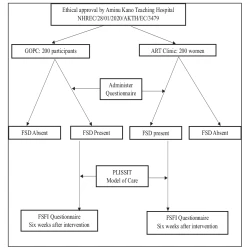
MethodsThis was a prospective cohort study of 200 women with HIV and a matched comparison arm of 200 women without HIV. Sexual function was assessed using the Female Sexual Function Index (FSFI), with a score ≤ 26.55 indicating FSD. We counseled women with FSD using the Permission, Limited Information, Specific Suggestions, Intensive Therapy (PLISSIT) model and evaluated the effectiveness of the model by comparing mean differences in baseline and six weeks post-intervention FSFI scores.
ResultsThe overall prevalence of FSD was 96.8%, with no difference between HIV-positive and HIV-negative participants (p = 0.398). Based on the six domains of the FSFI, the most common reported dysfunctions were sexual pain (21.7%), sexual desire disorder (17.6%), orgasm disorder (17.6%), lubrication disorder (17.2%), sexual arousal (16.9%), and poor sexual satisfaction (9.0%). The overall mean FSFI score (±standard deviation, SD) for those with FSD, in both groups (n = 387) prior to the counseling intervention was 16.05±10.65 (HIV-positive: 18.58±8.46; HIV-negative: 13.98±10.85). At the end of the intervention, the overall mean FSFI score in both groups increased to 23.58±16.53 (HIV-positive: 21.37±11.24; HIV-negative: 16.72±13.81) (p < 0.05 in all cases).
Conclusion and Global Health ImplicationsFSD is very common among women in Northern Nigeria, irrespective of HIV status. An adapted counseling care model improved sexual function in both HIV-positive and HIV-negative women. The PLISSIT model can guide healthcare providers to initiate and navigate sexual health discussions with women in this setting.
Downloads
Most read articles by the same author(s)
- Chioma A. Ikedionwu, Deepa Dongarwar, Courtney Williams, Evelyn Odeh, Maylis Peguy Nkeng Peh, Hilliary Hooker, Stacey Wiseman, Tramauni Brock, Erinn Payne-Green, Chidinma Chukwudum, Grace Loudd, Andrea Shelton, Jonnae O. Atkinson, Kiara K. Spooner, Jason L. Salemi, Hamisu M. Salihu, Omonike A. Olaleye, Trends and Risk Factors for Leishmaniasis among Reproductive Aged Women in the United States , International Journal of Maternal and Child Health and AIDS: Vol. 10 No. 2 (2021): International Journal of Maternal and Child Health and AIDS
- Trevor D. Hadley, Rowland W. Pettit, Tahir Malik, Amelia A. Khoei, Hamisu M. Salihu, Artificial Intelligence in Global Health —A Framework and Strategy for Adoption and Sustainability , International Journal of Maternal and Child Health and AIDS: Vol. 9 No. 1 (2020): International Journal of Maternal and Child Health and AIDS
- Chioma A Ikedionwu, Deepa Dongarwar, Korede K. Yusuf, Sitratullah O. Maiyegun, Sahra Ibrahimi, Hamisu M. Salihu, Using Nominal Group Technique to Elucidate a COVID-19 Research Agenda for Maternal and Child Health (MCH) Populations , International Journal of Maternal and Child Health and AIDS: Vol. 9 No. 3 (2020): International Journal of Maternal and Child Health and AIDS
- Comfort Z. Olorunsaiye, Korede K. Yusuf, Kylie Reinhart, Hamisu M. Salihu, COVID-19 and Child Vaccination: A Systematic Approach to Closing the Immunization Gap , International Journal of Maternal and Child Health and AIDS: Vol. 9 No. 3 (2020): International Journal of Maternal and Child Health and AIDS
- Hadiza Galadanci, Deepa Dongarwar, Wolfgang Künzel, Oladapo Shittu, Murtala Yusuf, Sadiq Abdurrahman, Dolapo Lufadeju, Hamisu M. Salihu, Cesarean Section and Maternal-fetal Mortality Rates in Nigeria: An Ecological Lens into the Last Decade , International Journal of Maternal and Child Health and AIDS: Vol. 9 No. 1 (2020): International Journal of Maternal and Child Health and AIDS
- Hamisu M. Salihu, Ronee E. Wilson, Lindsey M. King, Phillip J. Marty, Valerie E. Whiteman, Socio-ecological Model as a Framework for Overcoming Barriers and Challenges in Randomized Control Trials in Minority and Underserved Communities , International Journal of Maternal and Child Health and AIDS: Vol. 3 No. 1 (2015): International Journal of Maternal and Child Health and AIDS
- Korede K Yusuf, Deepa Dongarwar, Sahra Ibrahimi, Chioma Ikedionwu, Sitratullah O. Maiyegun, Hamisu M. Salihu, Expected Surge in Maternal Mortality and Severe Morbidity among African-Americans in the Era of COVID-19 Pandemic , International Journal of Maternal and Child Health and AIDS: Vol. 9 No. 3 (2020): International Journal of Maternal and Child Health and AIDS
- Faith D. Ihekweazu, Deepa Dongarwar, Hamisu M. Salihu, Richard Kellermayer, National Trends in Hospitalization, Surgical Resection, and Comorbidities in Pediatric Inflammatory Bowel Disease in the United States, 2002-2015 , International Journal of Maternal and Child Health and AIDS: Vol. 11 No. 1 (2022): International Journal of Maternal and Child Health and AIDS
- Sahra Ibrahimi, Korede K. Yusuf, Deepa Dongarwar, Sitratullah Olawunmi Maiyegun, Chioma Ikedionwu, Hamisu M. Salihu, COVID-19 Devastation of African American Families: Impact on Mental Health and the Consequence of Systemic Racism , International Journal of Maternal and Child Health and AIDS: Vol. 9 No. 3 (2020): International Journal of Maternal and Child Health and AIDS
- Veronica B. Ajewole, Ahone E. Ngujede, Emmanuella Oduguwa, Deepa Dongarwar, Manvir Kaur, Cecelia Knight, Maresha Jackson, Uyen Nguyen, Tasha Roshan, Jordan Simpson, Igor Vouffo, Omonike A. Olaleye, Hamisu M. Salihu, A Surveillance System for the Maternal and Child Health (MCH) Population During the COVID-19 Pandemic , International Journal of Maternal and Child Health and AIDS: Vol. 9 No. 3 (2020): International Journal of Maternal and Child Health and AIDS
Similar Articles
- Wah Wah Myint, Human Immunodeficiency Virus (HIV) Knowledge and Stigma: Findings from a Cross-sectional Survey , Vol. 15 (2026): International Journal of Maternal and Child Health and AIDS
- Charles Chibuisi Ehiemere, Ishaku Adamu Akyala, Bisayo Adetuyi Ogundipe, Chukwuebuka Clement Nri-Ezedi, Peter Joseph Anzaku, Waryit Esther Yonah, Efe Mary Imokhai, Isaac Onyebuchi Okohu, Idowu Olapemi Makinde, Ngozi Miriam Chimzobam-Nnalue, Beyond Access: Behavior Change and Gendered Realities in the Adoption of Digital Health Tools for Maternal, Newborn, and Child Health in Nigeria , Vol. 15 (2026): International Journal of Maternal and Child Health and AIDS
- Kolawole A. Fasakin, Christopher T. Omisakin, Idowu O. Adebara, Wasiu A. Ajetunmobi, Adebayo A. Adeniyi, Ayodele J. Esan, Olufunke B. Bolaji, Oluwafemi D. Ajayi, Abayomi J. Afe, Assessment of PMTCT Success Rates Based on Antiretroviral Interventions and Feeding Options: A Prospective Cohort Study , Vol. 7 No. 2 (2018): International Journal of Maternal and Child Health and AIDS
- Sorochi H. Iloanusi, Osaro O. Mgbere, Susan. M. Abughosh, Ekere J. Essien, HIV Non-Occupational Post Exposure Prophylaxis in Nigeria: A Systematic Review of Research Evidence and Practice , Vol. 8 No. 2 (2019): International Journal of Maternal and Child Health and AIDS
- Margaret Omowaleola Akinwaare, Jonah Musa, Chizoma Millicent Ndikom, Determinants of Digitalized Antenatal Education Use among Pregnant Women Living with Human Immunodeficiency Virus in Nigeria , Vol. 15 (2026): International Journal of Maternal and Child Health and AIDS
- Godwin Omokhagbo Emmanuel, Olaniyi Felix Sanni, Abang Roger, Paul Umoh, Ochonye Bartholomew Boniface, Amechi Paul, Ismaeel Mohammed Yahaya, Agie Muhmmad Auwal, Improving HIV Prevention for Key Populations in Nigeria: Insights on Access, Barriers, Stigma, and Service Utilization , Vol. 14 No. Continuous (2025): International Journal of Maternal and Child Health and AIDS
- Zubairu Iliyasu, Fatimah Hassan-Hanga, Sadiq Isah Ajuji, Musa M. Bello, Safiyya S. Abdulkadir, Nafisa S. Nass, Hamisu M. Salihu, Muktar H. Aliyu, Correlates of Health Care Workers’ Knowledge and HIV-Exposed Infant Immunization Counseling Practice in Northern Nigeria , Vol. 10 No. 1 (2021): International Journal of Maternal and Child Health and AIDS
- Bartholomew Boniface Ochonye, Paul Umoh, Olaniyi Felix Sanni, Abiye Kalaiwo, Roger Abang, Agboola Oguntonade, Paul Amechi, Godwin Emmanuel, Pre-Exposure Prophylaxis and HIV Prevention Among Key Populations in Nigeria , Vol. 13 No. Continuous (2024): International Journal of Maternal and Child Health and AIDS
- George Chidi Anwuri, Michael S. Dunn, Frederick Schulze, Determinants of Voluntary HIV/AIDS Counseling and Testing among Community College Students in the United States , Vol. 6 No. 2 (2017): International Journal of Maternal and Child Health and AIDS
- Brianna L. Smith, Sara Zizzo, Anouk Amzel, Sarah Wiant, Molly C. Pezzulo, Sarah Konopka, Rachel Golin, Alexandra C. Vrazo, Integration of Neonatal and Child Health Interventions with Pediatric HIV Interventions in Global Health , Vol. 7 No. 1 (2018): International Journal of Maternal and Child Health and AIDS
You may also start an advanced similarity search for this article.
Published
How to Cite
Issue
Section
License
Copyright © 2024 Fatima M. Damagum, Zainab D. Ahmed, Rabiu I. Jalo, Hamisu M. Salihu, C. William Wester, Muktar H. Aliyu. Published by Global Health and Education Projects, Inc., USA.

This is an open-access article distributed under the terms of the Creative Commons Attribution-NonCommercial-ShareAlike 4.0 International License , which permits others to remix, transform, and build upon the work non-commercially, provided the original author is credited and the new creations are licensed under the same terms.