
Global Inequalities in Cervical Cancer Incidence and Mortality are Linked to Deprivation, Low Socioeconomic Status, and Human Development
DOI:
https://doi.org/10.21106/ijma.12Keywords:
- Cervical cancer,
- Incidence,
- Mortality,
- Global inequality,
- Human development,
- Gender inequality,
- Social inequality,
- Poverty,
- Literacy,
- GNI per capita
Abstract
Objectives: This study examined global inequalities in cervical cancer incidence and mortality rates as a function of cross-national variations in the Human Development Index (HDI), socioeconomic factors, Gender Inequality Index (GII), and healthcare expenditure.
Methods: Age-adjusted incidence and mortality rates were calculated for women in 184 countries using the 2008 GLOBOCAN database, and incidence and mortality trends were analyzed using the WHO cancer mortality database. Log-linear regression was used to model annual trends, while OLS and Poisson regression models were used to estimate the impact of socioeconomic and human development factors on incidence and mortality rates.
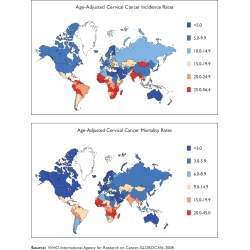
Results: Cervical cancer incidence and mortality rates varied widely, with many African countries such as Guinea, Zambia, Comoros, Tanzania, and Malawi having at least 10-to-20-fold higher rates than several West Asian, Middle East, and European countries, including Iran, Saudi Arabia, Syria, Egypt, and Switzerland. HDI, GII, poverty rate, health expenditure per capita, urbanization, and literacy rate were all significantly related to cervical cancer incidence and mortality, with HDI and poverty rate each explaining >52% of the global variance in mortality. Both incidence and mortality rates increased in relation to lower human development and higher gender inequality levels. A 0.2 unit increase in HDI was associated with a 20% decrease in cervical cancer risk and a 33% decrease in cervical cancer mortality risk. The risk of a cervical cancer diagnosis increased by 24% and of cervical cancer death by 42% for a 0.2 unit increase in GII. Higher health expenditure levels were independently associated with decreased incidence and mortality risks.
Conclusions: and Public Health Implications Global inequalities in cervical cancer are clearly linked to disparities in human development, social inequality, and living standards. Reductions in cervical cancer rates are achievable by reducing inequalities in socioeconomic conditions, availability of preventive health services, and women’s social status.
Downloads
Most read articles by the same author(s)
- Gopal K. Singh, Gem P. Daus, Michelle Allender, Christine T. Ramey, Elijah K. Martin, Chrisp Perry, Andrew A. De Los Reyes, Ivy P. Vedamuthu, Social Determinants of Health in the United States: Addressing Major Health Inequality Trends for the Nation, 1935-2016 , International Journal of Maternal and Child Health and AIDS: Vol. 6 No. 2 (2017): International Journal of Maternal and Child Health and AIDS
- Gopal K. Singh, Jihong Liu, Health Improvements Have Been More Rapid and Widespread in China than in India: A Comparative Analysis of Health and Socioeconomic Trends from 1960 to 2011 , International Journal of Maternal and Child Health and AIDS: Vol. 1 No. 1 (2012): International Journal of Maternal and Child Health and AIDS
- Hyunjung Lee, Gopal K. Singh, Monthly Trends in Drug Overdose Mortality among Youth Aged 15-34 Years in the United States, 2018-2021: Measuring the Impact of the COVID-19 Pandemic , International Journal of Maternal and Child Health and AIDS: Vol. 11 No. 2 (2022): International Journal of Maternal and Child Health and AIDS
- Hyunjung Lee, Gopal K. Singh, Psychological Distress and Heart Disease Mortality in the United States: Results from the 1997-2014 NHIS-NDI Record Linkage Study , International Journal of Maternal and Child Health and AIDS: Vol. 9 No. 3 (2020): International Journal of Maternal and Child Health and AIDS
- Romuladus E. Azuine, Janna Murray, Noor Alsafi, Gopal K. Singh, Exclusive Breastfeeding and Under-Five Mortality, 2006-2014: A Cross-National Analysis of 57 Low- and-Middle Income Countries , International Journal of Maternal and Child Health and AIDS: Vol. 4 No. 1 (2015): International Journal of Maternal and Child Health and AIDS
- Gopal K. Singh, Anagha Lokhande, Romuladus E. Azuine, Global Inequalities in Youth Mortality, 2007-2012 , International Journal of Maternal and Child Health and AIDS: Vol. 3 No. 1 (2015): International Journal of Maternal and Child Health and AIDS
- Hyunjung Lee, Gopal K. Singh, Contributions of Socioeconomic, Demographic, and Behavioral Risk Factors to All-Cause Mortality Disparities by Psychological Distress in the United States: A Blinder-Oaxaca Decomposition Analysis of Longitudinal Data , International Journal of Maternal and Child Health and AIDS: Vol. 11 No. 1 (2022): International Journal of Maternal and Child Health and AIDS
- Romuladus E. Azuine, Sussan E. Ekejiuba, Gopal K. Singh, Magnus A. Azuine, Ebola Virus Disease Epidemic: What Can the World Learn and Not Learn from West Africa? , International Journal of Maternal and Child Health and AIDS: Vol. 3 No. 1 (2015): International Journal of Maternal and Child Health and AIDS
- Raees A. Shaikh, Mohammad Siahpush, Gopal K. Singh, Melissa Tibbits, Socioeconomic Status, Smoking, Alcohol use, Physical Activity, and Dietary Behavior as Determinants of Obesity and Body Mass Index in the United States: Findings from the National Health Interview Survey , International Journal of Maternal and Child Health and AIDS: Vol. 4 No. 1 (2015): International Journal of Maternal and Child Health and AIDS
- Hyunjung Lee, Gopal K. Singh, Inequalities in Life Expectancy and All-Cause Mortality in the United States by Levels of Happiness and Life Satisfaction: A Longitudinal Study , International Journal of Maternal and Child Health and AIDS: Vol. 9 No. 3 (2020): International Journal of Maternal and Child Health and AIDS
Similar Articles
- Nidhi Fotedar, Nugehally Raju Ramesh Masthi, Burden of Fetal Anomalies among Antenatal Mothers Attending a Public Referral Hospital: A Mixed Cohort Study , Vol. 14 No. Continuous (2025): International Journal of Maternal and Child Health and AIDS
- Sara Rushwan, Fatu Forna, Ferid Abbas Abubeker, Tesfaye Tufa, Tieba Millogo, Miriam Nakalembe, Kwame Adu-Bonsaffoh, Francis L. Moses, Lester Chinery, Gilda Piaggio, Metin Gülmezoglu, Integrating Heat-Stable Carbetocin and Tranexamic Acid for Prevention and Management of Postpartum Hemorrhage in Sub-Saharan Africa: A Five-Country Pilot Implementation Study , Vol. 13 No. S1 (2024): International Journal of Maternal and Child Health and AIDS
- Mary Jane Rotheram-Borus, Mark Tomlinson, Utilizing Principles of Private Enterprise to Improve Maternal and Child Health Programs , Vol. 9 No. 2 (2020): International Journal of Maternal and Child Health and AIDS
- Rachael Bonawitz, Kathleen Lucy McGlasson, Jeanette L. Kaiser, Thandiwe Ngoma, Jody Lori, Carol Boyd, Godfrey Biemba, Davidson H. Hamer, Nancy A. Scott, Maternity Waiting Home Use by HIV-positive Pregnant Women in Zambia: Opportunity for Improved Prevention of Maternal to Child Transmission of HIV , Vol. 8 No. 1 (2019): International Journal of Maternal and Child Health and AIDS
- Nnennaya N. Kalu-Umeh, Mohammed N. Sambo N. Sambo, Suleiman H. Idris, Abubakar M. Kurfi, Costs and Patterns of Financing Maternal Health Care Services in Rural Communities in Northern Nigeria: Evidence for Designing National Fee Exemption Policy , Vol. 2 No. 1 (2013): International Journal of Maternal and Child Health and AIDS
- Gregory Pappas, Forward to AIDS 2014: Now is the Time to Unite for the Global HIV/AIDS Epidemic , Vol. 2 No. 2 (2014): International Journal of Maternal and Child Health and AIDS
- John Humphrey, James G Carlucci, Esther Karen Wanjama, Violet Naanyu, Lindah Muli, Joy Marsha Alera, Edwin Were, Alan McGuire, Winstone Nyandiko, Gregory Zimet, Julia Jerono Songok, Kara Wools Kaloustian, Implementing WHO Differentiated Service Delivery Model for Pregnant and Breastfeeding Women and Infants Living with HIV: Insights from Kenyan Healthcare Providers , Vol. 14 No. Continuous (2025): International Journal of Maternal and Child Health and AIDS
- Barbara Burmen, Gregory Kurtzman, Anthony A Olashore, Leyla Baghirova Busang, Ohemaa Poku, Phenyo Morakanyane, Ontibile Tshume, Onkemetse Phoi, Mogomotsi Matshaba, Elizabeth D Lowenthal, Knashawn H Morales, Merrian J Brooks, HIV Virologic Suppression and Mental Well-being in Adolescents and Young Adults Living with HIV , Vol. 14 No. Continuous (2025): International Journal of Maternal and Child Health and AIDS
- Charles Kouanfack, Skinner Nguefack Lekelem, Fala Bede, Claude Ngwayu Nkfusai, Yvette Micha Nouafo, Christian Tchokonte, Nicaise Tsomo Zephirin, Pierre Joseph Fouda, Use of Trained Non-Medical Staff to Improve Access to HIV Testing Services in Africa: Implementation of the World Health Organization Opt-out Approach in Cameroon , Vol. 10 No. 1 (2021): International Journal of Maternal and Child Health and AIDS
- Florence F. Kimario, Charles Festo, Josephine Shabani, Mwifadhi Mrisho, Determinants of Home Delivery among Women Aged 15-24 Years in Tanzania , Vol. 9 No. 2 (2020): International Journal of Maternal and Child Health and AIDS
<< < 11 12 13 14 15 16 17 18 19 20 > >>
You may also start an advanced similarity search for this article.
Published
How to Cite
Issue
Section
License
Copyright © 2016 Gopal K. Singh, Romuladus E. Azuine, Mohammad Siahpush. Published by Global Health and Education Projects, Inc., USA.

This is an open-access article distributed under the terms of the Creative Commons Attribution-NonCommercial-ShareAlike 4.0 International License , which permits others to remix, transform, and build upon the work non-commercially, provided the original author is credited and the new creations are licensed under the same terms.