
Global Inequalities in Cervical Cancer Incidence and Mortality are Linked to Deprivation, Low Socioeconomic Status, and Human Development
DOI:
https://doi.org/10.21106/ijma.12Keywords:
- Cervical cancer,
- Incidence,
- Mortality,
- Global inequality,
- Human development,
- Gender inequality,
- Social inequality,
- Poverty,
- Literacy,
- GNI per capita
Abstract
Objectives: This study examined global inequalities in cervical cancer incidence and mortality rates as a function of cross-national variations in the Human Development Index (HDI), socioeconomic factors, Gender Inequality Index (GII), and healthcare expenditure.
Methods: Age-adjusted incidence and mortality rates were calculated for women in 184 countries using the 2008 GLOBOCAN database, and incidence and mortality trends were analyzed using the WHO cancer mortality database. Log-linear regression was used to model annual trends, while OLS and Poisson regression models were used to estimate the impact of socioeconomic and human development factors on incidence and mortality rates.
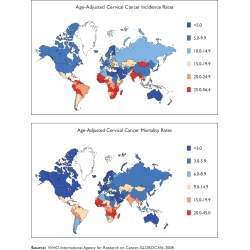
Results: Cervical cancer incidence and mortality rates varied widely, with many African countries such as Guinea, Zambia, Comoros, Tanzania, and Malawi having at least 10-to-20-fold higher rates than several West Asian, Middle East, and European countries, including Iran, Saudi Arabia, Syria, Egypt, and Switzerland. HDI, GII, poverty rate, health expenditure per capita, urbanization, and literacy rate were all significantly related to cervical cancer incidence and mortality, with HDI and poverty rate each explaining >52% of the global variance in mortality. Both incidence and mortality rates increased in relation to lower human development and higher gender inequality levels. A 0.2 unit increase in HDI was associated with a 20% decrease in cervical cancer risk and a 33% decrease in cervical cancer mortality risk. The risk of a cervical cancer diagnosis increased by 24% and of cervical cancer death by 42% for a 0.2 unit increase in GII. Higher health expenditure levels were independently associated with decreased incidence and mortality risks.
Conclusions: and Public Health Implications Global inequalities in cervical cancer are clearly linked to disparities in human development, social inequality, and living standards. Reductions in cervical cancer rates are achievable by reducing inequalities in socioeconomic conditions, availability of preventive health services, and women’s social status.
Downloads
Most read articles by the same author(s)
- Gopal K. Singh, Gem P. Daus, Michelle Allender, Christine T. Ramey, Elijah K. Martin, Chrisp Perry, Andrew A. De Los Reyes, Ivy P. Vedamuthu, Social Determinants of Health in the United States: Addressing Major Health Inequality Trends for the Nation, 1935-2016 , International Journal of Maternal and Child Health and AIDS: Vol. 6 No. 2 (2017): International Journal of Maternal and Child Health and AIDS
- Gopal K. Singh, Jihong Liu, Health Improvements Have Been More Rapid and Widespread in China than in India: A Comparative Analysis of Health and Socioeconomic Trends from 1960 to 2011 , International Journal of Maternal and Child Health and AIDS: Vol. 1 No. 1 (2012): International Journal of Maternal and Child Health and AIDS
- Hyunjung Lee, Gopal K. Singh, Monthly Trends in Drug Overdose Mortality among Youth Aged 15-34 Years in the United States, 2018-2021: Measuring the Impact of the COVID-19 Pandemic , International Journal of Maternal and Child Health and AIDS: Vol. 11 No. 2 (2022): International Journal of Maternal and Child Health and AIDS
- Hyunjung Lee, Gopal K. Singh, Psychological Distress and Heart Disease Mortality in the United States: Results from the 1997-2014 NHIS-NDI Record Linkage Study , International Journal of Maternal and Child Health and AIDS: Vol. 9 No. 3 (2020): International Journal of Maternal and Child Health and AIDS
- Romuladus E. Azuine, Janna Murray, Noor Alsafi, Gopal K. Singh, Exclusive Breastfeeding and Under-Five Mortality, 2006-2014: A Cross-National Analysis of 57 Low- and-Middle Income Countries , International Journal of Maternal and Child Health and AIDS: Vol. 4 No. 1 (2015): International Journal of Maternal and Child Health and AIDS
- Gopal K. Singh, Anagha Lokhande, Romuladus E. Azuine, Global Inequalities in Youth Mortality, 2007-2012 , International Journal of Maternal and Child Health and AIDS: Vol. 3 No. 1 (2015): International Journal of Maternal and Child Health and AIDS
- Hyunjung Lee, Gopal K. Singh, Contributions of Socioeconomic, Demographic, and Behavioral Risk Factors to All-Cause Mortality Disparities by Psychological Distress in the United States: A Blinder-Oaxaca Decomposition Analysis of Longitudinal Data , International Journal of Maternal and Child Health and AIDS: Vol. 11 No. 1 (2022): International Journal of Maternal and Child Health and AIDS
- Romuladus E. Azuine, Sussan E. Ekejiuba, Gopal K. Singh, Magnus A. Azuine, Ebola Virus Disease Epidemic: What Can the World Learn and Not Learn from West Africa? , International Journal of Maternal and Child Health and AIDS: Vol. 3 No. 1 (2015): International Journal of Maternal and Child Health and AIDS
- Raees A. Shaikh, Mohammad Siahpush, Gopal K. Singh, Melissa Tibbits, Socioeconomic Status, Smoking, Alcohol use, Physical Activity, and Dietary Behavior as Determinants of Obesity and Body Mass Index in the United States: Findings from the National Health Interview Survey , International Journal of Maternal and Child Health and AIDS: Vol. 4 No. 1 (2015): International Journal of Maternal and Child Health and AIDS
- Hyunjung Lee, Gopal K. Singh, Inequalities in Life Expectancy and All-Cause Mortality in the United States by Levels of Happiness and Life Satisfaction: A Longitudinal Study , International Journal of Maternal and Child Health and AIDS: Vol. 9 No. 3 (2020): International Journal of Maternal and Child Health and AIDS
Similar Articles
- Innocent Anayochukwu Ugwu, Calistus Obiora Nevo, Malachy Nwaeze Ezenwaeze, Antenatal Care Utilization and Delivery Location: Evidence from Postpartum Women in Enugu, South East Nigeria , Vol. 15 (2026): International Journal of Maternal and Child Health and AIDS
- Alana F. Hairston, Emily A. Bobrow, Christian S. Pitter, Towards the Elimination of Pediatric HIV: Enhancing Maternal, Sexual, and Reproductive Health Services , Vol. 1 No. 1 (2012): International Journal of Maternal and Child Health and AIDS
- Elizabeth Armstrong-Mensah, David-Praise Ebiringa, Kaleb Whitfield, Jake Coldiron, Genital Chlamydia Trachomatis Infection: Prevalence, Risk Factors and Adverse Pregnancy and Birth Outcomes in Children and Women in sub-Saharan Africa , Vol. 10 No. 2 (2021): International Journal of Maternal and Child Health and AIDS
- Muhammad Adamu Abbas, Aisha A Abdullahi, Hassan A Murtala, Abubakar L Yusuf, Rahila A Mukhtar, Hamisu M Salihu, New Paradigm for Battling Hospital-Acquired Infections in Developing Countries , Vol. 14 No. Continuous (2025): International Journal of Maternal and Child Health and AIDS
- Musawenkosi H L Mabaso, Thoko Ndaba, Zilungile L Mkhize-Kwitshana, Overview of Maternal, Neonatal and Child Deaths in South Africa: Challenges, Opportunities, Progress and Future Prospects , Vol. 2 No. 2 (2014): International Journal of Maternal and Child Health and AIDS
- Ashish Kumar Gupta, Kakoli Borkotoky, Amit Kumar, Household Headship and Infant Mortality in India: Evaluating the Determinants and Differentials , Vol. 3 No. 1 (2015): International Journal of Maternal and Child Health and AIDS
- Amina P. Alio, Candace Sibley, Halimah S. Ouedraogo, Stephaun E. Wallace, Steven Wakefield, Damon L. Humes, Sheldon D. Fields, Michael C. Keefer, House Ball Community Leaders’ Perceptions of HIV and HIV Vaccine Research , Vol. 9 No. 1 (2020): International Journal of Maternal and Child Health and AIDS
- Janice Katherine Kopinak, Mental Health in Developing Countries: Challenges and Opportunities in Introducing Western Mental Health System in Uganda , Vol. 3 No. 1 (2015): International Journal of Maternal and Child Health and AIDS
- Léonel Philibert, Judith Lapierre, Vulnerabilities and Strengths of Pregnant Haitian Adolescents and their Families During Transition to Motherhood , Vol. 11 No. 2 (2022): International Journal of Maternal and Child Health and AIDS
- Roger J. Chin, Domrongphol Sangmanee, Lisa Piergallini, PEPFAR Funding and Reduction in HIV Infection Rates in 12 Focus Sub-Saharan African Countries: A Quantitative Analysis , Vol. 3 No. 2 (2015): International Journal of Maternal and Child Health and AIDS
<< < 2 3 4 5 6 7 8 9 10 11 > >>
You may also start an advanced similarity search for this article.
Published
How to Cite
Issue
Section
License
Copyright © 2016 Gopal K. Singh, Romuladus E. Azuine, Mohammad Siahpush. Published by Global Health and Education Projects, Inc., USA.

This is an open-access article distributed under the terms of the Creative Commons Attribution-NonCommercial-ShareAlike 4.0 International License , which permits others to remix, transform, and build upon the work non-commercially, provided the original author is credited and the new creations are licensed under the same terms.