
Evaluation and Utility of a Family Information Table to Identify and Test Children at Risk for HIV in Kenya
DOI:
https://doi.org/10.21106/ijma.30Keywords:
- Family Information Table,
- Pediatrics,
- HIV/AIDS,
- Linkage,
- Kenya,
- HIV Testing
Abstract
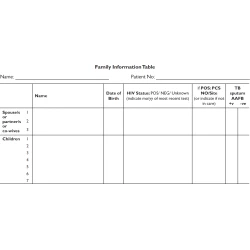
Background: Effective strategies to identify and screen children at risk for HIV are needed. The objectives of this study were to evaluate the utilization of a family information table (FIT) to identify and test at-risk children in Kenya and identify factors associated with child testing. Methods: A cross-sectional study was conducted among HIV-infected adults with children at five Kenyan clinics. HIV testing status for children aged ≤18 years was gathered from the patients’ FITs and compared to reports from in-person clinic visits as the gold standard. Generalized estimating equations were used to assess predictors for HIV testing of children adjusted for confounders and within parent correlation. Results: Our sample included 384 HIV-infected adults enrolled in care with 933 reported children. Overall, 323 FITs (84%) correctly listed all children in the family and 340 (89%) documented an HIV testing status (including untested) for all children. Seventy-five percent of parents verbally reported all children tested, compared to only 46% of FITs (OR=13.5, 95% CI 6.5-27.8). Verbal reports identified 739 (79%) children tested, with 55 (7.4%) HIV-positive and 17 (2.3%) HIV-exposed infants (HEI). Of 63 adults with HIV-positive children or HEI, 60 (95%) reported enrolling children into care. Likelihood that children had been tested was higher for younger children (≤4y vs. > 4y, aOR=2.0; 95% CI 1.4-2.9) and lower if the partner’s serostatus was unknown vs. seropositive (aOR=0.3; 95% CI: 0.1-0.8). Conclusions: Although the FIT may be a useful tool to identify children at risk for HIV, this study found underutilization by providers. To maximize impact of this tool, documentation of follow-up for untested and positive children is essential. Global Health Implications: Through early documentation of at-risk children and follow up of untested and infected children, the FIT may serve as an effective resource for improving HIV testing and linkage to care.
Downloads
Similar Articles
- Trevor D. Hadley, Rowland W. Pettit, Tahir Malik, Amelia A. Khoei, Hamisu M. Salihu, Artificial Intelligence in Global Health —A Framework and Strategy for Adoption and Sustainability , Vol. 9 No. 1 (2020): International Journal of Maternal and Child Health and AIDS
- Liye Wang, Deepa Dongarwar, Hamisu M. Salihu, Temporal Trends in the Rates of Singletons, Twins and Higher-order Multiple Births Over Five Decades Across Racial Groups in the United States , Vol. 9 No. 3 (2020): International Journal of Maternal and Child Health and AIDS
- Amina A. Umar, Hamisu M. Salihu, Romuladus E. Azuine, Crisis of Brain Drain in Nigeria’s Health Sector: Challenges, Opportunities, and the Path Forward , Vol. 14 No. Continuous (2025): International Journal of Maternal and Child Health and AIDS
- Fatemeh Bahreini, Rezvan Najafi, Razieh Amini, Salman Khazaei, Saeid Bashirian, Reducing False Negative PCR Test for COVID-19 , Vol. 9 No. 3 (2020): International Journal of Maternal and Child Health and AIDS
- Gerald J. Makuka, Moses M. Sango, Ayubu E. Mashambo, Abednego E. Mashambo, Sia E. Msuya, Sabina P. Mtweve, Clients’ Perspectives on Quality of Delivery Services in a Rural Setting in Tanzania: Findings from a Qualitative Action-Oriented Research , Vol. 6 No. 1 (2017): International Journal of Maternal and Child Health and AIDS
- Anne Esther Njom Nlend, Mpox and Breastfeeding in Sub-Saharan Africa: Clinical, Program, and Policy Recommendations , Vol. 14 No. Continuous (2025): International Journal of Maternal and Child Health and AIDS
- Kiydra Harris, Deepa Dongarwar, Tasha Roshan, Collins Onyenaka, Collins Enwerem, Omonike Olaleye, Hamisu M. Salihu, The Global Alliance for Maternal and Child Health (GLAM): A Pioneer Organization for MCH Students , Vol. 10 No. 1 (2021): International Journal of Maternal and Child Health and AIDS
- Arshiya Khan, Adarshlata Singh, Sugat Ambadas Jawade, Yash Kashikar, Extensive Intertrigo and Irritant Contact Dermatitis of Groins in Pregnant Female Due to Overuse of Feminine Hygiene Products , Vol. 13 No. Continuous (2024): International Journal of Maternal and Child Health and AIDS
- Sergio M. Navarro, Andile Sibiya, Maziar M. Nourian, Kelsey A. Stewart, Taylor D. Ottesen, Raymond R. Price, Addressing Supply Chain Management Issues in Cost-effective Maternal and Pediatric Global Surgery: A Call to Action , Vol. 9 No. 1 (2020): International Journal of Maternal and Child Health and AIDS
- Muhammad Adamu Abbas, Aisha A Abdullahi, Hassan A Murtala, Abubakar L Yusuf, Rahila A Mukhtar, Hamisu M Salihu, New Paradigm for Battling Hospital-Acquired Infections in Developing Countries , Vol. 14 No. Continuous (2025): International Journal of Maternal and Child Health and AIDS
<< < 25 26 27 28 29 30 31 > >>
You may also start an advanced similarity search for this article.
Published
How to Cite
Issue
Section
License
Copyright © 2015 Michelle Meyer, Molly Elmer-DeWitt, Cinthia Blat, Starley B Shade, Ijaa Kapule, Elizabeth Bukusi, Craig R Cohen, Lisa Abuogi. Published by Global Health and Education Projects, Inc., USA.

This is an open-access article distributed under the terms of the Creative Commons Attribution-NonCommercial-ShareAlike 4.0 International License , which permits others to remix, transform, and build upon the work non-commercially, provided the original author is credited and the new creations are licensed under the same terms.