
Cervical Precancer Treatment Outcomes in Cameroon
DOI:
https://doi.org/10.25259/IJMA_8_2024Keywords:
- Cervical Precancer,
- Clinical Outcome,
- Ablative and Excisional Procedures,
- Cameroon
Abstract
The ablative and excision treatment procedures are effective, accessible, and affordable in resource-constrained settings, but the rollout and posttreatment follow-up are not remarkable. The outcomes of treatment procedures among women treated for precancerous lesions of the cervix have not been adequately studied in Cameroon. This study assessed the outcome of ablative and excisional treatment procedures.
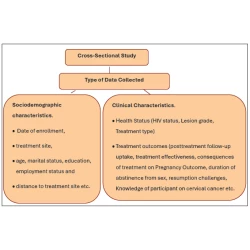
MethodsThis was a cross-sectional study that assessed the clinical outcome of 170 women treated for cervical precancers using ablative and excisional procedures in 2019 and 2020. Demographic and clinical data (treatment and posttreatment follow-up) were abstracted from the program registry. The data was analyzed to assess the clinical outcomes of cervical precancer treatment. The association between each independent variable and the dependent variable was examined in a simple logistic regression. All variables with p < 0.2 in the bivariate logistic regression model were subjected to a multivariable logistic model to get rid of cofounders and obtained adjustable odds ratios. The data was summarized using odds ratios, with p-value < 0.05 considered significant. All statistical analyses were performed using STATA version 17.
ResultsThe cervical precancer treatment effectiveness of 93.55% was disaggregated into 94.37% and 88.23% for ablative and excisional procedures, respectively, with less severe adverse clinical effects. Despite the high awareness of women on the importance and timing of posttreatment follow-up, its uptake was 54.71%. Most of the women who got pregnant after the procedures delivered live and healthy babies. Women who were HIV positive were 89% (0.89 times) [aOR = 0.11, 95%CI (0.01 0.85), p = 0.034] less likely to have effective treatment for cervical precancer when compared to HIV-negative women. Those with low-grade lesions were eight times [aOR = 8.39, 95%CI (1.10 64.06), p = 0.04] more likely to have effective treatment for cervical precancer treatment compared to those with high-grade lesions.
Conclusion and Global Health ImplicationsAblative and excisional treatment procedures for cervical precancer were effective with limited adverse effects in Cameroon. Women living with HIV and those with large lesions experienced lower treatment effectiveness. Most of the women who got pregnant after the procedures delivered live and healthy babies. Posttreatment follow-up which is highly recommended because of recurrent/persistent lesions was barely above average.
Downloads
Most read articles by the same author(s)
- Bestina Forkwa Ewang, Mathias Esum Eyong, Samuel Nambile Cumber, Claude Ngwayu Nkfusai, Brenda Mbouamba Yankam, Cho Sabastine Anye, Jacintha Rebang Achu, Bih Moki Suh, Mildred Njoache Nkeng, Rosette Boseme Nzoyom, Joyce Mahlako Tsoka-Gwegweni, Eric Achidi Akum, Vaccination Coverage Under the Expanded Program on Immunization in South West Cameroon , International Journal of Maternal and Child Health and AIDS: Vol. 9 No. 2 (2020): International Journal of Maternal and Child Health and AIDS
Similar Articles
- Ranjan Kumar Prusty, Sayeed Unisa, Reproductive Tract Infections and Treatment Seeking Behavior among Married Adolescent Women 15-19 Years in India , Vol. 2 No. 1 (2013): International Journal of Maternal and Child Health and AIDS
- Veronica B. Ajewole-Mwema, Nkechi U. Ogboh, Dolores Ramirez, Olanike A. Shamonda, Kassie L. Thompson, Sneha George, Deepa Dongarwar, Polly Niravath, Mobile Mammography Outreach in Communities with Unmet Health Needs: Assessment of Appointment Outcomes and Operational Insights from Texas, United States , Vol. 14 No. Continuous (2025): International Journal of Maternal and Child Health and AIDS
- Amina Abdullahi, Hassan Adam Murtala, Aisha Adam Abdullahi, Amina Aminu, Muktar H. Aliyu, Sani H. Aliyu, Ololade D. Adeyemi, Deepa Dongarwar, Jordi B. Torrelles, Gambo Aliyu, Hamisu M. Salihu, Drivers of Human Immunodeficiency Virus among Pregnant Women in Conflict and Non-conflict Zones of Nigeria , Vol. 14 No. Continuous (2025): International Journal of Maternal and Child Health and AIDS
- Chaw Hay Thar, Young Hwa Lee, Young June Choe, Human Immunodeficiency Virus/Acquired Immunodeficiency Syndrome Knowledge and Attitude among Myanmar Women , Vol. 13 No. Continuous (2024): International Journal of Maternal and Child Health and AIDS
- Renice Obure, Hamisu M. Salihu, Anjali Aggarwal, Acara E. Turner, Estrellita “Lo” Berry, Deborah A. Austin, Usman J. Wudil, Muktar H. Aliyu, Ronee E. Wilson, Evaluation of an Evidence-based and Community-responsive Fatherhood Training Program: Providers’ Perspective , Vol. 9 No. 1 (2020): International Journal of Maternal and Child Health and AIDS
- Deepa Dongarwar, Anjali Aggarwal, Kenneth Barning, Hamisu Mohammed Salihu, Stillbirths among Advanced Maternal Age Women in the United States: 2003-2017 , Vol. 9 No. 1 (2020): International Journal of Maternal and Child Health and AIDS
- Nupur B. Godbole, Megan S. Moberg, Parth Patel, Jayesh Kosambiya, Hamisu M. Salihu, Elba Adriana Campos, Lynette Menezes, Ragini Verma, Ronee Wilson, Paternal Involvement and Adverse Birth Outcomes in South Gujarat, India , Vol. 9 No. 1 (2020): International Journal of Maternal and Child Health and AIDS
- Aridoss Santhakumar, Malathi Mathiyazhakan, Nagaraj Jaganathasamy, Balsubramanian Ganesh, N Manikandan, VM Padmapriya, Angel Monika, Joseph K David, Arvind Kumar, Elangovan Arumugam, Prevalence and Risk Factors Associated with HIV Infection among Pregnant Women in Odisha State, India , Vol. 9 No. 3 (2020): International Journal of Maternal and Child Health and AIDS
- Hamisu M Salihu, Roneé E Wilson, Estrellita “Lo” Berry, The CI Index (CII): A New Instrument to Evaluate and Foster Collaborative Partnership in Public Health , Vol. 7 No. 1 (2018): International Journal of Maternal and Child Health and AIDS
- Hyacinthe Zamané, Hyacinthe Euvrard Sow, Dantola Paul Kain, Brice Wilfried Bicaba, Sibraogo Kiemtoré, Issaka Yameogo, Blandine Bonané-Thieba, Mamadou Sawadogo, Maternal Mortality at the Dori Regional Hospital in Northern Burkina Faso, 2014-2016 , Vol. 7 No. 2 (2018): International Journal of Maternal and Child Health and AIDS
<< < 17 18 19 20 21 22 23 24 25 26 > >>
You may also start an advanced similarity search for this article.
Published
How to Cite
Issue
Section
License
Copyright © 2025 Joseph F. Nkfusai, Simon M. Manga, Kathleen Nulah, Calvin Ngalla, Florence Manjuh, Claude Ngwayu Nkfusai, Tendongfor Nicholas, Halle Ekane Edie Gregory. Published by Global Health and Education Projects, Inc., USA.

This is an open-access article distributed under the terms of the Creative Commons Attribution-NonCommercial-ShareAlike 4.0 International License , which permits others to remix, transform, and build upon the work non-commercially, provided the original author is credited and the new creations are licensed under the same terms.