
Geospatial Analysis of Parental Healthcare-Seeking Behavior in the Vicinity of Multispecialty Hospital in India
DOI:
https://doi.org/10.25259/IJMA_628Keywords:
- Healthcare-Seeking Behavior,
- Geographical Information Systems,
- Child,
- Preschool
Abstract
The healthcare-seeking behavior of vulnerable groups, such as children under five, depends on a multitude of factors, including the caregiver’s decision making. Approximately 60% of Indians seek care from private hospitals. Recent health policy in India has favored the establishment of multispecialty hospitals. However, it remains unclear to what extent this policy has changed the number of Indians seeking healthcare from these government-established multispecialty hospitals. The study aims to assess the health-seeking behavior of parents of children under five in the vicinity of a public multispecialty tertiary care hospital.
MethodsThis was a community-based cross-sectional survey with geospatial mapping conducted among the parents of children under five using a semi-structured questionnaire in Epi-collect mobile app. The study site was an urban slum in a catchment area [within five kilometers (km)] of a multispecialty tertiary care public hospital in the central Indian state of Chhattisgarh. The study was conducted for one year duration from February 2019 to January 2020. A questionnaire was administered to the parents of the children under five (N = 353) after their household confirmation from the nearby Anganwadi center, the community level service providing center under the Integrated Child Development Scheme by the Ministry of Women and Child Development (WCD). The questionnaire included sections for demographic characteristics, the illness pattern among their children, health-seeking decision-making, and more. Descriptive analysis was presented with numbers and percentages. Univariate analysis was used to assess the association between sociodemographic variables and health-seeking characteristics. Statistical significance was considered at p value less than 0.05. We used geospatial mapping using coordinates collected and compiled using the Microsoft Excel version 2021 and analyzed using QGIS (Quantum Geographic Information System) software.
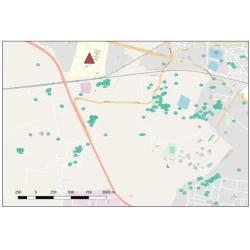
ResultsAmong the parents interviewed patients (N = 353), maternal literacy rates were over 85%. Approximately 54% of the families were below poverty line. Among 95.2% of the families, mothers were part of decision-making regarding their children’s health-seeking. Over 92% of the families opted for consultation in a nearby private hospital or dispensary. Geospatial mapping of private hospitals was a favored place for healthcare-seeking by mothers, irrespective of their socioeconomic status or education rather than multispecialty hospital.
Conclusion and Global Health ImplicationsThe majority of the parents in the vicinity of public multispecialty hospitals seek care from private clinics for ailments for children under five. The establishment of public multispecialty tertiary care hospitals, which are mandated for tertiary level of care and research, cannot replace primary-level healthcare institutions, showed that private hospitals were the favored places healthcare seeking by mothers. These primary-level institutions are critical for the management of common ailments for children under five near home and reducing the financial burden on the family, even in the vicinity of a multispecialty hospital.
Downloads
Similar Articles
- Charles Chibuisi Ehiemere, Ishaku Adamu Akyala, Bisayo Adetuyi Ogundipe, Chukwuebuka Clement Nri-Ezedi, Peter Joseph Anzaku, Waryit Esther Yonah, Efe Mary Imokhai, Isaac Onyebuchi Okohu, Idowu Olapemi Makinde, Ngozi Miriam Chimzobam-Nnalue, Beyond Access: Behavior Change and Gendered Realities in the Adoption of Digital Health Tools for Maternal, Newborn, and Child Health in Nigeria , Vol. 15 (2026): International Journal of Maternal and Child Health and AIDS
- Maria Vigil-Mallette, Daryle Pickens, Julliet Ogu, Deepa Dongarwar, Elizabeth Onugha, Hamisu M Salihu, Fifth Annual Summer Research Summit on Health Equity Organized by the Center of Excellence in Health Equity, Training and Research, Baylor College of Medicine, Houston, Texas 77030, USA on May 17, 2022 , Vol. 11 No. S2 (2022): International Journal of Maternal and Child Health and AIDS
- Margaret Omowaleola Akinwaare, Jonah Musa, Chizoma Millicent Ndikom, Determinants of Digitalized Antenatal Education Use among Pregnant Women Living with Human Immunodeficiency Virus in Nigeria , Vol. 15 (2026): International Journal of Maternal and Child Health and AIDS
- Océane J. Parker, Duc Minh Duong, Thuy Thu Nguyen, Vui Thi Le, Utilization of Sexual and Reproductive Healthcare Services Among Young Women in Two Districts of Hanoi, Vietnam , Vol. 15 (2026): International Journal of Maternal and Child Health and AIDS
- Yaw Owusu, Prerana Medakkar, Elizabeth M. Akinnawo, Althea Stewart-Pyne, Eta E. Ashu, Emigration of skilled healthcare workers from developing countries: can team-based healthcare practice fill the gaps in maternal, newborn and child healthcare delivery? , Vol. 6 No. 2 (2017): International Journal of Maternal and Child Health and AIDS
- Amol Jamkhande, Bhagyashree P. Agre, Neelam Gavali, Anjali Rajesh Gaikwad, Sanpreet Singh Sachdev, Association Between Maternal Periodontitis and Preterm Low Birth Weight in Indian Populations: A Literature Review , Vol. 15 (2026): International Journal of Maternal and Child Health and AIDS
- Brianna L. Smith, Sara Zizzo, Anouk Amzel, Sarah Wiant, Molly C. Pezzulo, Sarah Konopka, Rachel Golin, Alexandra C. Vrazo, Integration of Neonatal and Child Health Interventions with Pediatric HIV Interventions in Global Health , Vol. 7 No. 1 (2018): International Journal of Maternal and Child Health and AIDS
- Kolawole A. Fasakin, Christopher T. Omisakin, Idowu O. Adebara, Wasiu A. Ajetunmobi, Adebayo A. Adeniyi, Ayodele J. Esan, Olufunke B. Bolaji, Oluwafemi D. Ajayi, Abayomi J. Afe, Assessment of PMTCT Success Rates Based on Antiretroviral Interventions and Feeding Options: A Prospective Cohort Study , Vol. 7 No. 2 (2018): International Journal of Maternal and Child Health and AIDS
- Deepa Dongarwar, Toi B. Harris, Hamisu M. Salihu, Fourth Annual Summer Research Summit on Health Equity Organized by the Center of Excellence in Health Equity, Training and Research, Baylor College of Medicine, Houston, Texas 77030, USA on May 20, 2021 , Vol. 10 No. S3 (2021): International Journal of Maternal and Child Health and AIDS
- Muhammad Adamu Abbas, Aisha A Abdullahi, Hassan A Murtala, Abubakar L Yusuf, Rahila A Mukhtar, Hamisu M Salihu, New Paradigm for Battling Hospital-Acquired Infections in Developing Countries , Vol. 14 No. Continuous (2025): International Journal of Maternal and Child Health and AIDS
You may also start an advanced similarity search for this article.
Published
How to Cite
Issue
Section
License
Copyright © 2024 Anjali Pal, Sunil Kumar Panigrahi, Pragyan Paramita Parija, Sagarika Majumdar. Published by Global Health and Education Projects, Inc., USA.

This is an open-access article distributed under the terms of the Creative Commons Attribution-NonCommercial-ShareAlike 4.0 International License , which permits others to remix, transform, and build upon the work non-commercially, provided the original author is credited and the new creations are licensed under the same terms.