
Morbidity and Mortality of HIV-Exposed Uninfected Infants in a Tertiary Referral Facility in Yaoundé, Cameroon
DOI:
https://doi.org/10.21106/ijma.663Keywords:
- Retrospective Cohort Study,
- ARV Prophylaxis,
- Clinical Event,
- Morbidity,
- Mortality,
- Infants,
- HIV,
- Exposed Uninfected,
- Yaoundé
Abstract
Background and Objective: Following the recorded progress in the prevention of mother-to-child transmission of HIV in Yaoundé, Cameroon, the proportion of HIV-exposed infants who are uninfected (UIH) is increasing. These children are subject to infectious and non-infectious fragility. The purpose of this study was to assess infectious morbidity and mortality rates among UIH in Yaoundé, Cameroon.
Methods: We conducted a retrospective cohort study. Infants were included in the study and defined as the study subjects if they were between the ages of 24 months or younger, if they were born to HIV-positive mothers, and if they were confirmed to be HIV-negative. The main study outcomes were morbidity rate (defined as infectious, clinical events that required consultation or hospitalization) and death. Data were entered and saved in the Census and Survey Processing System (Cspro) 7.3. Statistical analyses were performed in R Software 3.6.2. The significance level was set at 0.05.
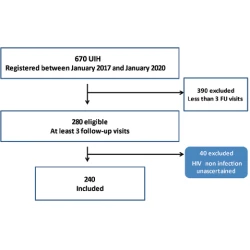
Results: In total, 240 subjects were recruited of whom 53.3% were males. Most of the HIV-positive mothers (95.7%) had used combination antiretroviral (ARV) therapy for at least four weeks during pregnancy. Among the subjects, 93.2% received ARV prophylaxis, 68.7% were exclusively breastfed for six months, 94.7% were fully vaccinated, and 60.6% had received cotrimoxazole up to the detection of the non-infection. Overall, the morbidity rate stood at 34.2%. The incidence of morbidity was 3 per 1,000 child months of the follow-up. The main pathologies were acute respiratory infections (60.79%) and malaria (17.65%). Three deaths were recorded, representing an overall mortality rate of 1.25% for an incidence of 1.1 per 1,000 child months of the follow-up (FU). Clinical events were more frequent in mothers diagnosed with HIV during pregnancy under the azidothymidine (AZT) + lamivudine (3TC) + névirapine (NVP) -based protocol (odds ratio of 3.83 [1.09-14.45; p = 0.039]). Morbidity was also higher for the follow-up periods of less than six months.
Conclusion and Global Health Implications: The overall mortality rate among UIH was low. However, the morbidity rate was considerably higher. Emphasis should be focused on in-care retention for up to 24 months for all UIH, which should include monitoring of HIV-infected mothers prior to pregnancy.
Downloads
Most read articles by the same author(s)
- Anne Esther Njom Nlend, Mpox and Breastfeeding in Sub-Saharan Africa: Clinical, Program, and Policy Recommendations , International Journal of Maternal and Child Health and AIDS: Vol. 14 No. Continuous (2025): International Journal of Maternal and Child Health and AIDS
Similar Articles
- Wah Wah Myint, Human Immunodeficiency Virus (HIV) Knowledge and Stigma: Findings from a Cross-sectional Survey , Vol. 15 (2026): International Journal of Maternal and Child Health and AIDS
- Kolawole A. Fasakin, Christopher T. Omisakin, Idowu O. Adebara, Wasiu A. Ajetunmobi, Adebayo A. Adeniyi, Ayodele J. Esan, Olufunke B. Bolaji, Oluwafemi D. Ajayi, Abayomi J. Afe, Assessment of PMTCT Success Rates Based on Antiretroviral Interventions and Feeding Options: A Prospective Cohort Study , Vol. 7 No. 2 (2018): International Journal of Maternal and Child Health and AIDS
- Amol Jamkhande, Bhagyashree P. Agre, Neelam Gavali, Anjali Rajesh Gaikwad, Sanpreet Singh Sachdev, Association Between Maternal Periodontitis and Preterm Low Birth Weight in Indian Populations: A Literature Review , Vol. 15 (2026): International Journal of Maternal and Child Health and AIDS
- Sorochi H. Iloanusi, Osaro O. Mgbere, Susan. M. Abughosh, Ekere J. Essien, HIV Non-Occupational Post Exposure Prophylaxis in Nigeria: A Systematic Review of Research Evidence and Practice , Vol. 8 No. 2 (2019): International Journal of Maternal and Child Health and AIDS
- Sara A. Holtz, Rudi Thetard, Sarah N. Konopka, Jennifer Albertini, Anouk Amzel, Karen P. Fogg, A Systematic Review of Interventions to Reduce Maternal Mortality among HIV-Infected Pregnant and Postpartum Women , Vol. 4 No. 2 (2015): International Journal of Maternal and Child Health and AIDS
- Margaret Omowaleola Akinwaare, Jonah Musa, Chizoma Millicent Ndikom, Determinants of Digitalized Antenatal Education Use among Pregnant Women Living with Human Immunodeficiency Virus in Nigeria , Vol. 15 (2026): International Journal of Maternal and Child Health and AIDS
- Agnes Langat, Tegan L. Callahan, Isabella Yonga, Boniface Ochanda, Anthony Waruru, Lucy W. Ng’anga, Abraham Katana, Brian Onyango, Benson Singa, Stephen Oyule, George Githuka, Lennah Omoto, Jane Muli, Thorkild Tylleskar, Surbhi Modi, Associations of Sociodemographic and Clinical Factors with Late Presentation for Early Infant HIV Diagnosis (EID) Services in Kenya , Vol. 10 No. 2 (2021): International Journal of Maternal and Child Health and AIDS
- Brianna L. Smith, Sara Zizzo, Anouk Amzel, Sarah Wiant, Molly C. Pezzulo, Sarah Konopka, Rachel Golin, Alexandra C. Vrazo, Integration of Neonatal and Child Health Interventions with Pediatric HIV Interventions in Global Health , Vol. 7 No. 1 (2018): International Journal of Maternal and Child Health and AIDS
- Anays Murillo, Mary Bachman DeSilva, Lora L. Sabin, Nafisa Halim, Harriet Chemusto, Philip Aroda, Julia Gasuza, Davidson H. Hamer, Anna Larson Williams, Barbara Mukasa, Lisa J. Messersmith, Rachael Bonawitz, Impact of a Maternal Prevention of Mother-to-child Transmission of HIV (PMTCT) Intervention on HIV-exposed Infants in Uganda , Vol. 9 No. 3 (2020): International Journal of Maternal and Child Health and AIDS
- Ebelechuku F. Ugochukwu, Chinyere U. Onubogu, Emeka S. Edokwe, Uchenna Ekwochi, Kenneth N. Okeke, Esther N. Umeadi, Stanley K. Onah, A Review and Analysis of Outcomes from Prevention of Mother-toChild Transmission of HIV Infant Follow-up Services at a Pediatric Infectious Diseases Unit of a Major Tertiary Hospital in Nigeria: 2007-2020 , Vol. 10 No. 2 (2021): International Journal of Maternal and Child Health and AIDS
You may also start an advanced similarity search for this article.
Published
How to Cite
Issue
Section
License
Copyright © 2023 Anne Esther Njom Nlend, Pascal Avenec, Jeannette Epée Ngoué, Arsène B. Sandie. Published by Global Health and Education Projects, Inc., USA.

This is an open-access article distributed under the terms of the Creative Commons Attribution-NonCommercial-ShareAlike 4.0 International License , which permits others to remix, transform, and build upon the work non-commercially, provided the original author is credited and the new creations are licensed under the same terms.