
Association Between Breakfast Consumption and Anthropometrically Determined Nutritional Status of Secondary-School Adolescents in Lagos, Southwest Nigeria
DOI:
https://doi.org/10.21106/ijma.503Keywords:
- Breakfast,
- Consumption,
- Knowledge,
- Nutritional Status,
- Overweight,
- Obesity
Abstract
Background and Objectives: Breakfast skipping has been associated with obesity among adolescents in some studies but little is known about the relationship between breakfast consumption and obesity among secondary-school adolescents in Nigeria. This study contributes to the empirical literature by analyzing the relationship between breakfast consumption and anthropometrically determined nutritional status of secondary-school adolescents in Lagos, Nigeria.
Methods: This was a descriptive cross-sectional study in which multi-stage sampling was used to select 397 secondary-school adolescents (10 to 19 years, mean = 13.8 ± 1.7 years).They were classified into student groups from public or private schools in Lagos. Data were collected using a semi-structured self-administered questionnaire and analyzed using Epi-info version 7. The independent variables were the proportion of adolescents who had a high level of knowledge about breakfast consumption, while the outcome variable was the proportion of adolescents who were overweight or obese. World Health Organization (WHO) AnthroPlus software was used to determine the nutritional status of adolescents. Mean and standard deviations were computed for continuous variables, and frequency tables were generated for categorical variables. Significant associations between variables were obtained using Chisquare with the level of significance set at p < 0.05.
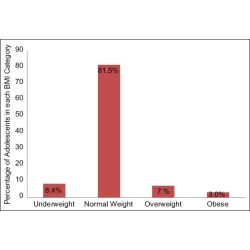
Results: Only 17% of the adolescents had good knowledge of breakfast consumption. More than half (57.4%) of the participants ate a daily breakfast. The percentage of adolescents who skipped breakfast was higher among older 16-19 years (52.2%) and middle 13-15 years (43%) than the younger adolescents (34.7%). Girls skipped breakfast more than boys. Most respondents were in the normal Body Mass Index (BMI) ranges for their genders. Prevalence of overweight and obesity were 7.1% and 3.3% among males and 7.1% and 2.8% among females respectively. The mean BMI of those who skipped breakfast (19.33 ± 3.27kg/m2 ) was significantly higher than the BMI of those who ate breakfast (18.56 ± 3.05 kg/m2 ) (p=0.019). Most of the adolescents who ate a daily breakfast had mothers who had completed only primary school education although the relationship was not statistically significant (χ2 =5, p=0.172).
Conclusion and Global Health Implications: Breakfast knowledge was low, while breakfast consumption was average. Adolescents who skipped breakfast had a significantly higher BMI (19.33 ± 3.27kg/m2 ) than those who ate breakfast (18.56 ± 3.05 kg/m2 ) (p=0.019). Nutrition education that emphasizes the importance of breakfast consumption with the purpose of behavioral change should be intensified among adolescents.
Downloads
Most read articles by the same author(s)
- Oluwafunmilayo Funke Adeniyi, Ekanem Ekure, Foluke A. Olatona, Elizabeth O. Ajayi, Nwaoma Nworgu, Nutritional Assessment and Maternal Perception of Toddler Body Size using Toddler Silhouette Scale in Nigeria a Developing Country , International Journal of Maternal and Child Health and AIDS: Vol. 7 No. 1 (2018): International Journal of Maternal and Child Health and AIDS
Similar Articles
- Wah Wah Myint, Human Immunodeficiency Virus (HIV) Knowledge and Stigma: Findings from a Cross-sectional Survey , Vol. 15 (2026): International Journal of Maternal and Child Health and AIDS
- Raees A. Shaikh, Mohammad Siahpush, Gopal K. Singh, Melissa Tibbits, Socioeconomic Status, Smoking, Alcohol use, Physical Activity, and Dietary Behavior as Determinants of Obesity and Body Mass Index in the United States: Findings from the National Health Interview Survey , Vol. 4 No. 1 (2015): International Journal of Maternal and Child Health and AIDS
- Zenab I. Yusuf, Deepa Dongarwar, Rafeek A Yusuf, Meishon Bell, Toi Harris Harris, Hamisu M. Salihu, Social Determinants of Overweight and Obesity Among Children in the United States , Vol. 9 No. 1 (2020): International Journal of Maternal and Child Health and AIDS
- Natalie C Frayer, Yeonsoo Kim, Caffeine Intake During Pregnancy and Risk of Childhood Obesity: A Systematic Review , Vol. 9 No. 3 (2020): International Journal of Maternal and Child Health and AIDS
- Oluwafunmilayo Funke Adeniyi, Gabriel T. Fagbenro, Foluke A. Olatona, Overweight and Obesity Among School-aged Children and Maternal Preventive Practices against Childhood Obesity in Select Local Government Areas of Lagos, Southwest, Nigeria , Vol. 8 No. 1 (2019): International Journal of Maternal and Child Health and AIDS
- Maria Vigil-Mallette, Daryle Pickens, Julliet Ogu, Deepa Dongarwar, Elizabeth Onugha, Hamisu M Salihu, Fifth Annual Summer Research Summit on Health Equity Organized by the Center of Excellence in Health Equity, Training and Research, Baylor College of Medicine, Houston, Texas 77030, USA on May 17, 2022 , Vol. 11 No. S2 (2022): International Journal of Maternal and Child Health and AIDS
- Amol Jamkhande, Bhagyashree P. Agre, Neelam Gavali, Anjali Rajesh Gaikwad, Sanpreet Singh Sachdev, Association Between Maternal Periodontitis and Preterm Low Birth Weight in Indian Populations: A Literature Review , Vol. 15 (2026): International Journal of Maternal and Child Health and AIDS
- Deepa Dongarwar, Morgan Lee, Christo Manikkuttiyil, Hamisu M. Salihu, Association Between Social Determinants of Health Issues and Maternal Obesity Among American Racial/Ethnic Groups , Vol. 12 No. 1 (2023): International Journal of Maternal and Child Health and AIDS
- Oluwafunmilayo Funke Adeniyi, Ekanem Ekure, Foluke A. Olatona, Elizabeth O. Ajayi, Nwaoma Nworgu, Nutritional Assessment and Maternal Perception of Toddler Body Size using Toddler Silhouette Scale in Nigeria a Developing Country , Vol. 7 No. 1 (2018): International Journal of Maternal and Child Health and AIDS
- Océane J. Parker, Duc Minh Duong, Thuy Thu Nguyen, Vui Thi Le, Utilization of Sexual and Reproductive Healthcare Services Among Young Women in Two Districts of Hanoi, Vietnam , Vol. 15 (2026): International Journal of Maternal and Child Health and AIDS
You may also start an advanced similarity search for this article.
Published
How to Cite
Issue
Section
License
Copyright © 2022 Foluke A. Olatona, Oyetola O. Oloruntola, Oluwafunmilayo F. Adeniyi, Eyitope O. Amu. Published by Global Health and Education Projects, Inc., USA.

This is an open-access article distributed under the terms of the Creative Commons Attribution-NonCommercial-ShareAlike 4.0 International License , which permits others to remix, transform, and build upon the work non-commercially, provided the original author is credited and the new creations are licensed under the same terms.