
Postpartum Hemorrhage in Humanitarian Settings: Heat-Stable Carbetocin and Tranexamic Acid Implementation Study in South Sudan
DOI:
https://doi.org/10.25259/IJMA_8_2023Keywords:
- Health Services Research,
- Postpartum Hemorrhage,
- Heat-Stable Carbetocin,
- Tranexamic Acid,
- Public Health Intervention Package,
- Humanitarian Settings,
- Fragile Settings
Abstract
Postpartum hemorrhage (PPH) remains a significant concern in crisis-affected contexts, where the implementation of heat-stable carbetocin (HSC) and tranexamic acid (TXA) for PPH prevention and treatment lacks evidence. This study aims to evaluate the effects of a capacity-strengthening package on the use of uterotonics for PPH prevention and detection, and the use of TXA for PPH treatment in basic maternity facilities in South Sudan.
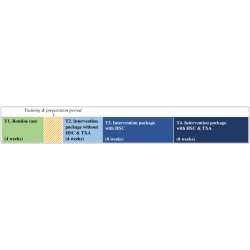
MethodsIn this implementation study, the six chosen facilities followed a stepwise sequence of PPH management: T1 (routine care), a transition period for package design; T2 (package without HSC and TXA); T3 (package and HSC); and T4 (package with HSC and TXA). The intervention comprised refresher training, an online provider community, PPH readiness kits, alarm bells, and displayed algorithms. The main outcomes were trends in prophylactic uterotonic use, including HSC, visual diagnosis of bleeding, and oxytocin and TXA use for PPH treatment. Analyses were adjusted for cluster effect and baseline characteristics. The study was registered in the Pan-African Clinical Trials Registry (PACTR202302476608339).
ResultsFrom February 1, 2022, to February 17, 2023, 3142 women were recruited. Nearly all women received prophylactic uterotonics across all four phases, with a significant increase after T3 (T4-T1: 100%–98%; 95% CI: 4.4–0.4). Oxytocin alone was the most used in T1 (98%) and T2 (94%) and HSC alone in T3 (87%) and T4 (82%) (T4-T1: 95% CI: 75.5–83.3). PPH diagnosis tripled from 1.2% of all births to 3.6% (T2-T1: 95% CI: 0.4–5.2) and stayed roughly at 3% in T3 and T4. For treatment, universal oxytocin use in T1 and T2 decreased in T3 upon HSC initiation (T3-T2: 27%–100%; 95% CI: 95.5–49.9), whereas TXA use increased in T4 (T4-T1: 95%–0%; 95% CI: 54.6–99.0).
Conclusion and Global Health ImplicationsAn intervention package to improve the quality of PPH prevention and treatment can effectively increase HSC and TXA use in crisis settings. It could be scaled up in similar contexts with ongoing supervision to mitigate confusion between the existing and new medications, such as the reduced use of oxytocin for PPH treatment. Sustaining cold chain investments remain vital to ensure oxytocin quality.
Downloads
Most read articles by the same author(s)
- Nguyen Toan Tran, Kidza Mugerwa, Awatta Walter Ochan, Sarah Muwanguzi, Jemelia Sake, Richard Mwesigwa, Okpwoku Sukere, Catrin Schulte-Hillen, Postpartum Hemorrhage in Humanitarian Settings: Implementation Insights from Using Heat-Stable Carbetocin and Tranexamic Acid , International Journal of Maternal and Child Health and AIDS: Vol. 13 No. S1 (2024): International Journal of Maternal and Child Health and AIDS
- Nguyen Toan Tran, Kidza Mugerwa, Sarah Muwanguzi, Richard Mwesigwa, Damien Wasswa, Willibald Zeck, Armando Seuc, Catrin Schulte-Hillen, Postpartum Hemorrhage in Humanitarian Settings: Heat-Stable Carbetocin and Tranexamic Acid Implementation Study in Uganda , International Journal of Maternal and Child Health and AIDS: Vol. 13 No. S1 (2024): International Journal of Maternal and Child Health and AIDS
- Alice Rosmini, Kidza Mugerwa, Awatta Walter Ochan, Sarah Muwanguzi, Jemelia Sake, Richard Mwesigwa, Okpwoku Sukere, Catrin Schulte-Hillen, Nguyen Toan Tran, Empowering Midwives in Humanitarian Settings: Integrating Heat-Stable Carbetocin and Tranexamic Acid into Postpartum Hemorrhage Training , International Journal of Maternal and Child Health and AIDS: Vol. 13 No. S1 (2024): International Journal of Maternal and Child Health and AIDS
Similar Articles
- Mehrete Girmay, Digital Health Divide: Opportunities for Reducing Health Disparities and Promoting Equitable Care for Maternal and Child Health Populations , Vol. 13 No. Continuous (2024): International Journal of Maternal and Child Health and AIDS
- Romuladus Emeka Azuine, Gopal K Singh, Sussan E Ekejiuba, Eta Ashu, Magnus A Azuine, Global Health Donor Presence, Variations in HIV/AIDS Prevalence, and External Resources for Health in Developing Countries in Africa and Asia , Vol. 2 No. 2 (2014): International Journal of Maternal and Child Health and AIDS
- Musawenkosi H L Mabaso, Thoko Ndaba, Zilungile L Mkhize-Kwitshana, Overview of Maternal, Neonatal and Child Deaths in South Africa: Challenges, Opportunities, Progress and Future Prospects , Vol. 2 No. 2 (2014): International Journal of Maternal and Child Health and AIDS
- Nnennaya N. Kalu-Umeh, Mohammed N. Sambo N. Sambo, Suleiman H. Idris, Abubakar M. Kurfi, Costs and Patterns of Financing Maternal Health Care Services in Rural Communities in Northern Nigeria: Evidence for Designing National Fee Exemption Policy , Vol. 2 No. 1 (2013): International Journal of Maternal and Child Health and AIDS
- Comfort Z. Olorunsaiye, A-Mac Harris, Korede K. Yusuf, Characteristics of Early Newborn Care: A Descriptive Analysis of Recent Births in Nigeria , Vol. 9 No. 1 (2020): International Journal of Maternal and Child Health and AIDS
- Nemati Ali, Tazakori Zahra, Maryam Namadi Vosogh, Nazila Vosoghi, Maryam Zare, Afroz Mardi, Adham Davoud, Hamidzadeh Arbabi Yousef, Kazemzadeh Rafat, Effectiveness Comparison of Mothers’ In-person Versus Written Nutritional Education Intervention on Infant Growth in Iran , Vol. 3 No. 1 (2015): International Journal of Maternal and Child Health and AIDS
- Godwin Omokhagbo Emmanuel, Olaniyi Felix Sanni, Abang Roger, Paul Umoh, Ochonye Bartholomew Boniface, Amechi Paul, Ismaeel Mohammed Yahaya, Agie Muhmmad Auwal, Improving HIV Prevention for Key Populations in Nigeria: Insights on Access, Barriers, Stigma, and Service Utilization , Vol. 14 No. Continuous (2025): International Journal of Maternal and Child Health and AIDS
- Hamisu M. Salihu, Ronee E. Wilson, Lindsey M. King, Phillip J. Marty, Valerie E. Whiteman, Socio-ecological Model as a Framework for Overcoming Barriers and Challenges in Randomized Control Trials in Minority and Underserved Communities , Vol. 3 No. 1 (2015): International Journal of Maternal and Child Health and AIDS
- Manpreet Singh Khurmi, Felix Sayinzoga, Atakilt Berhe, Tatien Bucyana, Assumpta Kayinamura Mwali, Emmanuel Manzi, Maharajan Muthu, Newborn Survival Case Study in Rwanda - Bottleneck Analysis and Projections in Key Maternal and Child Mortality Rates Using Lives Saved Tool (LiST) , Vol. 6 No. 2 (2017): International Journal of Maternal and Child Health and AIDS
- Abdallah Ibrahim, Anne Marie O’Keefe, Do Infant Birth Outcomes Vary Among Mothers With and Without Health Insurance Coverage in Sub-Saharan Africa? Findings from the National Health Insurance and Cash and Carry Eras in Ghana, West Africa , Vol. 2 No. 2 (2014): International Journal of Maternal and Child Health and AIDS
<< < 1 2 3 4 5 6 7 8 9 10 > >>
You may also start an advanced similarity search for this article.
Published
How to Cite
Issue
Section
License
Copyright © 2024 Nguyen Toan Tran, Awatta Walter Ochan, Jemelia Sake, Okpwoku Sukere, Willibald Zeck, Armando Seuc, Catrin Schulte-Hillen. Published by Global Health and Education Projects, Inc., USA.

This is an open-access article distributed under the terms of the Creative Commons Attribution-NonCommercial-ShareAlike 4.0 International License , which permits others to remix, transform, and build upon the work non-commercially, provided the original author is credited and the new creations are licensed under the same terms.