
Drivers of Human Immunodeficiency Virus among Pregnant Women in Conflict and Non-conflict Zones of Nigeria
DOI:
https://doi.org/10.25259/IJMA_31_2025Keywords:
- Behavior,
- Conflict,
- Human Immunodeficiency Virus,
- Pregnancy,
- Risk,
- Women
Abstract
Human immunodeficiency virus (HIV) is a major public health concern among pregnant women in Nigeria, with seven in every hundred women likely to have an HIV infection. Understanding factors associated with HIV infection among pregnant women is critical to improving prevention strategies, especially in conflict regions. This study investigates demographic, socio-economic, and behavioral determinants of HIV among pregnant women in Nigeria, with conflict exposure included as a key predictor in the analysis.
Methods:This study is a cross-sectional design using data from the 2018 Nigeria HIV/Acquired Immunodeficiency Syndrome (AIDS) Indicator and Impact Survey, the largest population-based HIV survey globally, implemented between July and December 2018 across all 36 states and the Federal Capital Territory of Nigeria. We analyzed weighted data from 3,879,192 pregnant women (both HIV-positive and negative), conducting bivariate and multivariate analyses to identify predictors of HIV infection among women aged 15–49 years while adjusting for potential confounders. Adjusted Odds Ratios (AORs) with 95% confidence intervals (CIs) were generated using unconditional logistic regression models to determine significant predictors.
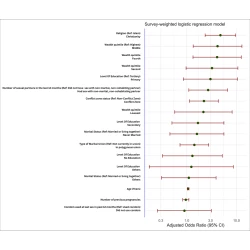
Results:Our analysis revealed that women in conflict zones were younger, less educated, and more likely to be in polygynous marriages and the lowest wealth quintile compared to those in non-conflict zones. In a multivariable analysis, residence in a conflict zone was associated with nearly twofold adjusted odds of HIV positivity (AOR = 1.93; CI: 0.98–3.82; p = 0.057). Increasing maternal age (AOR = 1.06; CI: 1.02–1.10; p = 0.002) and middle to fourth wealth quintile status (AOR = 4.10 and 3.80, respectively; p < 0.05) were significantly associated with a higher likelihood of HIV infection. Recent non-marital sexual activity was also significantly associated with HIV positivity (AOR = 2.96; p = 0.037).
Conclusion and Global Health Implications:The study identifies conflict exposure and socio-economic status as significant predictors of HIV infection among pregnant women in Nigeria. Our analysis reveals important demographic, socio-economic, and behavioral factors associated with HIV prevalence in this population. These findings underscore the need for comprehensive HIV prevention strategies that address the complex interplay of social determinants, particularly in vulnerable populations.
Downloads
Most read articles by the same author(s)
- Deepa Dongarwar, Hamisu M. Salihu, COVID-19 Pandemic: Marked Global Disparities in Fatalities According to Geographic Location and Universal Health Care , International Journal of Maternal and Child Health and AIDS: Vol. 9 No. 2 (2020): International Journal of Maternal and Child Health and AIDS
- Fatimah Isma’il Tsiga-Ahmed, Taiwo Gboluwaga Amole, Baba Maiyaki Musa, Aishatu Muhammad Nalado, Omeiza Baba Agoyi, Hadiza Shehu Galadanci, Hamisu M. Salihu, COVID 19: Evaluating the Knowledge, Attitude and Preventive Practices of Healthcare Workers in Northern Nigeria , International Journal of Maternal and Child Health and AIDS: Vol. 10 No. 1 (2021): International Journal of Maternal and Child Health and AIDS
- Roneé E. Wilson, Renice Obure, Precious Omokaro Omokaro, Hamisu M. Salihu, Estrellita “Lo” Berry, Deborah A. Austin A. Austin, Jennifer G. Christner, Effectiveness of a 24/7 Dad® Curriculum in Improving Father Involvement: Profiles of Engagement , International Journal of Maternal and Child Health and AIDS: Vol. 9 No. 1 (2020): International Journal of Maternal and Child Health and AIDS
- Hamisu M. Salihu, Romuladus E. Azuine, Current and Emerging Issues in Global Health: An Introduction to Special Journal Collection , International Journal of Maternal and Child Health and AIDS: Vol. 9 No. 1 (2020): International Journal of Maternal and Child Health and AIDS
- Deepa Dongarwar, Hamisu Mohammed Salihu, Risk of Stillbirth after Infertility Treatment in the United States: 2014-2017 , International Journal of Maternal and Child Health and AIDS: Vol. 9 No. 1 (2020): International Journal of Maternal and Child Health and AIDS
- Isabel Griffin, Boubakari Ibrahimou, Natasha Navejar, Anjali Aggarwal, Kristopher Myers, Daniel Mauck, Korede K. Yusuf, Usman J. Wudil, Muktar H. Aliyu, Hamisu M. Salihu, Maternal Caffeine Consumption and Racial Disparities in Fetal Telomere Length , International Journal of Maternal and Child Health and AIDS: Vol. 9 No. 1 (2020): International Journal of Maternal and Child Health and AIDS
- Deepa Dongarwar, Anjali Aggarwal, Kenneth Barning, Hamisu Mohammed Salihu, Trends in Stillbirths and Stillbirth Phenotypes in the United States: An Analysis of 131.5 Million Births , International Journal of Maternal and Child Health and AIDS: Vol. 9 No. 1 (2020): International Journal of Maternal and Child Health and AIDS
Similar Articles
- Amol Jamkhande, Bhagyashree P. Agre, Neelam Gavali, Anjali Rajesh Gaikwad, Sanpreet Singh Sachdev, Association Between Maternal Periodontitis and Preterm Low Birth Weight in Indian Populations: A Literature Review , Vol. 15 (2026): International Journal of Maternal and Child Health and AIDS
- Charles Chibuisi Ehiemere, Ishaku Adamu Akyala, Bisayo Adetuyi Ogundipe, Chukwuebuka Clement Nri-Ezedi, Peter Joseph Anzaku, Waryit Esther Yonah, Efe Mary Imokhai, Isaac Onyebuchi Okohu, Idowu Olapemi Makinde, Ngozi Miriam Chimzobam-Nnalue, Beyond Access: Behavior Change and Gendered Realities in the Adoption of Digital Health Tools for Maternal, Newborn, and Child Health in Nigeria , Vol. 15 (2026): International Journal of Maternal and Child Health and AIDS
- Wah Wah Myint, Human Immunodeficiency Virus (HIV) Knowledge and Stigma: Findings from a Cross-sectional Survey , Vol. 15 (2026): International Journal of Maternal and Child Health and AIDS
- Margaret Omowaleola Akinwaare, Jonah Musa, Chizoma Millicent Ndikom, Determinants of Digitalized Antenatal Education Use among Pregnant Women Living with Human Immunodeficiency Virus in Nigeria , Vol. 15 (2026): International Journal of Maternal and Child Health and AIDS
- Océane J. Parker, Duc Minh Duong, Thuy Thu Nguyen, Vui Thi Le, Utilization of Sexual and Reproductive Healthcare Services Among Young Women in Two Districts of Hanoi, Vietnam , Vol. 15 (2026): International Journal of Maternal and Child Health and AIDS
- Maria Vigil-Mallette, Daryle Pickens, Julliet Ogu, Deepa Dongarwar, Elizabeth Onugha, Hamisu M Salihu, Fifth Annual Summer Research Summit on Health Equity Organized by the Center of Excellence in Health Equity, Training and Research, Baylor College of Medicine, Houston, Texas 77030, USA on May 17, 2022 , Vol. 11 No. S2 (2022): International Journal of Maternal and Child Health and AIDS
- Elizabeth Armstrong-Mensah, David-Praise Ebiringa, Kaleb Whitfield, Jake Coldiron, Genital Chlamydia Trachomatis Infection: Prevalence, Risk Factors and Adverse Pregnancy and Birth Outcomes in Children and Women in sub-Saharan Africa , Vol. 10 No. 2 (2021): International Journal of Maternal and Child Health and AIDS
- Innocent Anayochukwu Ugwu, Calistus Obiora Nevo, Malachy Nwaeze Ezenwaeze, Antenatal Care Utilization and Delivery Location: Evidence from Postpartum Women in Enugu, South East Nigeria , Vol. 15 (2026): International Journal of Maternal and Child Health and AIDS
- Sara A. Holtz, Rudi Thetard, Sarah N. Konopka, Jennifer Albertini, Anouk Amzel, Karen P. Fogg, A Systematic Review of Interventions to Reduce Maternal Mortality among HIV-Infected Pregnant and Postpartum Women , Vol. 4 No. 2 (2015): International Journal of Maternal and Child Health and AIDS
- Vatsla Dadhwal, Aparna Sharma, Kavita Khoiwal, Dipika Deka, Plaboni Sarkar, P. Vanamail, Pregnancy Outcomes in HIV-Infected Women: Experience from a Tertiary Care Center in India , Vol. 6 No. 1 (2017): International Journal of Maternal and Child Health and AIDS
You may also start an advanced similarity search for this article.
Published
How to Cite
Issue
Section
License
Copyright © 2025 Amina Abdullahi, Hassan Adam Murtala, Aisha Adam Abdullahi, Amina Aminu, Muktar H. Aliyu, Sani H. Aliyu, Ololade D. Adeyemi, Deepa Dongarwar, Jordi B. Torrelles, Gambo Aliyu, Hamisu M. Salihu. Published by Global Health and Education Projects, Inc., USA.

This is an open-access article distributed under the terms of the Creative Commons Attribution-NonCommercial-ShareAlike 4.0 International License , which permits others to remix, transform, and build upon the work non-commercially, provided the original author is credited and the new creations are licensed under the same terms.