
Drivers of Human Immunodeficiency Virus among Pregnant Women in Conflict and Non-conflict Zones of Nigeria
DOI:
https://doi.org/10.25259/IJMA_31_2025Keywords:
- Behavior,
- Conflict,
- Human Immunodeficiency Virus,
- Pregnancy,
- Risk,
- Women
Abstract
Human immunodeficiency virus (HIV) is a major public health concern among pregnant women in Nigeria, with seven in every hundred women likely to have an HIV infection. Understanding factors associated with HIV infection among pregnant women is critical to improving prevention strategies, especially in conflict regions. This study investigates demographic, socio-economic, and behavioral determinants of HIV among pregnant women in Nigeria, with conflict exposure included as a key predictor in the analysis.
Methods:This study is a cross-sectional design using data from the 2018 Nigeria HIV/Acquired Immunodeficiency Syndrome (AIDS) Indicator and Impact Survey, the largest population-based HIV survey globally, implemented between July and December 2018 across all 36 states and the Federal Capital Territory of Nigeria. We analyzed weighted data from 3,879,192 pregnant women (both HIV-positive and negative), conducting bivariate and multivariate analyses to identify predictors of HIV infection among women aged 15–49 years while adjusting for potential confounders. Adjusted Odds Ratios (AORs) with 95% confidence intervals (CIs) were generated using unconditional logistic regression models to determine significant predictors.
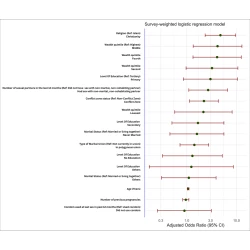
Results:Our analysis revealed that women in conflict zones were younger, less educated, and more likely to be in polygynous marriages and the lowest wealth quintile compared to those in non-conflict zones. In a multivariable analysis, residence in a conflict zone was associated with nearly twofold adjusted odds of HIV positivity (AOR = 1.93; CI: 0.98–3.82; p = 0.057). Increasing maternal age (AOR = 1.06; CI: 1.02–1.10; p = 0.002) and middle to fourth wealth quintile status (AOR = 4.10 and 3.80, respectively; p < 0.05) were significantly associated with a higher likelihood of HIV infection. Recent non-marital sexual activity was also significantly associated with HIV positivity (AOR = 2.96; p = 0.037).
Conclusion and Global Health Implications:The study identifies conflict exposure and socio-economic status as significant predictors of HIV infection among pregnant women in Nigeria. Our analysis reveals important demographic, socio-economic, and behavioral factors associated with HIV prevalence in this population. These findings underscore the need for comprehensive HIV prevention strategies that address the complex interplay of social determinants, particularly in vulnerable populations.
Downloads
Most read articles by the same author(s)
- Amina A. Umar, Hamisu M. Salihu, Romuladus E. Azuine, Crisis of Brain Drain in Nigeria’s Health Sector: Challenges, Opportunities, and the Path Forward , International Journal of Maternal and Child Health and AIDS: Vol. 14 No. Continuous (2025): International Journal of Maternal and Child Health and AIDS
- Zenab I. Yusuf, Deepa Dongarwar, Rafeek A Yusuf, Meishon Bell, Toi Harris Harris, Hamisu M. Salihu, Social Determinants of Overweight and Obesity Among Children in the United States , International Journal of Maternal and Child Health and AIDS: Vol. 9 No. 1 (2020): International Journal of Maternal and Child Health and AIDS
- Chioma A. Ikedionwu, Deepa Dongarwar, Courtney Williams, Evelyn Odeh, Maylis Peguy Nkeng Peh, Hilliary Hooker, Stacey Wiseman, Tramauni Brock, Erinn Payne-Green, Chidinma Chukwudum, Grace Loudd, Andrea Shelton, Jonnae O. Atkinson, Kiara K. Spooner, Jason L. Salemi, Hamisu M. Salihu, Omonike A. Olaleye, Trends and Risk Factors for Leishmaniasis among Reproductive Aged Women in the United States , International Journal of Maternal and Child Health and AIDS: Vol. 10 No. 2 (2021): International Journal of Maternal and Child Health and AIDS
- Devon Madelyn Rupley, Deepa Dongarwar, Hamisu M. Salihu, Allison M. Janda, Rachel Pope, Healthcare Access as a Risk-Marker for Obstetric Vesicovaginal Fistula in Malawi , International Journal of Maternal and Child Health and AIDS: Vol. 9 No. 1 (2020): International Journal of Maternal and Child Health and AIDS
- Chioma A Ikedionwu, Deepa Dongarwar, Korede K. Yusuf, Sitratullah O. Maiyegun, Sahra Ibrahimi, Hamisu M. Salihu, Using Nominal Group Technique to Elucidate a COVID-19 Research Agenda for Maternal and Child Health (MCH) Populations , International Journal of Maternal and Child Health and AIDS: Vol. 9 No. 3 (2020): International Journal of Maternal and Child Health and AIDS
- Hamisu M. Salih, Deepa Dongarwar, Muktar H. Aliyu, Romuladus E. Azuine, Global Ranking of COVID-19-Related Mortality by Country using a Novel Pandemic Efficiency Index (PEI) , International Journal of Maternal and Child Health and AIDS: Vol. 9 No. 2 (2020): International Journal of Maternal and Child Health and AIDS
- Hamisu M. Salihu, Amina A. Umar, Romuladus E. Azuine, Special Collection: Implementation Research Evidence for Prevention and Treatment of Postpartum Hemorrhage in High-Burden Low- and Middle-Income Countries , International Journal of Maternal and Child Health and AIDS: Vol. 13 No. S1 (2024): International Journal of Maternal and Child Health and AIDS
- Hadiza Galadanci, Deepa Dongarwar, Wolfgang Künzel, Oladapo Shittu, Murtala Yusuf, Sadiq Abdurrahman, Dolapo Lufadeju, Hamisu M. Salihu, Cesarean Section and Maternal-fetal Mortality Rates in Nigeria: An Ecological Lens into the Last Decade , International Journal of Maternal and Child Health and AIDS: Vol. 9 No. 1 (2020): International Journal of Maternal and Child Health and AIDS
- Zubairu Iliyasux, Amina A. Umar, Fatima S. Gaya, Nafisa S. Nass, Hadiza M. Abdullahi, Aminatu A. Kwaku, Taiwo G. Amole, Fatimah I. Tsiga-Ahmed, Hadiza S. Galadanci, Hamisu M. Salihu, Muktar H. Aliyu, ‘We delivered at home out of fear’: Maternity Care in Rural Nigeria During the COVID-19 Pandemic , International Journal of Maternal and Child Health and AIDS: Vol. 12 No. 1 (2023): International Journal of Maternal and Child Health and AIDS
- Ahmad Abdulhadi, Nasiru Abdullahi, Ibrahim Yusuf, Basheer I. Waziri, Kasimu Mamuda , Husna F. Ibrahim, Khadija Muhammad, Maryam M. Ibrahim , Aisha A. Abdullahi, Hassan A. Murtala, Muhammad A. Abbas, Hamisu M. Salihu, A Systematic Review and Meta-analysis on Innovative Approaches in Tuberculosis Diagnosis: Challenges and Future Directions , International Journal of Maternal and Child Health and AIDS: Vol. 15 (2026): International Journal of Maternal and Child Health and AIDS
Similar Articles
- Gopal K. Singh, Trends and Social Inequalities in Maternal Mortality in the United States, 1969-2018 , Vol. 10 No. 1 (2021): International Journal of Maternal and Child Health and AIDS
- Fekadu Mazengia Alemu, Alemayehu Worku Yalew, Mesganaw Fantahun, Eta Ebasi Ashu, Antiretroviral Therapy and Pregnancy Outcomes in Developing Countries: A Systematic Review , Vol. 3 No. 1 (2015): International Journal of Maternal and Child Health and AIDS
- Rachael Bonawitz, Kathleen Lucy McGlasson, Jeanette L. Kaiser, Thandiwe Ngoma, Jody Lori, Carol Boyd, Godfrey Biemba, Davidson H. Hamer, Nancy A. Scott, Maternity Waiting Home Use by HIV-positive Pregnant Women in Zambia: Opportunity for Improved Prevention of Maternal to Child Transmission of HIV , Vol. 8 No. 1 (2019): International Journal of Maternal and Child Health and AIDS
- Chaw Hay Thar, Young Hwa Lee, Young June Choe, Human Immunodeficiency Virus/Acquired Immunodeficiency Syndrome Knowledge and Attitude among Myanmar Women , Vol. 13 No. Continuous (2024): International Journal of Maternal and Child Health and AIDS
- Khadija Kofoworola Adeleye, Margaret Omowaleola Akinwaare, Prisca Olabisi Adejumo, Reproductive Plans And Utilization of Contraceptives Among Women Living With HIV , Vol. 8 No. 2 (2019): International Journal of Maternal and Child Health and AIDS
- Comfort Z. Olorunsaiye, Larissa R. Brunner Huber, Samira P. Ouedraogo, Interbirth Intervals of Immigrant and Refugee Women in the United States: A Cross-Sectional Study , Vol. 12 No. 1 (2023): International Journal of Maternal and Child Health and AIDS
- Sanni Yaya, Gebretsadik Shibre, Dina Idriss-Wheeler, Olalekan A Uthman, Women’s Empowerment and HIV Testing Uptake: A Meta-analysis of Demographic and Health Surveys from 33 Sub-Saharan African Countries , Vol. 9 No. 3 (2020): International Journal of Maternal and Child Health and AIDS
- Faith Iretioluwa Olaniyi, Ayodele Ebenezer Owolabi, Gideon Temitope Olowe, Ololade Daniella Olunloyo, Eric Anuoluwapo Ogunleye, Ifeoluwapo Oluwafunke Kolawole, Perception, Pattern of Use, and Determinants of Family Planning Uptake Among Women of Childbearing Age in Ibadan, South West Nigeria , Vol. 15 (2026): International Journal of Maternal and Child Health and AIDS
- Vinay Kumar, Gunjan Arora, Ish Kumar Midha, Yogender Pal Gupta, Infant and Young Child Feeding Behaviors among Working Mothers in India: Implications for Global Health Policy and Practice , Vol. 3 No. 1 (2015): International Journal of Maternal and Child Health and AIDS
- Ashu Michael Agbor, Loyick Nguafack Zencha, Henri Essome, Che Bleck Ndikum, Pascal Foumane, Oral Health Status of Pregnant Women Attending Antenatal Clinic in Cameroon , Vol. 14 No. Continuous (2025): International Journal of Maternal and Child Health and AIDS
<< < 1 2 3 4 5 6 7 8 9 10 > >>
You may also start an advanced similarity search for this article.
Published
How to Cite
Issue
Section
License
Copyright © 2025 Amina Abdullahi, Hassan Adam Murtala, Aisha Adam Abdullahi, Amina Aminu, Muktar H. Aliyu, Sani H. Aliyu, Ololade D. Adeyemi, Deepa Dongarwar, Jordi B. Torrelles, Gambo Aliyu, Hamisu M. Salihu. Published by Global Health and Education Projects, Inc., USA.

This is an open-access article distributed under the terms of the Creative Commons Attribution-NonCommercial-ShareAlike 4.0 International License , which permits others to remix, transform, and build upon the work non-commercially, provided the original author is credited and the new creations are licensed under the same terms.