
HIV Serodiscordance among Couples in Cameroon: Effects on Sexual and Reproductive Health
DOI:
https://doi.org/10.21106/ijma.370Keywords:
- HIV,
- Serodiscordance,
- Sexual health,
- Childbearing,
- Cameroon,
- Reproductive health
Abstract
Background and Objectives: One of the main reasons for risky sexual behavior observed in HIV serodiscordant couples despite the knowledge of the partner’s status and counselling is childbearing. In Cameroon, there are few reports on HIV serodiscordant couples. This paper describes the influence of HIV on sexual relationships and decision to procreate.
Methods: This cross-sectional study was conducted in five health centers. Self-administered questionnaire was used to collect social and demographic information, while semi-structured in-depth individual and couple interviews were used to explore sexual relationships and decisions about fatherhood/motherhood. Blood samples were collected from the couples and tested for HIV to confirm serodiscordance. The data were analyzed using the GraphPad Prism Version 6 software.
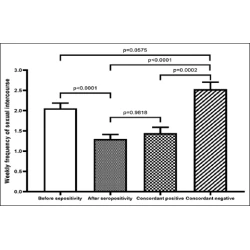
Results: A total of 53/192 (27.6%) HIV serodiscordant couples participated in the study, and 18/74 (24.32%) HIV positive seroconcordant couples and 32/80 HIV negative seroconcordant couples were used as controls. The majority of HIV-positive partners in serodiscordant couples were women (30/53), of whom 25/30 were on antiretroviral therapy. Nearly half of the respondents (23 /53) reported tensions related to serodiscordance, shown by reduced sex frequency. The use of condoms was not systematically observed among seroconcordant and serodiscordant couples with respective proportions of 55.55% and 20.75% (p = 0.0086). Thirty seven out of 53 HIV serodiscordant couples wanted children, among them, seven couples did not have any and expressed their aspiration for parenthood despite fear of infecting one’s partner.
Conclusion and Global Health Implications: Sexuality of serodiscordant couples as well as of HIV positive seroconcordant couples was affected by the presence of HIV/AIDS. The desire to procreate may lead couples to adopt risky sexual behaviors. It is important to define specific guidelines for serodiscordant couples in order to improve their sexual life and consequently enable them to procreate with minimal risk of infecting their partner and or to transmit the virus to their baby.
Downloads
Most read articles by the same author(s)
- Céline N. Nkenfou, Marie-Nicole Ngoufack, Georges Nguefack-Tsague, Barbara T. Atogho, Constantin Tchakounte, Brian T. Bongwong, Carine N. Nguefeu-Tchinda, Elise Elong, Laeticia H. Yatchou, Joel K. Kameni, Aline Tiga, Wilfred F. Mbacham, Alexis Ndjolo, Maternal Socio-Demographic Factors and Mother-to-Child Transmission of HIV in the North Region of Cameroon , International Journal of Maternal and Child Health and AIDS: Vol. 12 No. 1 (2023): International Journal of Maternal and Child Health and AIDS
Similar Articles
- Issaka Saouadogo, Douglas Mbang Massom, Soutongnoma Safiata Kabore, Ronny Kevin Fomete Djatsa, Josiane Seu, Patrice Ngangue, Perceived Benefits and Disadvantages Associated with the Use of the Electronic Consultation Register by Health Providers in the Health District of Toma, Burkina Faso , Vol. 13 No. Continuous (2024): International Journal of Maternal and Child Health and AIDS
- Gopal K. Singh, Hyunjung Lee, Lyoung Hee Kim, Shanita D. Williams, Social Determinants of Health Among American Indians and Alaska Natives and Tribal Communities: Comparison with Other Major Racial and Ethnic Groups in the United States, 1990–2022 , Vol. 13 No. Continuous (2024): International Journal of Maternal and Child Health and AIDS
- Neza Guillaine, Wilberforce Mwizerwa, Jackline Odhiambo, Bethany L. Hedt-Gauthier, Lisa R. Hirschhorn, Placidie Mugwaneza, Jean Paul Umugisha, Felix Rwabukwisi Cyamatare, Christine Mutaganzwa, Neil Gupta, A Novel Combined Mother-Infant Clinic to Optimize Post-Partum Maternal Retention, Service Utilization, and Linkage to Services in HIV Care in Rural Rwanda , Vol. 6 No. 1 (2017): International Journal of Maternal and Child Health and AIDS
- Gopal K. Singh, Jihong Liu, Health Improvements Have Been More Rapid and Widespread in China than in India: A Comparative Analysis of Health and Socioeconomic Trends from 1960 to 2011 , Vol. 1 No. 1 (2012): International Journal of Maternal and Child Health and AIDS
- Aridoss Santhakumar, Malathi Mathiyazhakan, Nagaraj Jaganathasamy, Balsubramanian Ganesh, N Manikandan, VM Padmapriya, Angel Monika, Joseph K David, Arvind Kumar, Elangovan Arumugam, Prevalence and Risk Factors Associated with HIV Infection among Pregnant Women in Odisha State, India , Vol. 9 No. 3 (2020): International Journal of Maternal and Child Health and AIDS
- Fulufhedzani C. Malindi, Maria S. Maputle, Involvement of Male Partners in Sustaining Interventions for Preventing Mother-to-Child Transmission of HIV Among Women with HIV , Vol. 13 No. Continuous (2024): International Journal of Maternal and Child Health and AIDS
- Agnes Napyo, James K Tumwine, David Mukunya, Josephine Tumuhamye, Anna Agnes Ojok Arach, Grace Ndeezi, Paul Waako, Thorkild Tylleskär, Detectable HIV-RNA Viral Load Among HIV-Infected Pregnant Women on Treatment in Northern Uganda , Vol. 9 No. 2 (2020): International Journal of Maternal and Child Health and AIDS
- Ohemaa B. Poku, Timothy D. Becker, Shathani Rampa, Supriya Misra, Ari R. Ho-Foster, Patlo Entaile, Charisse Tay, Karen Choe, Tonya Arscott-Mills, Michael B. Blank, Philip Renison Opondo, Lawrence H. Yang, Theory-Driven, Multi-Stage Process to Develop a Culturally-Informed Anti-Stigma Intervention for Pregnant Women Living with HIV in Botswana , Vol. 11 No. 2 (2022): International Journal of Maternal and Child Health and AIDS
- Anays Murillo, Mary Bachman DeSilva, Lora L. Sabin, Nafisa Halim, Harriet Chemusto, Philip Aroda, Julia Gasuza, Davidson H. Hamer, Anna Larson Williams, Barbara Mukasa, Lisa J. Messersmith, Rachael Bonawitz, Impact of a Maternal Prevention of Mother-to-child Transmission of HIV (PMTCT) Intervention on HIV-exposed Infants in Uganda , Vol. 9 No. 3 (2020): International Journal of Maternal and Child Health and AIDS
- Jaleah D. Rutledge, Alexis Kiyanda, Christina Jean-Louis, Elizabeth Raskin, Joanne Gaillard, Morgan Maxwell, Tynetta Smith, Trace Kershaw, Jasmine Abrams, Recommendations for Integrating Traditional Birth Attendants to Improve Maternal Health Outcomes in Low- and Middle-Income Countries , Vol. 13 No. Continuous (2024): International Journal of Maternal and Child Health and AIDS
<< < 3 4 5 6 7 8 9 10 11 12 > >>
You may also start an advanced similarity search for this article.
Published
How to Cite
Issue
Section
License
Copyright © 2020 Constantin Tchakounté, Céline N. Nkenfou, Thibau F. Tchouangueu, Nicole M. Ngoufack, Salomon B. Tchuandom, Olivier D. Ngono, Jules-Rogers Kuiate, Alexis Ndjolo. Published by Global Health and Education Projects, Inc., USA.

This is an open-access article distributed under the terms of the Creative Commons Attribution-NonCommercial-ShareAlike 4.0 International License , which permits others to remix, transform, and build upon the work non-commercially, provided the original author is credited and the new creations are licensed under the same terms.