
HIV Serodiscordance among Couples in Cameroon: Effects on Sexual and Reproductive Health
DOI:
https://doi.org/10.21106/ijma.370Keywords:
- HIV,
- Serodiscordance,
- Sexual health,
- Childbearing,
- Cameroon,
- Reproductive health
Abstract
Background and Objectives: One of the main reasons for risky sexual behavior observed in HIV serodiscordant couples despite the knowledge of the partner’s status and counselling is childbearing. In Cameroon, there are few reports on HIV serodiscordant couples. This paper describes the influence of HIV on sexual relationships and decision to procreate.
Methods: This cross-sectional study was conducted in five health centers. Self-administered questionnaire was used to collect social and demographic information, while semi-structured in-depth individual and couple interviews were used to explore sexual relationships and decisions about fatherhood/motherhood. Blood samples were collected from the couples and tested for HIV to confirm serodiscordance. The data were analyzed using the GraphPad Prism Version 6 software.
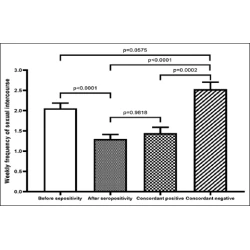
Results: A total of 53/192 (27.6%) HIV serodiscordant couples participated in the study, and 18/74 (24.32%) HIV positive seroconcordant couples and 32/80 HIV negative seroconcordant couples were used as controls. The majority of HIV-positive partners in serodiscordant couples were women (30/53), of whom 25/30 were on antiretroviral therapy. Nearly half of the respondents (23 /53) reported tensions related to serodiscordance, shown by reduced sex frequency. The use of condoms was not systematically observed among seroconcordant and serodiscordant couples with respective proportions of 55.55% and 20.75% (p = 0.0086). Thirty seven out of 53 HIV serodiscordant couples wanted children, among them, seven couples did not have any and expressed their aspiration for parenthood despite fear of infecting one’s partner.
Conclusion and Global Health Implications: Sexuality of serodiscordant couples as well as of HIV positive seroconcordant couples was affected by the presence of HIV/AIDS. The desire to procreate may lead couples to adopt risky sexual behaviors. It is important to define specific guidelines for serodiscordant couples in order to improve their sexual life and consequently enable them to procreate with minimal risk of infecting their partner and or to transmit the virus to their baby.
Downloads
Most read articles by the same author(s)
- Céline N. Nkenfou, Marie-Nicole Ngoufack, Georges Nguefack-Tsague, Barbara T. Atogho, Constantin Tchakounte, Brian T. Bongwong, Carine N. Nguefeu-Tchinda, Elise Elong, Laeticia H. Yatchou, Joel K. Kameni, Aline Tiga, Wilfred F. Mbacham, Alexis Ndjolo, Maternal Socio-Demographic Factors and Mother-to-Child Transmission of HIV in the North Region of Cameroon , International Journal of Maternal and Child Health and AIDS: Vol. 12 No. 1 (2023): International Journal of Maternal and Child Health and AIDS
Similar Articles
- John Humphrey, Esther Wanjama, James G. Carlucci, Violet Naanyu, Lindah Muli, Edwin Were, Alan McGuire, Winstone M. Nyandiko, Julia Songok, Gregory Zimet, Kara Wools-Kaloustian, Understanding Women’s Preferences for Prevention of Mother-to-Child HIV Transmission Services in Kenya , Vol. 13 No. Continuous (2024): International Journal of Maternal and Child Health and AIDS
- Bartholomew Boniface Ochonye, Paul Umoh, Olaniyi Felix Sanni, Abiye Kalaiwo, Roger Abang, Agboola Oguntonade, Paul Amechi, Godwin Emmanuel, Pre-Exposure Prophylaxis and HIV Prevention Among Key Populations in Nigeria , Vol. 13 No. Continuous (2024): International Journal of Maternal and Child Health and AIDS
- Zubairu Iliyasux, Amina A. Umar, Fatima S. Gaya, Nafisa S. Nass, Hadiza M. Abdullahi, Aminatu A. Kwaku, Taiwo G. Amole, Fatimah I. Tsiga-Ahmed, Hadiza S. Galadanci, Hamisu M. Salihu, Muktar H. Aliyu, ‘We delivered at home out of fear’: Maternity Care in Rural Nigeria During the COVID-19 Pandemic , Vol. 12 No. 1 (2023): International Journal of Maternal and Child Health and AIDS
- Sanni Yaya, Gebretsadik Shibre, Dina Idriss-Wheeler, Olalekan A Uthman, Women’s Empowerment and HIV Testing Uptake: A Meta-analysis of Demographic and Health Surveys from 33 Sub-Saharan African Countries , Vol. 9 No. 3 (2020): International Journal of Maternal and Child Health and AIDS
- Alexander Suuk Laar, Veioshnee Govender, Individual and Community Perspectives, Attitudes, and Practices to Mother-to-Child-Transmission and Infant Feeding among HIV-Positive Mothers in Sub-Saharan Africa: A Systematic Literature Review , Vol. 2 No. 1 (2013): International Journal of Maternal and Child Health and AIDS
- Elizabeth Armstrong, Priya Srinivasan, Dawood Azeemy, Fayja Habib, Ernest Alema-Mensah, COVID-19 Stressors and Maternal Mental Health in Georgia, United States: Sources, Effects, and Recommendations , Vol. 14 No. Continuous (2025): International Journal of Maternal and Child Health and AIDS
- Charles Kouanfack, Hermine Meli, Samuel N. Cumber, Fala Bede, Claude N. Nkfusai, Patience Y. Ijang, Emerson Wepngong, Olga Yvonne M. Bassong, Benjamin-Alexandre Nkoum, Non-Occupational HIV Post-exposure Prophylaxis: A 10-Year Retrospective Review of Data Following Sexual Exposure From Yaounde Central Hospital, Cameroon , Vol. 8 No. 2 (2019): International Journal of Maternal and Child Health and AIDS
- Khadija Kofoworola Adeleye, Margaret Omowaleola Akinwaare, Prisca Olabisi Adejumo, Reproductive Plans And Utilization of Contraceptives Among Women Living With HIV , Vol. 8 No. 2 (2019): International Journal of Maternal and Child Health and AIDS
- San Hone, Li Li, W. Scott Comulada, Roger Detels, Progress and Challenges of Implementing Decentralized HIV Testing For Prevention of Mother-to-Child Transmission of HIV – Myanmar , Vol. 8 No. 1 (2019): International Journal of Maternal and Child Health and AIDS
- Oluwasola Stephen Ayosanmi, Lorette Oden, Titilope Ayosanmi, Babatunde Y. Alli, Mei Wen Wen, Jamie Johnson, Acceptability of HIV Screening in a Sample of International Students in the United States , Vol. 9 No. 3 (2020): International Journal of Maternal and Child Health and AIDS
<< < 1 2 3 4 5 6 7 8 9 10 > >>
You may also start an advanced similarity search for this article.
Published
How to Cite
Issue
Section
License
Copyright © 2020 Constantin Tchakounté, Céline N. Nkenfou, Thibau F. Tchouangueu, Nicole M. Ngoufack, Salomon B. Tchuandom, Olivier D. Ngono, Jules-Rogers Kuiate, Alexis Ndjolo. Published by Global Health and Education Projects, Inc., USA.

This is an open-access article distributed under the terms of the Creative Commons Attribution-NonCommercial-ShareAlike 4.0 International License , which permits others to remix, transform, and build upon the work non-commercially, provided the original author is credited and the new creations are licensed under the same terms.