
Improving HIV Prevention for Key Populations in Nigeria: Insights on Access, Barriers, Stigma, and Service Utilization
DOI:
https://doi.org/10.25259/IJMA_49_2024Keywords:
- Health Services Accessibility,
- HIV Seroprevalence,
- Key Populations,
- Population Groups,
- Willingness to Access HIV Services
Abstract
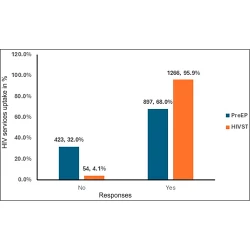
Background and Objective: Human immunodeficiency virus and acquired immunodeficiency syndrome (HIV/AIDS) remains a significant public health challenge globally, with key populations (KPs) such as female sex workers (FSWs), men who have sex with men (MSM), and people who inject drugs (PWIDs) being disproportionately affected. Despite the availability of various HIV prevention services, including pre-exposure prophylaxis (PrEP) and community-based antiretroviral therapy (ART), the willingness of KPs to access these services remains a critical concern. This study aims to assess the prevalence of HIV and the willingness to access HIV preventive services among KPs in three selected local government areas (LGAs) in Nigeria. Methods: A cross-sectional study was conducted in 2023 across three LGAs, Gwale, Fagge, and Tarauni, in Kano State, Nigeria, using a snowball sampling technique. A total of 1,320 participants, recruited from brothels and nightclubs, were tested for HIV using self-test kits. Willingness to access HIV services was assessed using a structured questionnaire. Data were analyzed using descriptive statistics and binary logistic regression. Results: The overall HIV prevalence among KPs was 10.8%. MSM and PWIDs exhibited higher HIV prevalence rates compared to FSWs. Willingness to access HIV preventive services was recorded at 57.7%, with significant influences from geographical location and sexual practices. Participants from Tarauni were more willing to access services, and those engaging in vaginal sex were more likely to seek preventive services. HIV self-testing had a high uptake of 95.9%, while PrEP uptake was 68.0%. Major barriers included stigma, lack of comprehensive services, and limited knowledge of service providers. Conclusion and Global Health Implications: This study highlights the critical need for targeted interventions addressing the specific barriers faced by KPs in these regions. Enhancing service accessibility and addressing stigma is essential for reducing HIV transmission and achieving epidemic control in Nigeria by 2030.
Downloads
Most read articles by the same author(s)
- Bartholomew Boniface Ochonye, Paul Umoh, Olaniyi Felix Sanni, Abiye Kalaiwo, Roger Abang, Agboola Oguntonade, Paul Amechi, Godwin Emmanuel, Pre-Exposure Prophylaxis and HIV Prevention Among Key Populations in Nigeria , International Journal of Maternal and Child Health and AIDS: Vol. 13 No. Continuous (2024): International Journal of Maternal and Child Health and AIDS
- Chidimma Ezenwa Anyanwu, Kwasi Torpey, Olaiya Paul Abiodun, Olaniyi Felix Sanni, Ifeanyi Donald Anyanwu, Variations in the Prevalence of Female Genital Mutilation Among Reproductive-aged Women in Nigeria Across Three Generations , International Journal of Maternal and Child Health and AIDS: Vol. 11 No. 2 (2022): International Journal of Maternal and Child Health and AIDS
Similar Articles
- Gopal K. Singh, Gem P. Daus, Michelle Allender, Christine T. Ramey, Elijah K. Martin, Chrisp Perry, Andrew A. De Los Reyes, Ivy P. Vedamuthu, Social Determinants of Health in the United States: Addressing Major Health Inequality Trends for the Nation, 1935-2016 , Vol. 6 No. 2 (2017): International Journal of Maternal and Child Health and AIDS
- Charles Ikeanyionwu, Deepa Dongarwar, Zenab Yusuf, Rafeek Yusuf, Meishon Bell, Toi Harris, Hamisu M. Salihu, 2019 Health Equity Summer Research Summit Organized by the Center of Excellence in Health Equity, Training and Research, Baylor College of Medicine, Houston, Texas 77030, USA on June 18th, 2019 , Vol. 9 No. S1 (2020): International Journal of Maternal and Child Health and AIDS
- Sorochi H. Iloanusi, Osaro O. Mgbere, Susan. M. Abughosh, Ekere J. Essien, HIV Non-Occupational Post Exposure Prophylaxis in Nigeria: A Systematic Review of Research Evidence and Practice , Vol. 8 No. 2 (2019): International Journal of Maternal and Child Health and AIDS
- Faith Iretioluwa Olaniyi, Ayodele Ebenezer Owolabi, Gideon Temitope Olowe, Ololade Daniella Olunloyo, Eric Anuoluwapo Ogunleye, Ifeoluwapo Oluwafunke Kolawole, Perception, Pattern of Use, and Determinants of Family Planning Uptake Among Women of Childbearing Age in Ibadan, South West Nigeria , Vol. 15 (2026): International Journal of Maternal and Child Health and AIDS
- John Humphrey, Esther Wanjama, James G. Carlucci, Violet Naanyu, Lindah Muli, Edwin Were, Alan McGuire, Winstone M. Nyandiko, Julia Songok, Gregory Zimet, Kara Wools-Kaloustian, Understanding Women’s Preferences for Prevention of Mother-to-Child HIV Transmission Services in Kenya , Vol. 13 No. Continuous (2024): International Journal of Maternal and Child Health and AIDS
- Innocent Anayochukwu Ugwu, Calistus Obiora Nevo, Malachy Nwaeze Ezenwaeze, Antenatal Care Utilization and Delivery Location: Evidence from Postpartum Women in Enugu, South East Nigeria , Vol. 15 (2026): International Journal of Maternal and Child Health and AIDS
- Gopal K. Singh, Hyunjung Lee, Lyoung Hee Kim, Shanita D. Williams, Social Determinants of Health Among American Indians and Alaska Natives and Tribal Communities: Comparison with Other Major Racial and Ethnic Groups in the United States, 1990–2022 , Vol. 13 No. Continuous (2024): International Journal of Maternal and Child Health and AIDS
- Agnes Langat, Tegan L. Callahan, Isabella Yonga, Boniface Ochanda, Anthony Waruru, Lucy W. Ng’anga, Abraham Katana, Brian Onyango, Benson Singa, Stephen Oyule, George Githuka, Lennah Omoto, Jane Muli, Thorkild Tylleskar, Surbhi Modi, Associations of Sociodemographic and Clinical Factors with Late Presentation for Early Infant HIV Diagnosis (EID) Services in Kenya , Vol. 10 No. 2 (2021): International Journal of Maternal and Child Health and AIDS
- Zubairu Iliyasux, Amina A. Umar, Fatima S. Gaya, Nafisa S. Nass, Hadiza M. Abdullahi, Aminatu A. Kwaku, Taiwo G. Amole, Fatimah I. Tsiga-Ahmed, Hadiza S. Galadanci, Hamisu M. Salihu, Muktar H. Aliyu, ‘We delivered at home out of fear’: Maternity Care in Rural Nigeria During the COVID-19 Pandemic , Vol. 12 No. 1 (2023): International Journal of Maternal and Child Health and AIDS
- Ernest Tambo, Chidiebere E. Ugwu, Yayi Guan, Ding Wei, Xiao-Ning, Zhou Xiao-Nong, China-Africa Health Development Initiatives: Benefits and Implications for Shaping Innovative and Evidence-informed National Health Policies and Programs in Sub-saharan African Countries , Vol. 5 No. 2 (2016): International Journal of Maternal and Child Health and AIDS
<< < 1 2 3 4 5 6 7 8 9 10 > >>
You may also start an advanced similarity search for this article.
Published
How to Cite
Issue
Section
License
Copyright © 2025 Godwin Omokhagbo Emmanuel, Olaniyi Felix Sanni, Abang Roger, Paul Umoh, Ochonye Bartholomew Boniface, Amechi Paul, Ismaeel Mohammed Yahaya, Agie Muhmmad Auwal. Published by Global Health and Education Projects, Inc., USA.

This is an open-access article distributed under the terms of the Creative Commons Attribution-NonCommercial-ShareAlike 4.0 International License , which permits others to remix, transform, and build upon the work non-commercially, provided the original author is credited and the new creations are licensed under the same terms.