
Increasing Area Deprivation and Socioeconomic Inequalities in Heart Disease, Stroke, and Cardiovascular Disease Mortality Among Working Age Populations, United States, 1969-2011
DOI:
https://doi.org/10.21106/ijma.45Keywords:
- CVD mortality,
- Heart,
- Disease,
- Stroke,
- Deprivation,
- SES,
- Work,
- force
Abstract
We examined the extent to which area- and individual-level socioeconomic inequalities in cardiovascular-disease (CVD), heart disease, and stroke mortality among United States men and women aged 25-64 years changed between 1969 and 2011.
Methods:National vital statistics data and the National Longitudinal Mortality Study were used to estimate area- and individual-level socioeconomic gradients in mortality over time. Rate ratios and log-linear and Cox regression were used to model mortality trends and differentials.
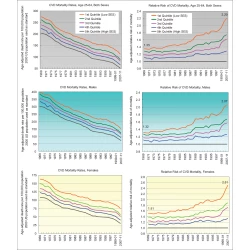
Results:Area socioeconomic gradients in mortality from CVD, heart disease, and stroke increased substantially during the study period. Compared to those in the most affluent group, individuals in the most deprived area group had, respectively 35%, 29%, and 73% higher CVD, heart disease, and stroke mortality in 1969, but 120-121% higher mortality in 2007-2011. Gradients were steeper for women than for men. Education, income, and occupation were inversely associated with CVD, heart disease, and stroke mortality, with individual-level socioeconomic gradients being steeper during 1990-2002 than in 1979-1989. Individuals with low education and incomes had 2.7 to 3.7 times higher CVD, heart disease, and stroke mortality risks than their counterparts with high education and income levels.
Conclusions and Global Health Implications:Although mortality declined for all US groups during 1969-2011, socioeconomic disparities in mortality from CVD, heart disease and stroke remained marked and increased over time because of faster declines in mortality among higher socioeconomic groups. Widening disparities in mortality may reflect increasing temporal areal inequalities in living conditions, behavioral risk factors such as smoking, obesity and physical inactivity, and access to and use of health services. With social inequalities and prevalence of smoking, obesity, and physical inactivity on the rise, most segments of the working-age population in low- and middle-income countries will likely experience increased cardiovascular- disease burden in terms of higher morbidity and mortality rates.
Downloads
Most read articles by the same author(s)
- Amina A. Umar, Hamisu M. Salihu, Romuladus E. Azuine, Crisis of Brain Drain in Nigeria’s Health Sector: Challenges, Opportunities, and the Path Forward , International Journal of Maternal and Child Health and AIDS: Vol. 14 No. Continuous (2025): International Journal of Maternal and Child Health and AIDS
- Gopal K. Singh, Hyunjung Lee, Lyoung Hee Kim, Shanita D. Williams, Social Determinants of Health Among American Indians and Alaska Natives and Tribal Communities: Comparison with Other Major Racial and Ethnic Groups in the United States, 1990–2022 , International Journal of Maternal and Child Health and AIDS: Vol. 13 No. Continuous (2024): International Journal of Maternal and Child Health and AIDS
- Gopal K. Singh, Stella M. Yu, Infant Mortality in the United States, 1915-2017: Large Social Inequalities have Persisted for Over a Century , International Journal of Maternal and Child Health and AIDS: Vol. 8 No. 1 (2019): International Journal of Maternal and Child Health and AIDS
- Hamisu M. Salih, Deepa Dongarwar, Muktar H. Aliyu, Romuladus E. Azuine, Global Ranking of COVID-19-Related Mortality by Country using a Novel Pandemic Efficiency Index (PEI) , International Journal of Maternal and Child Health and AIDS: Vol. 9 No. 2 (2020): International Journal of Maternal and Child Health and AIDS
- Gopal K. Singh, Romuladus E. Azuine, Mohammad Siahpush, Global Inequalities in Cervical Cancer Incidence and Mortality are Linked to Deprivation, Low Socioeconomic Status, and Human Development , International Journal of Maternal and Child Health and AIDS: Vol. 1 No. 1 (2012): International Journal of Maternal and Child Health and AIDS
- Gopal K. Singh, Isaac E. Kim, Mehrete Girmay, Chrisp Perry, Gem P. Daus, Ivy P. Vedamuthu, Andrew A. De Los Reyes, Christine T. Ramey, Elijah K. Martin, Michelle Allender, Opioid Epidemic in the United States: Empirical Trends, and A Literature Review of Social Determinants and Epidemiological, Pain Management, and Treatment Patterns , International Journal of Maternal and Child Health and AIDS: Vol. 8 No. 2 (2019): International Journal of Maternal and Child Health and AIDS
- Raees A. Shaikh, Mohammad Siahpush, Gopal K. Singh, Melissa Tibbits, Socioeconomic Status, Smoking, Alcohol use, Physical Activity, and Dietary Behavior as Determinants of Obesity and Body Mass Index in the United States: Findings from the National Health Interview Survey , International Journal of Maternal and Child Health and AIDS: Vol. 4 No. 1 (2015): International Journal of Maternal and Child Health and AIDS
- Gopal K. Singh, Mohammad Siahpush, Romuladus E. Azuine, Shanita D. Williams, Widening Socioeconomic and Racial Disparities in Cardiovascular Disease Mortality in the United States, 1969-2013 , International Journal of Maternal and Child Health and AIDS: Vol. 3 No. 2 (2015): International Journal of Maternal and Child Health and AIDS
- Gopal K. Singh, Romuladus E. Azuine, Mohammad Siahpush, Shanita D. Williams, Widening Geographical Disparities in Cardiovascular Disease Mortality in the United States, 1969-2011 , International Journal of Maternal and Child Health and AIDS: Vol. 3 No. 2 (2015): International Journal of Maternal and Child Health and AIDS
Similar Articles
- Romuladus E. Azuine, Gopal K. Singh, Addressing Global Health, Development, and Social Inequalities through Research and Policy Analyses: The International Journal of MCH and AIDS , Vol. 1 No. 1 (2012): International Journal of Maternal and Child Health and AIDS
- Chelsea E Modlin, Helga Naburi, Kristy M Hendricks, Goodluck Lyatuu, Josphine Kimaro, Lisa V Adams, Paul E Palumbo, C. Fordham von Reyn, Nutritional Deficiencies and Food Insecurity Among HIV-infected Children in Tanzania , Vol. 2 No. 2 (2014): International Journal of Maternal and Child Health and AIDS
- Ikenna J. Nwakamma, Amber Erinmwinhe, Arinzechukwu Ajogwu, Aniekan Udoh, Anne Ada-Ogoh, Mitigating Gender and Maternal and Child Health Injustices through Faith Community-Led Initiatives , Vol. 8 No. 2 (2019): International Journal of Maternal and Child Health and AIDS
- Aradhana Singh, Vibha Rani Pipal, Raj Kishore Singh, Preeti Bala Singh, Nidhi Singh, Anupama Singh, Incidence and Predictors of Uterine Rupture with Maternal and Perinatal Outcome: A Cross-sectional Study , Vol. 14 No. Continuous (2025): International Journal of Maternal and Child Health and AIDS
- Veronica B. Ajewole, Ahone E. Ngujede, Emmanuella Oduguwa, Deepa Dongarwar, Manvir Kaur, Cecelia Knight, Maresha Jackson, Uyen Nguyen, Tasha Roshan, Jordan Simpson, Igor Vouffo, Omonike A. Olaleye, Hamisu M. Salihu, A Surveillance System for the Maternal and Child Health (MCH) Population During the COVID-19 Pandemic , Vol. 9 No. 3 (2020): International Journal of Maternal and Child Health and AIDS
- Veronicah A. Wechuli, Monicah W. Karara, Allan T. Wafula, Godfrey W. Mayoka, Impact of COVID-19 on the Utilization of Maternal and Child Health Services at a Regional Referral Hospital in Kenya , Vol. 13 No. Continuous (2024): International Journal of Maternal and Child Health and AIDS
- Deepa Dongarwar, Hamisu M. Salihu, COVID-19 Pandemic: Marked Global Disparities in Fatalities According to Geographic Location and Universal Health Care , Vol. 9 No. 2 (2020): International Journal of Maternal and Child Health and AIDS
- Nidhi Fotedar, Nugehally Raju Ramesh Masthi, Burden of Fetal Anomalies among Antenatal Mothers Attending a Public Referral Hospital: A Mixed Cohort Study , Vol. 14 No. Continuous (2025): International Journal of Maternal and Child Health and AIDS
- Agnes Langat, Tegan L. Callahan, Isabella Yonga, Boniface Ochanda, Anthony Waruru, Lucy W. Ng’anga, Abraham Katana, Brian Onyango, Benson Singa, Stephen Oyule, George Githuka, Lennah Omoto, Jane Muli, Thorkild Tylleskar, Surbhi Modi, Associations of Sociodemographic and Clinical Factors with Late Presentation for Early Infant HIV Diagnosis (EID) Services in Kenya , Vol. 10 No. 2 (2021): International Journal of Maternal and Child Health and AIDS
- Anastasia Y. Bongajum, Pascal Foumane, Charlotte O. Moussi, Noel Vogue, Hycinth S. Banseka, Jujlius M. Nwobegahay, Martina L. Baye, Strengthening Maternal Death Surveillance Systems for Evidence-Based Decision Making in Sub-Saharan Africa: The Case of the Center Region in Cameroon , Vol. 10 No. 2 (2021): International Journal of Maternal and Child Health and AIDS
<< < 4 5 6 7 8 9 10 11 12 13 > >>
You may also start an advanced similarity search for this article.
Published
How to Cite
Issue
Section
License
Copyright © 2015 Gopal K. Singh, Mohammad Siahpush, Romuladus E. Azuine, Shanita D. Williams. Published by Global Health and Education Projects, Inc., USA.

This is an open-access article distributed under the terms of the Creative Commons Attribution-NonCommercial-ShareAlike 4.0 International License , which permits others to remix, transform, and build upon the work non-commercially, provided the original author is credited and the new creations are licensed under the same terms.