
Widening Geographical Disparities in Cardiovascular Disease Mortality in the United States, 1969-2011
DOI:
https://doi.org/10.21106/ijma.46Keywords:
- CVD mortality,
- Geography,
- Deprivation,
- SES,
- Inequality,
- Trend,
- Longitudinal
Abstract
This study examined trends in geographical disparities in cardiovascular-disease (CVD) mortality in the United States between 1969 and 2011.
Methods:National vital statistics data and the National Longitudinal Mortality Study were used to estimate regional, state, and county-level disparities in CVD mortality over time. Log-linear, weighted least squares, and Cox regression were used to analyze mortality trends and differentials.
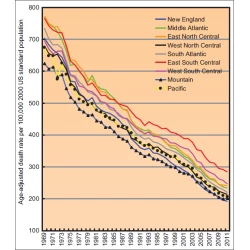
Results:During 1969-2011, CVD mortality rates declined fastest in New England and Mid-Atlantic regions and slowest in the Southeast and Southwestern regions. In 1969, the mortality rate was 9% higher in the Southeast than in New England, but the differential increased to 48% in 2011. In 2011, Southeastern states, Mississippi and Alabama, had the highest CVD mortality rates, nearly twice the rates for Minnesota and Hawaii. Controlling for individual-level covariates reduced state differentials. State- and county-level differentials in CVD mortality rates widened over time as geographical disparity in CVD mortality increased by 50% between 1969 and 2011. Area deprivation, smoking, obesity, physical inactivity, diabetes prevalence, urbanization, lack of health insurance, and lower access to primary medical care were all significant predictors of county-level CVD mortality rates and accounted for 52.7% of the county variance.
Conclusions and Global Health Implications:Although CVD mortality has declined for all geographical areas in the United States, geographical disparity has widened over time as certain regions and states, particularly those in the South, have lagged behind in mortality reduction. Geographical disparities in CVD mortality reflect inequalities in socioeconomic conditions and behavioral risk factors. With the global CVD burden on the rise, monitoring geographical disparities, particularly in low- and middle-income countries, could indicate the extent to which reductions in CVD mortality are achievable and may help identify effective policy strategies for CVD prevention and control.
Downloads
Most read articles by the same author(s)
- Amina A. Umar, Hamisu M. Salihu, Romuladus E. Azuine, Crisis of Brain Drain in Nigeria’s Health Sector: Challenges, Opportunities, and the Path Forward , International Journal of Maternal and Child Health and AIDS: Vol. 14 No. Continuous (2025): International Journal of Maternal and Child Health and AIDS
- Gopal K. Singh, Hyunjung Lee, Lyoung Hee Kim, Shanita D. Williams, Social Determinants of Health Among American Indians and Alaska Natives and Tribal Communities: Comparison with Other Major Racial and Ethnic Groups in the United States, 1990–2022 , International Journal of Maternal and Child Health and AIDS: Vol. 13 No. Continuous (2024): International Journal of Maternal and Child Health and AIDS
- Gopal K. Singh, Stella M. Yu, Infant Mortality in the United States, 1915-2017: Large Social Inequalities have Persisted for Over a Century , International Journal of Maternal and Child Health and AIDS: Vol. 8 No. 1 (2019): International Journal of Maternal and Child Health and AIDS
- Hamisu M. Salih, Deepa Dongarwar, Muktar H. Aliyu, Romuladus E. Azuine, Global Ranking of COVID-19-Related Mortality by Country using a Novel Pandemic Efficiency Index (PEI) , International Journal of Maternal and Child Health and AIDS: Vol. 9 No. 2 (2020): International Journal of Maternal and Child Health and AIDS
- Gopal K. Singh, Romuladus E. Azuine, Mohammad Siahpush, Global Inequalities in Cervical Cancer Incidence and Mortality are Linked to Deprivation, Low Socioeconomic Status, and Human Development , International Journal of Maternal and Child Health and AIDS: Vol. 1 No. 1 (2012): International Journal of Maternal and Child Health and AIDS
- Gopal K. Singh, Isaac E. Kim, Mehrete Girmay, Chrisp Perry, Gem P. Daus, Ivy P. Vedamuthu, Andrew A. De Los Reyes, Christine T. Ramey, Elijah K. Martin, Michelle Allender, Opioid Epidemic in the United States: Empirical Trends, and A Literature Review of Social Determinants and Epidemiological, Pain Management, and Treatment Patterns , International Journal of Maternal and Child Health and AIDS: Vol. 8 No. 2 (2019): International Journal of Maternal and Child Health and AIDS
- Raees A. Shaikh, Mohammad Siahpush, Gopal K. Singh, Melissa Tibbits, Socioeconomic Status, Smoking, Alcohol use, Physical Activity, and Dietary Behavior as Determinants of Obesity and Body Mass Index in the United States: Findings from the National Health Interview Survey , International Journal of Maternal and Child Health and AIDS: Vol. 4 No. 1 (2015): International Journal of Maternal and Child Health and AIDS
- Gopal K. Singh, Mohammad Siahpush, Romuladus E. Azuine, Shanita D. Williams, Increasing Area Deprivation and Socioeconomic Inequalities in Heart Disease, Stroke, and Cardiovascular Disease Mortality Among Working Age Populations, United States, 1969-2011 , International Journal of Maternal and Child Health and AIDS: Vol. 3 No. 2 (2015): International Journal of Maternal and Child Health and AIDS
- Gopal K. Singh, Mohammad Siahpush, Romuladus E. Azuine, Shanita D. Williams, Widening Socioeconomic and Racial Disparities in Cardiovascular Disease Mortality in the United States, 1969-2013 , International Journal of Maternal and Child Health and AIDS: Vol. 3 No. 2 (2015): International Journal of Maternal and Child Health and AIDS
Similar Articles
- Elizabeth Armstrong-Mensah, David-Praise Ebiringa, Kaleb Whitfield, Jake Coldiron, Genital Chlamydia Trachomatis Infection: Prevalence, Risk Factors and Adverse Pregnancy and Birth Outcomes in Children and Women in sub-Saharan Africa , Vol. 10 No. 2 (2021): International Journal of Maternal and Child Health and AIDS
- Sanni Yaya, Gebretsadik Shibre, Dina Idriss-Wheeler, Olalekan A Uthman, Women’s Empowerment and HIV Testing Uptake: A Meta-analysis of Demographic and Health Surveys from 33 Sub-Saharan African Countries , Vol. 9 No. 3 (2020): International Journal of Maternal and Child Health and AIDS
- Munyaradzi Muchacha, Edmos Mtetwa, Social and Economic Barriers to Exclusive Breast Feeding In Rural Zimbabwe , Vol. 3 No. 1 (2015): International Journal of Maternal and Child Health and AIDS
- Emmanuel Numfor, Nkengafac Nyiawung Fobellah, Joel Noutakdie Tochie, Tsi Njim, Sylvester Atanga Ndesso, Oxytocin Versus Misoprostol Plus Oxytocin in the Prevention of Postpartum Hemorrhage at a Semi-Urban Hospital in sub-Saharan Africa: A Retrospective Cohort Study , Vol. 9 No. 3 (2020): International Journal of Maternal and Child Health and AIDS
- Deepa Dongarwar, Veronica B. Ajewole, Emmanuella Oduguwa, Ahone Ngujede, Kiydra Harris, Theresa U. Ofili, Omonike A. Olaleye, Hamisu M. Salihu, Role of Social Determinants of Health in Widening Maternal and Child Health Disparities in the Era of Covid-19 Pandemic , Vol. 9 No. 3 (2020): International Journal of Maternal and Child Health and AIDS
- Gopal K. Singh, Hyunjung Lee, Romuladus E. Azuine, Marked Disparities in COVID-19 Vaccination among US Children and Adolescents by Racial/Ethnic, Socioeconomic, Geographic, and Health Characteristics, United States, December 2021 – April 2022 , Vol. 11 No. 2 (2022): International Journal of Maternal and Child Health and AIDS
- Natalie C Frayer, Yeonsoo Kim, Caffeine Intake During Pregnancy and Risk of Childhood Obesity: A Systematic Review , Vol. 9 No. 3 (2020): International Journal of Maternal and Child Health and AIDS
- Sybil S. Opoku Asiedu, Nana Abena Ansah Apatu, Rosemond Tetteh, Abraham Hodgson, Neonatal Cord Care Practices among Mothers and Caregivers in the Volta Region of Ghana , Vol. 8 No. 1 (2019): International Journal of Maternal and Child Health and AIDS
- Tsi N Njim, Late Pregnancy Outcomes among Women who Attended and Women who did not Attend First Trimester Antenatal Care Visits in a Suburban Regional Hospital in Cameroon , Vol. 5 No. 1 (2016): International Journal of Maternal and Child Health and AIDS
- Nathan Isabirye, Amara E. Ezeamama, Rachel Kyeyune-Bakyayita, Danstan Bagenda, Wafaie W. Fawzi, David Guwatudde, Dietary Micronutrients and Gender, Body Mass Index and Viral Suppression Among HIV-Infected Patients in Kampala, Uganda , Vol. 9 No. 3 (2020): International Journal of Maternal and Child Health and AIDS
<< < 6 7 8 9 10 11 12 13 14 15 > >>
You may also start an advanced similarity search for this article.
Published
How to Cite
Issue
Section
License
Copyright © 2015 Gopal K. Singh, Romuladus E. Azuine, Mohammad Siahpush, Shanita D. Williams. Published by Global Health and Education Projects, Inc., USA.

This is an open-access article distributed under the terms of the Creative Commons Attribution-NonCommercial-ShareAlike 4.0 International License , which permits others to remix, transform, and build upon the work non-commercially, provided the original author is credited and the new creations are licensed under the same terms.