
Women’s Empowerment and HIV Testing Uptake: A Meta-analysis of Demographic and Health Surveys from 33 Sub-Saharan African Countries
DOI:
https://doi.org/10.21106/ijma.372Keywords:
- HIV/AIDS prevention,
- Women,
- Empowerment,
- Gender equality,
- Global health,
- Sub-Saharan Africa
Abstract
Background: There is a growing body of evidence suggesting that women’s empowerment can help achieve better health behaviours and outcomes. However, few have looked at the impact of women’s empowerment on HIV testing in Sub-Saharan Africa (SSA). This study investigated the association between women’s empowerment and HIV testing among women in 33 countries across SSA.
Methods: Cross-sectional data from the most recent Demographic and Health Surveys (2005-2018) of 33 countries in SSA were used. Confounder adjusted logistic regression analysis was completed separately for each of the 33 DHS datasets to produce the adjusted Odds Ratio (OR) for the association between women empowerment and HIV testing. The regression analysis strictly accounted for the three design elements (weight, cluster and strata) to produce an estimate representative of the respective countries. Finally, an Individual Participant Data (IPD) meta-analysis approach was used to statistically pool the effect of women empowerment on HIV testing.
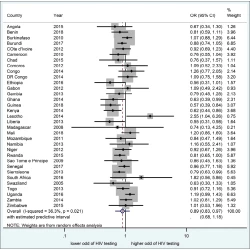
Results: There was a wide variation in the percentage of women who were empowered among the countries studied, with only a few countries such as South Africa, Angola and Ghana having a high prevalence of negative attitudes toward wife beating. HIV testing was higher in Angola, Lesotho, Uganda and South Africa. While participation in one or two of the three decisions had been marginally associated with lower odds of HIV testing across the SSA regions (0.89; 95%CI: 0.83, 0.97); the corresponding prediction interval crossed the null. Being involved in the three decisions (0.92; 95%CI: 0.84, 1.00) and disagreement to wife-beating (0.99; 95%CI: 0.94, 1.05) had no statistical relationship with HIV testing uptake.
Conclusion and Global Health Implications: The two indirect indicators of women empowerment could not predict HIV testing uptake. Further studies are recommended to establish the nature of the relationship between HIV testing and women’s empowerment that is measured through standard tools.
Downloads
Similar Articles
- Charles Chibuisi Ehiemere, Ishaku Adamu Akyala, Bisayo Adetuyi Ogundipe, Chukwuebuka Clement Nri-Ezedi, Peter Joseph Anzaku, Waryit Esther Yonah, Efe Mary Imokhai, Isaac Onyebuchi Okohu, Idowu Olapemi Makinde, Ngozi Miriam Chimzobam-Nnalue, Beyond Access: Behavior Change and Gendered Realities in the Adoption of Digital Health Tools for Maternal, Newborn, and Child Health in Nigeria , Vol. 15 (2026): International Journal of Maternal and Child Health and AIDS
- Wah Wah Myint, Human Immunodeficiency Virus (HIV) Knowledge and Stigma: Findings from a Cross-sectional Survey , Vol. 15 (2026): International Journal of Maternal and Child Health and AIDS
- Maria Vigil-Mallette, Daryle Pickens, Julliet Ogu, Deepa Dongarwar, Elizabeth Onugha, Hamisu M Salihu, Fifth Annual Summer Research Summit on Health Equity Organized by the Center of Excellence in Health Equity, Training and Research, Baylor College of Medicine, Houston, Texas 77030, USA on May 17, 2022 , Vol. 11 No. S2 (2022): International Journal of Maternal and Child Health and AIDS
- Margaret Omowaleola Akinwaare, Jonah Musa, Chizoma Millicent Ndikom, Determinants of Digitalized Antenatal Education Use among Pregnant Women Living with Human Immunodeficiency Virus in Nigeria , Vol. 15 (2026): International Journal of Maternal and Child Health and AIDS
- Amol Jamkhande, Bhagyashree P. Agre, Neelam Gavali, Anjali Rajesh Gaikwad, Sanpreet Singh Sachdev, Association Between Maternal Periodontitis and Preterm Low Birth Weight in Indian Populations: A Literature Review , Vol. 15 (2026): International Journal of Maternal and Child Health and AIDS
- Océane J. Parker, Duc Minh Duong, Thuy Thu Nguyen, Vui Thi Le, Utilization of Sexual and Reproductive Healthcare Services Among Young Women in Two Districts of Hanoi, Vietnam , Vol. 15 (2026): International Journal of Maternal and Child Health and AIDS
- Kolawole A. Fasakin, Christopher T. Omisakin, Idowu O. Adebara, Wasiu A. Ajetunmobi, Adebayo A. Adeniyi, Ayodele J. Esan, Olufunke B. Bolaji, Oluwafemi D. Ajayi, Abayomi J. Afe, Assessment of PMTCT Success Rates Based on Antiretroviral Interventions and Feeding Options: A Prospective Cohort Study , Vol. 7 No. 2 (2018): International Journal of Maternal and Child Health and AIDS
- Ernest Tambo, Chidiebere E. Ugwu, Yayi Guan, Ding Wei, Xiao-Ning, Zhou Xiao-Nong, China-Africa Health Development Initiatives: Benefits and Implications for Shaping Innovative and Evidence-informed National Health Policies and Programs in Sub-saharan African Countries , Vol. 5 No. 2 (2016): International Journal of Maternal and Child Health and AIDS
- Sorochi H. Iloanusi, Osaro O. Mgbere, Susan. M. Abughosh, Ekere J. Essien, HIV Non-Occupational Post Exposure Prophylaxis in Nigeria: A Systematic Review of Research Evidence and Practice , Vol. 8 No. 2 (2019): International Journal of Maternal and Child Health and AIDS
- Innocent Anayochukwu Ugwu, Calistus Obiora Nevo, Malachy Nwaeze Ezenwaeze, Antenatal Care Utilization and Delivery Location: Evidence from Postpartum Women in Enugu, South East Nigeria , Vol. 15 (2026): International Journal of Maternal and Child Health and AIDS
You may also start an advanced similarity search for this article.
Published
How to Cite
Issue
Section
License
Copyright © 2020 Sanni Yaya, Gebretsadik Shibre, Dina Idriss-Wheeler, Olalekan A Uthman. Published by Global Health and Education Projects, Inc., USA.

This is an open-access article distributed under the terms of the Creative Commons Attribution-NonCommercial-ShareAlike 4.0 International License , which permits others to remix, transform, and build upon the work non-commercially, provided the original author is credited and the new creations are licensed under the same terms.