
Does Pre-Survey Training Impact Knowledge of Survey Administrators and Survey Outcomes in Developing Countries? Evaluation Findings of a Training of Trainers Workshop for National AIDS and Reproductive Health Survey-Plus in Nigeria
DOI:
https://doi.org/10.21106/ijma.18Keywords:
- Training,
- Survey,
- NARHS-Plus,
- State AIDS Program Coordinators,
- Reproductive Health Coordinators,
- State Laboratory Scientists,
- Lead Supervisors and Counselor Testers,
- Abuja,
- Nigeria
Abstract
Although, Nigeria had conducted various national surveys followed by central and state level trainings for survey administrators, prior pre-survey trainings have not been systematically evaluated to assess their impact on knowledge gain and final outcome of the survey. A central training of trainers' session was organized for master trainers on the conduct of the 2012 National AIDS and Reproductive Health Survey.
Objectives:To evaluate the impact of training on the quality of conduct of a national research survey in the 36 states and the Federal Capital Territory in Nigeria.
Method:A total of 185 participants consisting of State AIDS Program Coordinators, Reproductive Health Coordinators, State Laboratory Scientists, Lead Supervisors and Counselor Testers were invited from the 36 states in Nigeria and the FCT for the central training of trainers in Abuja. The training lasted 5 days and the trainees were grouped into two on the basis of behavioral epidemiology and laboratory components. Training tools such as the developed protocol, training power point slides, practical sessions such as role plays, and usage of HIV rapid test kits were utilized during the training. The facilitators were drawn from Federal Ministry of Health (FMoH), universities and research Institutions as well as Non-Governmental Organizations (NGOs). The facilitators prepared and administered 25 structured questions for the behavioral group and 28 questions for the laboratory group at the beginning of the training to assess the participants' knowledge of HIV and the survey. The same questions answered by Trainees responded to the same questions prior to the commencement and at the end of the trainings. Scores were aggregated to 100 for each test. We conducted paired t-test to determine statistically significant differences between pre-test and post-test results at 0.05 significance level and ANOVA to determine if there were differences in knowledge level among different groups.
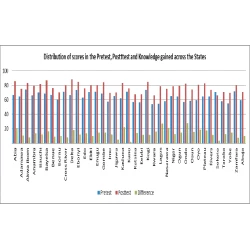
Result:The overall mean pre-test and post-test scores were 64.0% and 77.4% respectively indicating a 13.4% knowledge gain above what it was at the beginning of the training. The mean pre-test score and post-test score for the Southern states (SN) were 64.7% and 80.3% while that of the Northern states (NN) were 63.5% and 75.3% representing a knowledge gain of 15.6% and 11.8% respectively. There was statistical significant difference in the post-test scores between the two regions (p=0.001) and in knowledge gained after the training (p=0.017).
Conclusions and Public Health Implications:Comparison between the pre test and post test scores at the 5-day training showed a significant gain in knowledge of participants. The survey training contributed positively to the preparation and building of knowledge needed for the conduct of 2012 NARHS-plus.
Downloads
Similar Articles
- Romuladus E. Azuine, Sussan E. Ekejiuba, Gopal K. Singh, Magnus A. Azuine, Ebola Virus Disease Epidemic: What Can the World Learn and Not Learn from West Africa? , Vol. 3 No. 1 (2015): International Journal of Maternal and Child Health and AIDS
- Vaishali Alwadhi, Archana Mishra, Anil Nagendra, Devina Bajpayee, Naresh Chandra Joshi, Sachin Gupta, Harish Kumar, Introduction of Heat-Stable Carbetocin through a Public-Private Partnership Model in India: A Retrospective Study to Determine Feasibility and Its Optimal Use in Public Health Settings , Vol. 13 No. S1 (2024): International Journal of Maternal and Child Health and AIDS
- Roger J. Chin, Domrongphol Sangmanee, Lisa Piergallini, PEPFAR Funding and Reduction in HIV Infection Rates in 12 Focus Sub-Saharan African Countries: A Quantitative Analysis , Vol. 3 No. 2 (2015): International Journal of Maternal and Child Health and AIDS
- Justice Ajaari, Honorati Masanja, Renay Weiner, Shalom Akonvi Abokyi, Seth Owusu-Agyei, Impact of Place of Delivery on Neonatal Mortality in Rural Tanzania , Vol. 1 No. 1 (2012): International Journal of Maternal and Child Health and AIDS
- Kimberly Fryer, Chinyere N. Reid, Naciely Cabral, Jennifer Marshall, Usha Menon, Exploring Patients’ Needs and Desires for Quality Prenatal Care in Florida, United States , Vol. 12 No. 1 (2023): International Journal of Maternal and Child Health and AIDS
- Deepa Dongarwar, Hamisu M. Salihu, Place of Residence and Inequities in Adverse Pregnancy and Birth Outcomes in India , Vol. 9 No. 1 (2020): International Journal of Maternal and Child Health and AIDS
- Cedrina L. Calder, Heather O’Hara, Mohammad Tabatabai, Celia J. Maxwell, Salisha Marryshow, Aima A. Ahonkhai, Carolyn M. Audet, C. William Wester, Muktar H. Aliyu, Adherence to Combination Antiretroviral Therapy among Pregnant Women Enrolled in a HIV Prevention Program in Rural North-central Nigeria , Vol. 9 No. 1 (2020): International Journal of Maternal and Child Health and AIDS
- Ekere James Essien, Osaro Mgbere, Sorochi Iloanusi, Susan M. Abughosh, COVID-19 Infection among People with HIV/AIDS in Africa: Knowledge Gaps, Public Health Preparedness and Research Priorities , Vol. 10 No. 1 (2021): International Journal of Maternal and Child Health and AIDS
- Hyunjung Lee, Gopal K. Singh, Contributions of Socioeconomic, Demographic, and Behavioral Risk Factors to All-Cause Mortality Disparities by Psychological Distress in the United States: A Blinder-Oaxaca Decomposition Analysis of Longitudinal Data , Vol. 11 No. 1 (2022): International Journal of Maternal and Child Health and AIDS
- Neza Guillaine, Wilberforce Mwizerwa, Jackline Odhiambo, Bethany L. Hedt-Gauthier, Lisa R. Hirschhorn, Placidie Mugwaneza, Jean Paul Umugisha, Felix Rwabukwisi Cyamatare, Christine Mutaganzwa, Neil Gupta, A Novel Combined Mother-Infant Clinic to Optimize Post-Partum Maternal Retention, Service Utilization, and Linkage to Services in HIV Care in Rural Rwanda , Vol. 6 No. 1 (2017): International Journal of Maternal and Child Health and AIDS
<< < 6 7 8 9 10 11 12 13 14 15 > >>
You may also start an advanced similarity search for this article.
Published
How to Cite
Issue
Section
License
Copyright © 2015 Kolawole Solomon Oyedeji, Adeniyi Francis Fagbamigbe, Johnbull Sonny Ogboi, Adebobola Toluwalashe Bashorun, Kawu Bolakale Issa, Perpetua Amida, Adeniyi Ogundiran, Ezire Onoriode. Published by Global Health and Education Projects, Inc., USA.

This is an open-access article distributed under the terms of the Creative Commons Attribution-NonCommercial-ShareAlike 4.0 International License , which permits others to remix, transform, and build upon the work non-commercially, provided the original author is credited and the new creations are licensed under the same terms.