
Exploring Patients’ Needs and Desires for Quality Prenatal Care in Florida, United States
DOI:
https://doi.org/10.21106/ijma.622Keywords:
- Medicaid,
- Patient Preference,
- Patient-Centered Care,
- Pregnancy,
- Prenatal Care,
- Qualitative Research,
- Quality of Health Care,
- United States
Abstract
High-quality prenatal care promotes adequate care throughout pregnancy by increasing patients’ desires to return for follow-up visits. Almost 15% of women in the United States receive inadequate prenatal care, with 6% receiving late or no prenatal care. Only 63% of pregnant women in Florida receive adequate prenatal care, and little is known about their perceptions of high-quality prenatal care. Therefore, the objective of this study was to assess women’s perceptions of the quality of their prenatal care and to describe their preferences for seeking prenatal care that meets their needs.
Methods:From April to December 2019, a qualitative study was conducted with postpartum women (n = 55) who received no or late prenatal care and delivered in Tampa, Florida, USA. Eligible women completed an open-ended qualitative survey and a semi-structured in-depth interview. The interview contextualized the factors influencing prenatal care quality perceptions. The qualitative data analysis was based on Donabedian’s quality of care model.
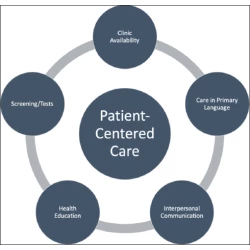
Results:The qualitative data analysis revealed three key themes about women’s perceptions and preferences for prenatal care that meets their needs. First, clinical care processes included provision of health education and medical assessments. Second, structural conditions included language preferences, clinic availability, and the presence of ancillary staff. Finally, interpersonal communication encompassed interactions with providers and continuity of care. Overall, participants desired patient-centered care and care that was informative, tailored to their needs, and worked within the constraints of their daily lives.
Conclusion and Global Health Implications:Women seeking and receiving prenatal care prefer a welcoming, patient-centered health care environment. These findings should prompt health care providers and organizations to improve existing prenatal care models and develop new prenatal care models that provide early, accessible, and high-quality prenatal care to a diverse population of maternity patients.
Downloads
Most read articles by the same author(s)
- Arlin Delgado, Chinyere N. Reid, Emma Hale, Jennifer Marshall, Kimberly Fryer, Evaluation of Virtual Prenatal Care for Obstetric Care Delivery During the COVID-19 Pandemic: A Mixed Method Research Study Using the Consolidated Framework in Implementation Research , International Journal of Maternal and Child Health and AIDS: Vol. 12 No. 2 (2023): International Journal of Maternal and Child Health and AIDS
Similar Articles
- Charles Chibuisi Ehiemere, Ishaku Adamu Akyala, Bisayo Adetuyi Ogundipe, Chukwuebuka Clement Nri-Ezedi, Peter Joseph Anzaku, Waryit Esther Yonah, Efe Mary Imokhai, Isaac Onyebuchi Okohu, Idowu Olapemi Makinde, Ngozi Miriam Chimzobam-Nnalue, Beyond Access: Behavior Change and Gendered Realities in the Adoption of Digital Health Tools for Maternal, Newborn, and Child Health in Nigeria , Vol. 15 (2026): International Journal of Maternal and Child Health and AIDS
- Amol Jamkhande, Bhagyashree P. Agre, Neelam Gavali, Anjali Rajesh Gaikwad, Sanpreet Singh Sachdev, Association Between Maternal Periodontitis and Preterm Low Birth Weight in Indian Populations: A Literature Review , Vol. 15 (2026): International Journal of Maternal and Child Health and AIDS
- Maria Vigil-Mallette, Daryle Pickens, Julliet Ogu, Deepa Dongarwar, Elizabeth Onugha, Hamisu M Salihu, Fifth Annual Summer Research Summit on Health Equity Organized by the Center of Excellence in Health Equity, Training and Research, Baylor College of Medicine, Houston, Texas 77030, USA on May 17, 2022 , Vol. 11 No. S2 (2022): International Journal of Maternal and Child Health and AIDS
- Margaret Omowaleola Akinwaare, Jonah Musa, Chizoma Millicent Ndikom, Determinants of Digitalized Antenatal Education Use among Pregnant Women Living with Human Immunodeficiency Virus in Nigeria , Vol. 15 (2026): International Journal of Maternal and Child Health and AIDS
- Océane J. Parker, Duc Minh Duong, Thuy Thu Nguyen, Vui Thi Le, Utilization of Sexual and Reproductive Healthcare Services Among Young Women in Two Districts of Hanoi, Vietnam , Vol. 15 (2026): International Journal of Maternal and Child Health and AIDS
- Deepa Dongarwar, Toi B. Harris, Hamisu M. Salihu, Fourth Annual Summer Research Summit on Health Equity Organized by the Center of Excellence in Health Equity, Training and Research, Baylor College of Medicine, Houston, Texas 77030, USA on May 20, 2021 , Vol. 10 No. S3 (2021): International Journal of Maternal and Child Health and AIDS
- Elizabeth Armstrong-Mensah, Damilola Dada, Amber Bowers, Aruba Muhammad, Chisom Nnoli, Geographic, Health Care Access, Racial Discrimination, and Socioeconomic Determinants of Maternal Mortality in Georgia, United States , Vol. 10 No. 2 (2021): International Journal of Maternal and Child Health and AIDS
- Gopal K. Singh, Gem P. Daus, Michelle Allender, Christine T. Ramey, Elijah K. Martin, Chrisp Perry, Andrew A. De Los Reyes, Ivy P. Vedamuthu, Social Determinants of Health in the United States: Addressing Major Health Inequality Trends for the Nation, 1935-2016 , Vol. 6 No. 2 (2017): International Journal of Maternal and Child Health and AIDS
- Hamisu M. Salihu, Deepa Dongarwar, Toi B. Harris, Third Annual Summer Research Summit on Health Equity Organized by the Center of Excellence in Health Equity, Training and Research, Baylor College of Medicine, Houston, Texas 77030, USA on June 9, 2020: ABSTRACT: Advancing Health Equity Through Innovation , Vol. 9 No. S3 (2020): International Journal of Maternal and Child Health and AIDS
- Innocent Anayochukwu Ugwu, Calistus Obiora Nevo, Malachy Nwaeze Ezenwaeze, Antenatal Care Utilization and Delivery Location: Evidence from Postpartum Women in Enugu, South East Nigeria , Vol. 15 (2026): International Journal of Maternal and Child Health and AIDS
You may also start an advanced similarity search for this article.
Published
How to Cite
Issue
Section
License
Copyright © 2023 Kimberly Fryer, Chinyere N. Reid, Naciely Cabral, Jennifer Marshall, Usha Menon. Published by Global Health and Education Projects, Inc., USA.

This is an open-access article distributed under the terms of the Creative Commons Attribution-NonCommercial-ShareAlike 4.0 International License , which permits others to remix, transform, and build upon the work non-commercially, provided the original author is credited and the new creations are licensed under the same terms.