
Has the Rate of Reduction in Infant Mortality Increased in India Since the Launch of National Rural Health Mission? Analysis of Time Trends 2000-2009 with Projection to 2015
DOI:
https://doi.org/10.21106/ijma.19Keywords:
- India,
- National Rural Health Mission,
- Infant Mortality Rate,
- Millennium Development Goals,
- Health Systems
Abstract
National Rural Health Mission (NRHM) - India was launched in 2005 to tackle urban-rural health inequalities, especially in maternal and child health. We examined national and state level trends in Infant Mortality Rates (iMR) from 2000 through 2009 to: 1) assess whether the NRHM had increased the average annual reduction rate (AARR) of IMR 2) evaluate state-wise progress towards Millennium Development Goals (MDG4) and estimate required AARRs for ‘off track’ states.
Methods:Log-linear regression models were applied to national and state IMR data collated from the Sample Registration System (SRS)-India to estimate average annual reduction rates and compare AAARs before and after introduction of NRHM. The log-linear trend of infant mortality rates was also projected forward to 2015.
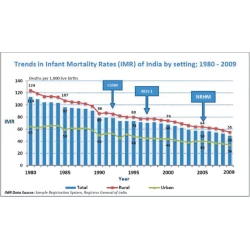
Results:The infant mortality rate in rural India declined from 74 to 55/1000 live births between 2000 and 2009, with AARR of 3.0% (95% CI=2.6%-3.4%) and the urban-rural gap in infant mortality narrowed (p =0.036). However there was no evidence (p=0.49) that AARR in rural India increased post NRHM (3.4%, 95% CI 2.0-4.7%) compared to pre NRHM (2.8%, 95% CI 2.1%-3.5%). States varied widely in rates of infant mortality reduction. Projections of infant mortality rates suggested that only eight states might be on track to help India achieve MDG4 by 2015.
Conclusions and Public Health Implications:Despite a narrowing urban-rural gap and high AARRs in some states, there was no evidence that the rate of reduction in infant mortality has increased in rural India post NRHM introduction. India appears unlikely to achieve child survival-related NRHM and millennium development goals. Government should revisit the child survival related NRHM strategies and ensure equitable access to health services. More robust monitoring and evaluation mechanisms must be inbuilt for following years.
Downloads
Similar Articles
- Gopal K. Singh, Hyunjung Lee, Trends and Racial/Ethnic, Socioeconomic, and Geographic Disparities in Maternal Mortality from Indirect Obstetric Causes in the United States, 1999-2017 , Vol. 10 No. 1 (2021): International Journal of Maternal and Child Health and AIDS
- Armand Duclaire Kemo, Bruno Kenfack, Jérôme Ateudjieu, Partograph Utilization and its Determinant Factors among Healthcare Providers during Childbirth in West Cameroon , Vol. 14 No. Continuous (2025): International Journal of Maternal and Child Health and AIDS
- Faith Iretioluwa Olaniyi, Ayodele Ebenezer Owolabi, Gideon Temitope Olowe, Ololade Daniella Olunloyo, Eric Anuoluwapo Ogunleye, Ifeoluwapo Oluwafunke Kolawole, Perception, Pattern of Use, and Determinants of Family Planning Uptake Among Women of Childbearing Age in Ibadan, South West Nigeria , Vol. 15 (2026): International Journal of Maternal and Child Health and AIDS
- Musawenkosi H L Mabaso, Thoko Ndaba, Zilungile L Mkhize-Kwitshana, Overview of Maternal, Neonatal and Child Deaths in South Africa: Challenges, Opportunities, Progress and Future Prospects , Vol. 2 No. 2 (2014): International Journal of Maternal and Child Health and AIDS
- Deepa Dongarwar, Hamisu M. Salihu, Place of Residence and Inequities in Adverse Pregnancy and Birth Outcomes in India , Vol. 9 No. 1 (2020): International Journal of Maternal and Child Health and AIDS
- Zubairu Iliyasux, Amina A. Umar, Fatima S. Gaya, Nafisa S. Nass, Hadiza M. Abdullahi, Aminatu A. Kwaku, Taiwo G. Amole, Fatimah I. Tsiga-Ahmed, Hadiza S. Galadanci, Hamisu M. Salihu, Muktar H. Aliyu, ‘We delivered at home out of fear’: Maternity Care in Rural Nigeria During the COVID-19 Pandemic , Vol. 12 No. 1 (2023): International Journal of Maternal and Child Health and AIDS
- Ndidiamaka Amutah-Onukagha, Monica Rodriguez, Ijeoma Opara, Michelle Gardner, Maame Araba Assan, Rodney Hammond, Jesus Plata, Kimberly Pierre, Ehsan Farag, Progresses and challenges of utilizing traditional birth attendants in maternal and child health in Nigeria , Vol. 6 No. 2 (2017): International Journal of Maternal and Child Health and AIDS
- Abdul-Wahab Inusa, Nana Asha Alhassan, Ana Maria Simono Charadan, Roy Rillera Marzo, Shamsu-Deen Ziblim, Influence of Sociodemographic Factors and Obstetric History on Choice of Place of Delivery: A Retrospective Study Among Post-Natal Women in Ghana , Vol. 12 No. 2 (2023): International Journal of Maternal and Child Health and AIDS
- Kolawole A. Fasakin, Christopher T. Omisakin, Idowu O. Adebara, Wasiu A. Ajetunmobi, Adebayo A. Adeniyi, Ayodele J. Esan, Olufunke B. Bolaji, Oluwafemi D. Ajayi, Abayomi J. Afe, Assessment of PMTCT Success Rates Based on Antiretroviral Interventions and Feeding Options: A Prospective Cohort Study , Vol. 7 No. 2 (2018): International Journal of Maternal and Child Health and AIDS
- Romuladus Emeka Azuine, Gopal K Singh, Sussan E Ekejiuba, Eta Ashu, Magnus A Azuine, Global Health Donor Presence, Variations in HIV/AIDS Prevalence, and External Resources for Health in Developing Countries in Africa and Asia , Vol. 2 No. 2 (2014): International Journal of Maternal and Child Health and AIDS
<< < 1 2 3 4 5 6 7 8 9 10 > >>
You may also start an advanced similarity search for this article.
Published
How to Cite
Issue
Section
License
Copyright © 2015 Rajesh Narwal, Lu Gram. Published by Global Health and Education Projects, Inc., USA.

This is an open-access article distributed under the terms of the Creative Commons Attribution-NonCommercial-ShareAlike 4.0 International License , which permits others to remix, transform, and build upon the work non-commercially, provided the original author is credited and the new creations are licensed under the same terms.