
Beyond Access: Behavior Change and Gendered Realities in the Adoption of Digital Health Tools for Maternal, Newborn, and Child Health in Nigeria
DOI:
https://doi.org/10.21106/IJMA_45_2025Keywords:
- Behavior Change,
- Digital Health,
- Gender,
- Health-Seeking Behavior,
- Maternal and Child Health,
- Nigeria,
- Technology adoption
Abstract
Background and Objective: Digital health innovations are increasingly being deployed to improve maternal, newborn, and child health (MNCH) outcomes in Nigeria. However, their adoption and effectiveness are influenced not only by technological access and infrastructure but also by behavioral factors, gender norms, and cultural contexts that shape user engagement and health-seeking behaviors.
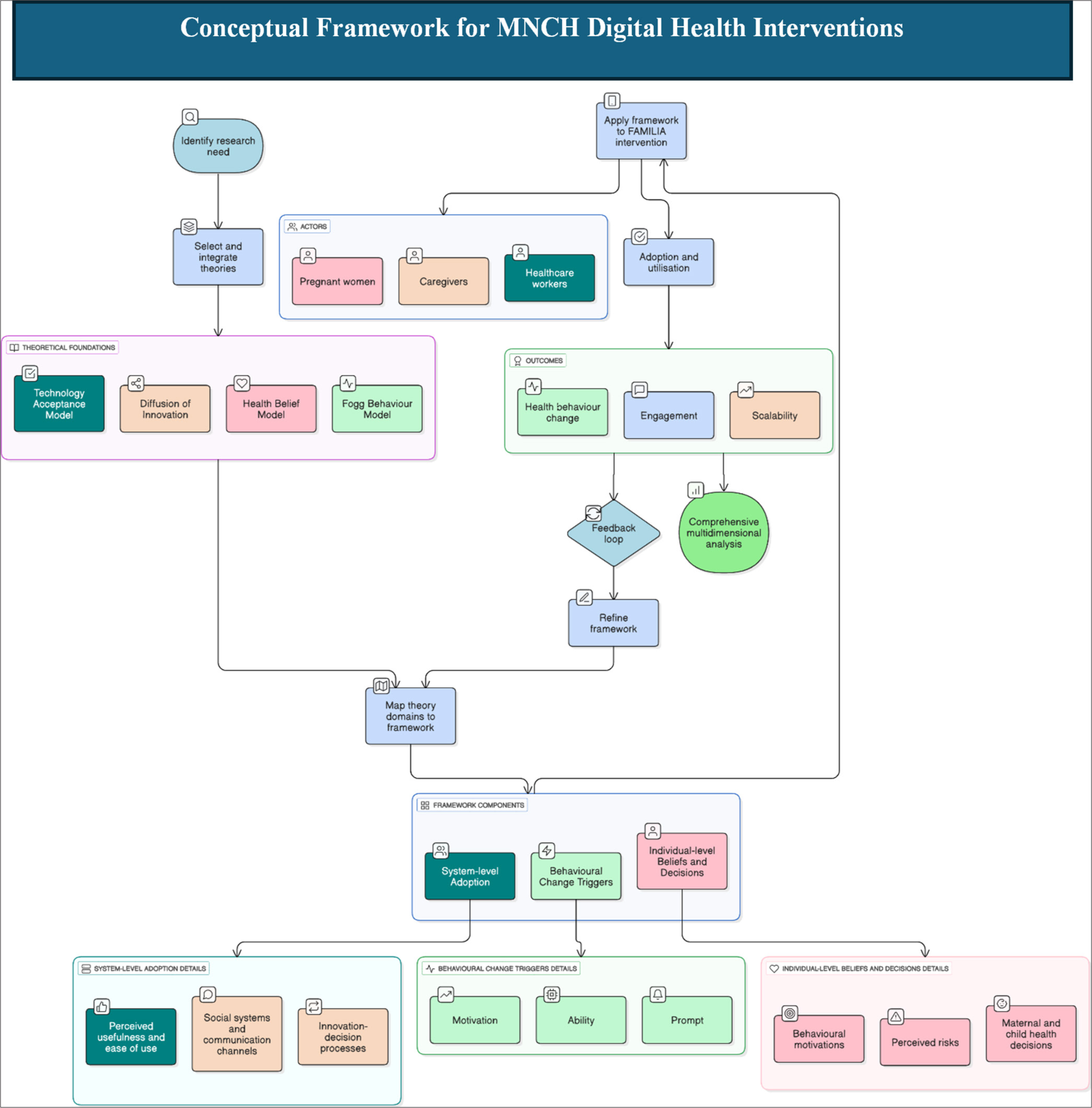
Methods: A narrative review was conducted using PubMed, Web of Science, Scopus, and African Journals Online, covering studies published between 2015 and 2025. From an initial pool of records, 46 studies met the inclusion criteria following screening. This review synthesized empirical studies, program evaluations, and behavioral frameworks, such as the Fogg Behavior Model and Health Belief Model, to examine how gender dynamics, social hierarchies, and behavioral readiness shape digital MNCH adoption.
Results: The findings reveal that digital literacy gaps, gendered power relations, sociocultural beliefs, and intrahousehold decision-making processes significantly affect technology uptake. Interventions that incorporated voice-based content, local languages, and male-inclusive engagement strategies demonstrated higher levels of acceptance and retention in the target population. Behaviorally informed designs, culturally tailored messaging, and the involvement of trusted intermediaries, such as community health workers, were critical success factors.
Conclusion and Global Health Implications: Effective digital health interventions must move beyond mere technical provision to integrate behavioral science and gender responsiveness into their design and delivery. Approaches that prioritize the lived realities of users, particularly women’s agency within household decisionmaking, are more likely to achieve equitable and sustainable MNCH outcomes. Policy and program developers should prioritize human-centered, behaviorally intelligent, and gender-transformative digital health models, while future interventions must integrate cultural adaptability, motivational triggers, and inclusive engagement strategies to enhance digital MNCH impact.
Downloads
Similar Articles
- Presley Chick Tayong, Herbert Afegenwi Mbunkah, Raphael Awah Abong, Sumelong Sharon Dione Akomoneh, Raoul Tuekam Kayo, Elvis Achondou Akomoneh, Incidence of Mother-to-Child Transmission of HIV and Associated Factors in Postpartum Women in Cameroon , Vol. 14 No. Continuous (2025): International Journal of Maternal and Child Health and AIDS
- Fatima M. Damagum, Zainab D. Ahmed, Rabiu I. Jalo, Hamisu M. Salihu, C. William Wester, Muktar H. Aliyu, Adapted Counseling Care Model for Management of Female Sexual Dysfunction Among Women Living With and Without HIV , Vol. 13 No. Continuous (2024): International Journal of Maternal and Child Health and AIDS
- Godwin Omokhagbo Emmanuel, Olaniyi Felix Sanni, Abang Roger, Paul Umoh, Ochonye Bartholomew Boniface, Amechi Paul, Ismaeel Mohammed Yahaya, Agie Muhmmad Auwal, Improving HIV Prevention for Key Populations in Nigeria: Insights on Access, Barriers, Stigma, and Service Utilization , Vol. 14 No. Continuous (2025): International Journal of Maternal and Child Health and AIDS
- Comfort Z. Olorunsaiye, Larissa R. Brunner Huber, Samira P. Ouedraogo, Interbirth Intervals of Immigrant and Refugee Women in the United States: A Cross-Sectional Study , Vol. 12 No. 1 (2023): International Journal of Maternal and Child Health and AIDS
- Raees A. Shaikh, Mohammad Siahpush, Gopal K. Singh, Melissa Tibbits, Socioeconomic Status, Smoking, Alcohol use, Physical Activity, and Dietary Behavior as Determinants of Obesity and Body Mass Index in the United States: Findings from the National Health Interview Survey , Vol. 4 No. 1 (2015): International Journal of Maternal and Child Health and AIDS
- Deepa Dongarwar, Veronica B. Ajewole, Kiydra Harris, Emmanuella Oduguwa, Theresa U. Ofili, Collins Onyenaka, Sade Arnold, Jorhn Broussard, Joan Ishioye, Jasmine Marshal, Jamila Mayoya, Danchau Le, Mouch Fadel, Omonike A. Olaleye, Hamisu M. Salihu, A Framework for Protecting Pregnant Women in the Era of COVID-19 Pandemic , Vol. 10 No. 1 (2021): International Journal of Maternal and Child Health and AIDS
- Natalie C Frayer, Yeonsoo Kim, Caffeine Intake During Pregnancy and Risk of Childhood Obesity: A Systematic Review , Vol. 9 No. 3 (2020): International Journal of Maternal and Child Health and AIDS
- Modupe Rebekah Akinyinka, Foluke Adenike Olatona, Esther Oluwakemi Oluwole, Breastfeeding Knowledge and Practices among Mothers of Children under 2 Years of Age Living in a Military Barrack in Southwest Nigeria , Vol. 5 No. 1 (2016): International Journal of Maternal and Child Health and AIDS
- Korede K Yusuf, Deepa Dongarwar, Sahra Ibrahimi, Chioma Ikedionwu, Sitratullah O. Maiyegun, Hamisu M. Salihu, Expected Surge in Maternal Mortality and Severe Morbidity among African-Americans in the Era of COVID-19 Pandemic , Vol. 9 No. 3 (2020): International Journal of Maternal and Child Health and AIDS
- Rasaki O Shittu, Baba A Issa, Ganiyu T Olanrewaju, Abdulraheem O Mahmoud, Louis O Odeigah, Abdullateef G Sule, Social Determinants of Depression: Social Cohesion, Negative Life Events, and Depression Among People Living with HIV/Aids in Nigeria, West Africa , Vol. 2 No. 2 (2014): International Journal of Maternal and Child Health and AIDS
<< < 8 9 10 11 12 13 14 15 16 17 > >>
You may also start an advanced similarity search for this article.
Published
How to Cite
Issue
Section
License
Copyright © 2026 Charles Chibuisi Ehiemere, Ishaku Adamu Akyala, Bisayo Adetuyi Ogundipe, Chukwuebuka Clement Nri-Ezedi, Peter Joseph Anzaku, Waryit Esther Yonah, Efe Mary Imokhai, Isaac Onyebuchi Okohu, Idowu Olapemi Makinde, Ngozi Miriam Chimzobam-Nnalue. Published by Global Health and Education Projects, Inc., USA.

This is an open-access article distributed under the terms of the Creative Commons Attribution-NonCommercial-ShareAlike 4.0 International License , which permits others to remix, transform, and build upon the work non-commercially, provided the original author is credited and the new creations are licensed under the same terms.