
Beyond Access: Behavior Change and Gendered Realities in the Adoption of Digital Health Tools for Maternal, Newborn, and Child Health in Nigeria
DOI:
https://doi.org/10.21106/IJMA_45_2025Keywords:
- Behavior Change,
- Digital Health,
- Gender,
- Health-Seeking Behavior,
- Maternal and Child Health,
- Nigeria,
- Technology adoption
Abstract
Background and Objective: Digital health innovations are increasingly being deployed to improve maternal, newborn, and child health (MNCH) outcomes in Nigeria. However, their adoption and effectiveness are influenced not only by technological access and infrastructure but also by behavioral factors, gender norms, and cultural contexts that shape user engagement and health-seeking behaviors.
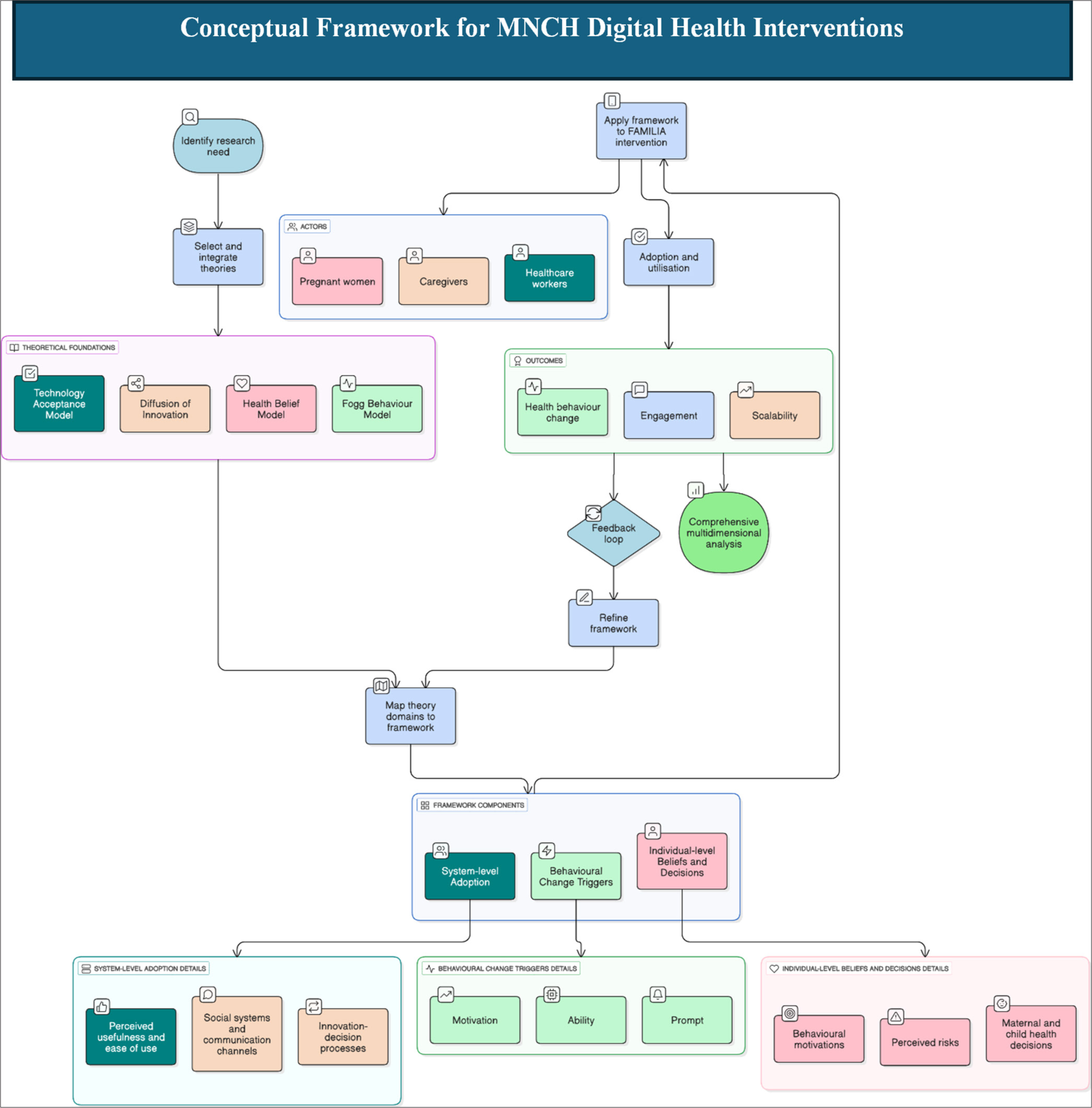
Methods: A narrative review was conducted using PubMed, Web of Science, Scopus, and African Journals Online, covering studies published between 2015 and 2025. From an initial pool of records, 46 studies met the inclusion criteria following screening. This review synthesized empirical studies, program evaluations, and behavioral frameworks, such as the Fogg Behavior Model and Health Belief Model, to examine how gender dynamics, social hierarchies, and behavioral readiness shape digital MNCH adoption.
Results: The findings reveal that digital literacy gaps, gendered power relations, sociocultural beliefs, and intrahousehold decision-making processes significantly affect technology uptake. Interventions that incorporated voice-based content, local languages, and male-inclusive engagement strategies demonstrated higher levels of acceptance and retention in the target population. Behaviorally informed designs, culturally tailored messaging, and the involvement of trusted intermediaries, such as community health workers, were critical success factors.
Conclusion and Global Health Implications: Effective digital health interventions must move beyond mere technical provision to integrate behavioral science and gender responsiveness into their design and delivery. Approaches that prioritize the lived realities of users, particularly women’s agency within household decisionmaking, are more likely to achieve equitable and sustainable MNCH outcomes. Policy and program developers should prioritize human-centered, behaviorally intelligent, and gender-transformative digital health models, while future interventions must integrate cultural adaptability, motivational triggers, and inclusive engagement strategies to enhance digital MNCH impact.
Downloads
Similar Articles
- Amina A. Umar, Hamisu M. Salihu, Romuladus E. Azuine, Crisis of Brain Drain in Nigeria’s Health Sector: Challenges, Opportunities, and the Path Forward , Vol. 14 No. Continuous (2025): International Journal of Maternal and Child Health and AIDS
- Kalaivani Mani, Sada Nand Dwivedi, Ravindra Mohan Pandey, Determinants of Under-Five Mortality in Rural Empowered Action Group States in India: An Application of Cox Frailty Model , Vol. 1 No. 1 (2012): International Journal of Maternal and Child Health and AIDS
- Khadija Kofoworola Adeleye, Margaret Omowaleola Akinwaare, Prisca Olabisi Adejumo, Reproductive Plans And Utilization of Contraceptives Among Women Living With HIV , Vol. 8 No. 2 (2019): International Journal of Maternal and Child Health and AIDS
- Zenab I. Yusuf, Deepa Dongarwar, Rafeek A Yusuf, Meishon Bell, Toi Harris Harris, Hamisu M. Salihu, Social Determinants of Overweight and Obesity Among Children in the United States , Vol. 9 No. 1 (2020): International Journal of Maternal and Child Health and AIDS
- Neza Guillaine, Wilberforce Mwizerwa, Jackline Odhiambo, Bethany L. Hedt-Gauthier, Lisa R. Hirschhorn, Placidie Mugwaneza, Jean Paul Umugisha, Felix Rwabukwisi Cyamatare, Christine Mutaganzwa, Neil Gupta, A Novel Combined Mother-Infant Clinic to Optimize Post-Partum Maternal Retention, Service Utilization, and Linkage to Services in HIV Care in Rural Rwanda , Vol. 6 No. 1 (2017): International Journal of Maternal and Child Health and AIDS
- Deepa Dongarwar, Veronica B. Ajewole, Emmanuella Oduguwa, Ahone Ngujede, Kiydra Harris, Theresa U. Ofili, Omonike A. Olaleye, Hamisu M. Salihu, Role of Social Determinants of Health in Widening Maternal and Child Health Disparities in the Era of Covid-19 Pandemic , Vol. 9 No. 3 (2020): International Journal of Maternal and Child Health and AIDS
- Eren Oyungu, Anna Roose, Ananda R. Ombitsa, Rachel C. Vreeman, Megan S. McHenry, Child Development Monitoring in Well-baby Clinics in Kenya , Vol. 10 No. 1 (2021): International Journal of Maternal and Child Health and AIDS
- Md Nazrul Islam Mondai, Md Monzur Morshad Nasir Ullah, Md Rafiqul Islam, Md Shafiur Rahman, Md Nuruzzaman Khan, Kazi Mohiuddin Ahmed, Mohammad Shariful Islam, Sociodemographic and Health Determinants of Inequalities in Life Expectancy in Least Developed Countries , Vol. 4 No. 1 (2015): International Journal of Maternal and Child Health and AIDS
- San Hone, Li Li, W. Scott Comulada, Roger Detels, Progress and Challenges of Implementing Decentralized HIV Testing For Prevention of Mother-to-Child Transmission of HIV – Myanmar , Vol. 8 No. 1 (2019): International Journal of Maternal and Child Health and AIDS
- Hamisu M. Salihu, Romuladus E. Azuine, Current and Emerging Issues in Global Health: An Introduction to Special Journal Collection , Vol. 9 No. 1 (2020): International Journal of Maternal and Child Health and AIDS
<< < 9 10 11 12 13 14 15 16 17 18 > >>
You may also start an advanced similarity search for this article.
Published
How to Cite
Issue
Section
License
Copyright © 2026 Charles Chibuisi Ehiemere, Ishaku Adamu Akyala, Bisayo Adetuyi Ogundipe, Chukwuebuka Clement Nri-Ezedi, Peter Joseph Anzaku, Waryit Esther Yonah, Efe Mary Imokhai, Isaac Onyebuchi Okohu, Idowu Olapemi Makinde, Ngozi Miriam Chimzobam-Nnalue. Published by Global Health and Education Projects, Inc., USA.

This is an open-access article distributed under the terms of the Creative Commons Attribution-NonCommercial-ShareAlike 4.0 International License , which permits others to remix, transform, and build upon the work non-commercially, provided the original author is credited and the new creations are licensed under the same terms.