
Birth Preparedness Plans and Status Disclosure Among Pregnant Women Living with HIV Who are Receiving Antiretroviral Therapy in Ibadan, Southwest, Nigeria
DOI:
https://doi.org/10.21106/ijma.613Keywords:
- HIV,
- PMTCT,
- Pregnancy,
- Maternal Health,
- Antenatal Care
Abstract
Promoting the maternal health of pregnant women who are living with human immunodeficiency virus (HIV; [PWLH]) is key to reducing maternal mortality and morbidity. Thus, inadequate birth preparedness plans, non-institutional delivery, and status concealment among PWLH contribute to the spread of HIV infection and threaten the prevention of mother-to-child transmission (PMTCT). Therefore, this study aimed to assess the birth preparedness plan and status disclosure among PWLH, as well as the prevalence of HIV infection among pregnant women.
Methods:The study adopted a descriptive cross-sectional research design; a quantitative approach was used for data collection. Three healthcare facilities that represented the three levels of healthcare institutions and referral centers for the care of PWLH in the Ibadan metropolis were selected for the recruitment process. A validated questionnaire was used to collect data from 77 participants within the targeted population. Ethical approval was obtained prior to the commencement of data collection.
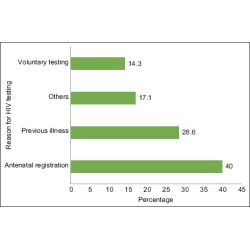
Results:The prevalence rate of HIV infection among the participants was 3.7%. Only 37.1% of the participants had a birth preparedness plan. A total of 40% of the participants tested for HIV, because testing was compulsory for antenatal registration. Only 7.1% of the participants had their status disclosed to their partners. Although 90% of the participants proposed delivering their babies in a hospital, only 80% of these participants had their status known in their proposed place of birth.
Conclusion and Global Health Implications:The prevalence of HIV infection among pregnant women is very low, which is an indication of improved maternal health. However, the level of birth preparedness plan and status disclosure to partners are equally low, and these factors can hinder PMTCT. Institutional delivery should be encouraged among all PWLH, and their HIV status must be disclosed at their place of birth.
Downloads
Most read articles by the same author(s)
- Margaret Omowaleola Akinwaare, Jonah Musa, Chizoma Millicent Ndikom, Determinants of Digitalized Antenatal Education Use among Pregnant Women Living with Human Immunodeficiency Virus in Nigeria , International Journal of Maternal and Child Health and AIDS: Vol. 15 (2026): International Journal of Maternal and Child Health and AIDS
Similar Articles
- Temesgen Geta, Eskindir Israe, Buzuayehu Atinafu, Prevalence and Associated Factors of Client Satisfaction with Antenatal Care Services Among Antenatal Care Attendants in Ethiopia: A Systematic Review and Meta-Analysis , Vol. 13 No. Continuous (2024): International Journal of Maternal and Child Health and AIDS
- Anays Murillo, Mary Bachman DeSilva, Lora L. Sabin, Nafisa Halim, Harriet Chemusto, Philip Aroda, Julia Gasuza, Davidson H. Hamer, Anna Larson Williams, Barbara Mukasa, Lisa J. Messersmith, Rachael Bonawitz, Impact of a Maternal Prevention of Mother-to-child Transmission of HIV (PMTCT) Intervention on HIV-exposed Infants in Uganda , Vol. 9 No. 3 (2020): International Journal of Maternal and Child Health and AIDS
- Charles Kouanfack, Skinner Nguefack Lekelem, Fala Bede, Claude Ngwayu Nkfusai, Yvette Micha Nouafo, Christian Tchokonte, Nicaise Tsomo Zephirin, Pierre Joseph Fouda, Use of Trained Non-Medical Staff to Improve Access to HIV Testing Services in Africa: Implementation of the World Health Organization Opt-out Approach in Cameroon , Vol. 10 No. 1 (2021): International Journal of Maternal and Child Health and AIDS
- Srijana Pandey, Supendra Karki, Socio-economic and Demographic Determinants of Antenatal Care Services Utilization in Central Nepal , Vol. 2 No. 2 (2014): International Journal of Maternal and Child Health and AIDS
- Elizabeth Armstrong-Mensah, Krystal Ruiz, Aminata Fofana, Victoria Hawley, Perinatal HIV Transmission Prevention: Challenges among Women Living with HIV in sub-Saharan Africa , Vol. 9 No. 3 (2020): International Journal of Maternal and Child Health and AIDS
- Anastasia Y. Bongajum, Pascal Foumane, Charlotte O. Moussi, Noel Vogue, Hycinth S. Banseka, Jujlius M. Nwobegahay, Martina L. Baye, Strengthening Maternal Death Surveillance Systems for Evidence-Based Decision Making in Sub-Saharan Africa: The Case of the Center Region in Cameroon , Vol. 10 No. 2 (2021): International Journal of Maternal and Child Health and AIDS
- Mehrete Girmay, Digital Health Divide: Opportunities for Reducing Health Disparities and Promoting Equitable Care for Maternal and Child Health Populations , Vol. 13 No. Continuous (2024): International Journal of Maternal and Child Health and AIDS
- Presley Chick Tayong, Herbert Afegenwi Mbunkah, Raphael Awah Abong, Sumelong Sharon Dione Akomoneh, Raoul Tuekam Kayo, Elvis Achondou Akomoneh, Incidence of Mother-to-Child Transmission of HIV and Associated Factors in Postpartum Women in Cameroon , Vol. 14 No. Continuous (2025): International Journal of Maternal and Child Health and AIDS
- Fekadu Mazengia Alemu, Alemayehu Worku Yalew, Mesganaw Fantahun, Eta Ebasi Ashu, Antiretroviral Therapy and Pregnancy Outcomes in Developing Countries: A Systematic Review , Vol. 3 No. 1 (2015): International Journal of Maternal and Child Health and AIDS
- Alicia E. Hersey, Betty Norman, Rebecca Reece, Assessing Reproductive Decision-making Among HIV-Positive Women in Kumasi, Ghana , Vol. 8 No. 1 (2019): International Journal of Maternal and Child Health and AIDS
<< < 2 3 4 5 6 7 8 9 10 11 > >>
You may also start an advanced similarity search for this article.
Published
How to Cite
Issue
Section
License
Copyright © 2024 Margaret Omowaleola Akinwaare, Funmilayo A. Okanlawon, Monisola A. Popoola, Omotayo O. Adetunji. Published by Global Health and Education Projects, Inc., USA.

This is an open-access article distributed under the terms of the Creative Commons Attribution-NonCommercial-ShareAlike 4.0 International License , which permits others to remix, transform, and build upon the work non-commercially, provided the original author is credited and the new creations are licensed under the same terms.