
Marked Disparities in Life Expectancy by Education, Poverty Level, Occupation, and Housing Tenure in the United States, 1997-2014
DOI:
https://doi.org/10.21106/ijma.402Keywords:
- Life expectancy,
- Education,
- Poverty,
- Occupation,
- Housing Tenure,
- Social determinants,
- Longitudinal
Abstract
Socioeconomic disparities in life expectancy in the United States (US) are marked and have widened over time. However, there is limited research using individual-level socioeconomic variables as such information is generally lacking or unreliable in vital records used for life table construction. Using longitudinal cohort data, we computed life expectancy for US adults by social determinants such as education, income/poverty level, occupation, and housing tenure.
Methods:We analyzed the 1997-2014 National Health Interview Survey prospectively linked to mortality records in the National Death Index (N=1,146,271). Standard life table methodologies were used to compute life expectancy and other life table functions at various ages according to socioeconomic variables stratified by sex and race/ethnicity.
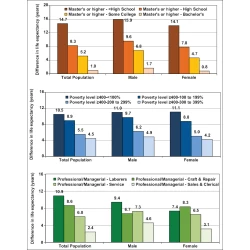
Results:Adults with at least a Master’s degree had 14.7 years higher life expectancy at age 18 than those with less than a high school education and 8.3 years higher life expectancy than those with a high school education. Poverty was inversely related to life expectancy. Individuals living in poverty had 10.5 years lower life expectancy at age 18 than those with incomes ≥400% of the poverty threshold. Laborers and those employed in craft and repair occupations had, respectively, 10.9 years and 8.6 years lower life expectancy at age 18 than those with professional and managerial occupations. Male and female renters had, respectively, 4.0 years and 4.6 years lower life expectancy at age 18 than homeowners. Women in the most advantaged socioeconomic group outlived men in the most disadvantaged group by 23.5 years at age 18.
Conclusions and Global Health Implications:Marked socioeconomic gradients in US life expectancy were found across all sex and racial/ethnic groups. Adults with lower education, higher poverty levels, in manual occupations, and with rental housing had substantially lower life expectancy compared to their counterparts with higher socioeconomic position.
Downloads
Most read articles by the same author(s)
- Gopal K. Singh, Hyunjung Lee, Lyoung Hee Kim, Shanita D. Williams, Social Determinants of Health Among American Indians and Alaska Natives and Tribal Communities: Comparison with Other Major Racial and Ethnic Groups in the United States, 1990–2022 , International Journal of Maternal and Child Health and AIDS: Vol. 13 No. Continuous (2024): International Journal of Maternal and Child Health and AIDS
- Hyunjung Lee, Gopal K. Singh, Psychological Distress and Heart Disease Mortality in the United States: Results from the 1997-2014 NHIS-NDI Record Linkage Study , International Journal of Maternal and Child Health and AIDS: Vol. 9 No. 3 (2020): International Journal of Maternal and Child Health and AIDS
- Gopal K. Singh, Hyunjung Lee, Trends and Racial/Ethnic, Socioeconomic, and Geographic Disparities in Maternal Mortality from Indirect Obstetric Causes in the United States, 1999-2017 , International Journal of Maternal and Child Health and AIDS: Vol. 10 No. 1 (2021): International Journal of Maternal and Child Health and AIDS
- Hyunjung Lee, Gopal K. Singh, Contributions of Socioeconomic, Demographic, and Behavioral Risk Factors to All-Cause Mortality Disparities by Psychological Distress in the United States: A Blinder-Oaxaca Decomposition Analysis of Longitudinal Data , International Journal of Maternal and Child Health and AIDS: Vol. 11 No. 1 (2022): International Journal of Maternal and Child Health and AIDS
- Gopal K. Singh, Hyunjung Lee, Lyoung Hee Kim, Housing and Inequalities in US Life Expectancy, Child and Youth Mortality, and All-Cause and Cause-Specific Mortality, 1979-2020: Results from the National Longitudinal Mortality Study and the National Vital Statistics System , International Journal of Maternal and Child Health and AIDS: Vol. 12 No. 2 (2023): International Journal of Maternal and Child Health and AIDS
- Gopal K. Singh, Hyunjung Lee, Romuladus E. Azuine, Marked Disparities in COVID-19 Vaccination among US Children and Adolescents by Racial/Ethnic, Socioeconomic, Geographic, and Health Characteristics, United States, December 2021 – April 2022 , International Journal of Maternal and Child Health and AIDS: Vol. 11 No. 2 (2022): International Journal of Maternal and Child Health and AIDS
Similar Articles
- Hamisu M. Salihu, Ronee E. Wilson, Lindsey M. King, Phillip J. Marty, Valerie E. Whiteman, Socio-ecological Model as a Framework for Overcoming Barriers and Challenges in Randomized Control Trials in Minority and Underserved Communities , Vol. 3 No. 1 (2015): International Journal of Maternal and Child Health and AIDS
- Maame Aba Coleman, Deepa Dongarwar, Jessica Ramirez, Mei-Li Laracuente, Chelsea Livingston, Julliet Ogu, Racquel Lyn, Arabella Hall, Sylvia Adu-Gyamfi, Hamisu M. Salihu, Factors Impacting Vaccine Uptake during Pregnancy: A Retrospective Analysis , Vol. 11 No. 2 (2022): International Journal of Maternal and Child Health and AIDS
- Kenneth N. Opara, Rebecca T. Akomalafe, Nsima I. Udoidung, Udeme U. Afia, Clement A. Yaro, Bassey E. Bassey, Urogenital Schistosomiasis among Primary School Children in Rural Communities in Obudu, Southern Nigeria , Vol. 10 No. 1 (2021): International Journal of Maternal and Child Health and AIDS
- Matiur Rahman, Kaoser Bin Siddique, Aminur Rahman, Rahidul Islam, Mohammad Mahbub Ur Rahim, Access to and Utilization of Maternal and Child Healthcare Services During COVID-19 Pandemic in Rural Bangladesh , Vol. 13 No. Continuous (2024): International Journal of Maternal and Child Health and AIDS
- Abhiruchi Galhotra, Sanjana Agrawal, Aditi Chandrakar, Effectiveness of Human Immunodeficiency Virus Index Testing: A Global Scoping Review , Vol. 14 No. Continuous (2025): International Journal of Maternal and Child Health and AIDS
- Sanni Yaya, Gebretsadik Shibre, Dina Idriss-Wheeler, Olalekan A Uthman, Women’s Empowerment and HIV Testing Uptake: A Meta-analysis of Demographic and Health Surveys from 33 Sub-Saharan African Countries , Vol. 9 No. 3 (2020): International Journal of Maternal and Child Health and AIDS
- Pangi Vijaya Nirmala, Mani Gudivada, Chikkam Vijaya Lashmi, Comparative Study of the Prevalence of Type-2 Diabetes Mellitus in Various Demographic Regions of Andhra Pradesh, India: a Population based Study , Vol. 5 No. 2 (2016): International Journal of Maternal and Child Health and AIDS
- Michelle Meyer, Molly Elmer-DeWitt, Cinthia Blat, Starley B Shade, Ijaa Kapule, Elizabeth Bukusi, Craig R Cohen, Lisa Abuogi, Evaluation and Utility of a Family Information Table to Identify and Test Children at Risk for HIV in Kenya , Vol. 2 No. 2 (2014): International Journal of Maternal and Child Health and AIDS
- Romuladus E. Azuine, Sussan E. Ekejiuba, Overcoming Challenges in Conducting Clinical Trials in Minority Populations: Identifying and Testing What Works , Vol. 3 No. 1 (2015): International Journal of Maternal and Child Health and AIDS
- Ekere James Essien, Osaro Mgbere, Long-acting Antiretroviral Agents in the Prevention and Treatment of HIV/AIDS: A Review of Recent Advances in Sub-Saharan Africa , Vol. 14 No. Continuous (2025): International Journal of Maternal and Child Health and AIDS
<< < 11 12 13 14 15 16 17 18 19 20 > >>
You may also start an advanced similarity search for this article.
Published
How to Cite
Issue
Section
License
Copyright © 2020 Gopal K. Singh, Hyunjung Lee. Published by Global Health and Education Projects, Inc., USA.

This is an open-access article distributed under the terms of the Creative Commons Attribution-NonCommercial-ShareAlike 4.0 International License , which permits others to remix, transform, and build upon the work non-commercially, provided the original author is credited and the new creations are licensed under the same terms.