
Utilization, Predictors and Gaps in the Continuum of Care for Maternal and Newborn Health in Ghana
DOI:
https://doi.org/10.21106/ijma.425Keywords:
- Continuum-of-care,
- Antenatal care,
- Skilled birth attendance,
- Postnatal care,
- Maternal health services,
- Maternal health,
- Newborn health,
- Ghana
Abstract
Background: Continuum-of-care (CoC) throughout pregnancy, childbirth and the postnatal period is essential for the health and survival of mothers and their babies. This study assesses the utilization, predictors, and gaps in the continuum of maternal and newborn health (MNH) services in Eastern Ghana.
Methods: A retrospective cross-sectional survey was conducted to assess utilization of MNH services and their determinants in the East Akim Municipality of Ghana. Three hundred and ten (310) mothers aged 15- 49 years were sampled from 4 communities (3 rural; 1 urban) in the municipality using stratified sampling methodology. Logistic regression models were fitted to determine the likelihood of utilizing skilled birth attendance (SBA) and postnatal care (PNC) after antenatal care (ANC).
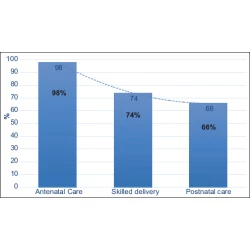
Results: Sixty-six percent (66%) of mothers surveyed received the full complement of MNH services (ANC, SBA, PNC) for their most-recent birth. While 98% of mothers made at least one ANC visit with 83.5% receiving the World Health Organization-recommended 4+ visits, only 74% accessed SBA indicating a 24% attrition in the CoC from ANC to SBA, and an 8% attrition from SBA to PNC. About 86% of mothers accessed PNC within 42 days postpartum. Distance to health facility, urban residence, and exposure to media information were strong predictors of the full complement of MNH continuumof-care utilization.
Conclusion and Global Health Implications: The study found a remarkable utilization of MNH services in East Akim with significant attrition along the continuum-of-care. Efforts to enhance utilization of the MNH continuum-of-care should focus on increasing access to SBA in particular, through equitable distribution of MNH services in hard-to-reach areas and innovative communication approaches for reducing attrition at each level of the continuum-of-care. Evidence from this study can inform strategies for achieving universal access and utilization of the MNH continuum-of-care towards global goals and improved health outcomes in Ghana and other countries.
Downloads
Similar Articles
- Gopal K. Singh, Hyunjung Lee, Marked Disparities in Life Expectancy by Education, Poverty Level, Occupation, and Housing Tenure in the United States, 1997-2014 , Vol. 10 No. 1 (2021): International Journal of Maternal and Child Health and AIDS
- Amos Kankponang Laar, Belynda Amankwa, Charlotte Asiedu, Prevention-of-Mother-To-Child-Transmission of HIV Services in Sub-Saharan Africa: A Qualitative Analysis of Healthcare Providers and Clients Challenges in Ghana , Vol. 2 No. 2 (2014): International Journal of Maternal and Child Health and AIDS
- Gopal K. Singh, Hyunjung Lee, Lyoung Hee Kim, Housing and Inequalities in US Life Expectancy, Child and Youth Mortality, and All-Cause and Cause-Specific Mortality, 1979-2020: Results from the National Longitudinal Mortality Study and the National Vital Statistics System , Vol. 12 No. 2 (2023): International Journal of Maternal and Child Health and AIDS
- Eren Oyungu, Anna Roose, Ananda R. Ombitsa, Rachel C. Vreeman, Megan S. McHenry, Child Development Monitoring in Well-baby Clinics in Kenya , Vol. 10 No. 1 (2021): International Journal of Maternal and Child Health and AIDS
- Rajesh Narwal, Lu Gram, Has the Rate of Reduction in Infant Mortality Increased in India Since the Launch of National Rural Health Mission? Analysis of Time Trends 2000-2009 with Projection to 2015 , Vol. 2 No. 1 (2013): International Journal of Maternal and Child Health and AIDS
- Alice Rosmini, Kidza Mugerwa, Awatta Walter Ochan, Sarah Muwanguzi, Jemelia Sake, Richard Mwesigwa, Okpwoku Sukere, Catrin Schulte-Hillen, Nguyen Toan Tran, Empowering Midwives in Humanitarian Settings: Integrating Heat-Stable Carbetocin and Tranexamic Acid into Postpartum Hemorrhage Training , Vol. 13 No. S1 (2024): International Journal of Maternal and Child Health and AIDS
- Kalaivani Mani, Sada Nand Dwivedi, Ravindra Mohan Pandey, Determinants of Under-Five Mortality in Rural Empowered Action Group States in India: An Application of Cox Frailty Model , Vol. 1 No. 1 (2012): International Journal of Maternal and Child Health and AIDS
- Hadiza Galadanci, Deepa Dongarwar, Wolfgang Künzel, Oladapo Shittu, Murtala Yusuf, Sadiq Abdurrahman, Dolapo Lufadeju, Hamisu M. Salihu, Cesarean Section and Maternal-fetal Mortality Rates in Nigeria: An Ecological Lens into the Last Decade , Vol. 9 No. 1 (2020): International Journal of Maternal and Child Health and AIDS
- Anays Murillo, Mary Bachman DeSilva, Lora L. Sabin, Nafisa Halim, Harriet Chemusto, Philip Aroda, Julia Gasuza, Davidson H. Hamer, Anna Larson Williams, Barbara Mukasa, Lisa J. Messersmith, Rachael Bonawitz, Impact of a Maternal Prevention of Mother-to-child Transmission of HIV (PMTCT) Intervention on HIV-exposed Infants in Uganda , Vol. 9 No. 3 (2020): International Journal of Maternal and Child Health and AIDS
- Isabel Griffin, Boubakari Ibrahimou, Natasha Navejar, Anjali Aggarwal, Kristopher Myers, Daniel Mauck, Korede K. Yusuf, Usman J. Wudil, Muktar H. Aliyu, Hamisu M. Salihu, Maternal Caffeine Consumption and Racial Disparities in Fetal Telomere Length , Vol. 9 No. 1 (2020): International Journal of Maternal and Child Health and AIDS
<< < 9 10 11 12 13 14 15 16 17 18 > >>
You may also start an advanced similarity search for this article.
Published
How to Cite
Issue
Section
License
Copyright © 2021 Juliana Y. Enos, Richard D. Amoako, Innocent K. Doku. Published by Global Health and Education Projects, Inc., USA.

This is an open-access article distributed under the terms of the Creative Commons Attribution-NonCommercial-ShareAlike 4.0 International License , which permits others to remix, transform, and build upon the work non-commercially, provided the original author is credited and the new creations are licensed under the same terms.