
Non-Occupational HIV Post-exposure Prophylaxis: A 10-Year Retrospective Review of Data Following Sexual Exposure From Yaounde Central Hospital, Cameroon
DOI:
https://doi.org/10.21106/ijma.311Keywords:
- Human immunodeficiency virus,
- Yaounde Central Hospital (Hôpital Central Yaoundé),
- Post-exposure prophylaxis,
- Cameroon,
- Sexual exposure,
- Non-occupational post exposure prophylaxis,
- HIV,
- PEP,
- nPEP,
- AIDS
Abstract
Human Immunodeficiency Virus (HIV) post exposure prophylaxis (PEP) consists of administering antiretroviral therapy within 72 hours of viral exposure and continued for four weeks. PEP has been shown to be an important means of preventing and decreasing the number of new HIV infections in the general population. The purpose of this study was to describe the profile of patients who consulted at the HIV/AIDS Care and Treatment Center of the Yaounde Central Hospital (YCH) for PEP following non-occupational exposure to HIV. To attain our objective, we carried out a 10-year retrospective review of patient records of all persons who consulted for accidental HIV exposure at the YCH, Cameroon.
Methods:This study was an observational, retrospective analysis of hospital records of persons who consulted for PEP following accidental exposure to HIV in the outpatient HIV clinic at YCH between January 2007 and December 2016. Data extracted from patients’ records were: type of HIV exposure, sex, age, profession, level of education, HIV status of source and time to consultation. Descriptive and inferential statistics were analyzed using STATA IC 12.0. Results were presented as median and interquartile range for continuous variables. Categorical variables were expressed as frequencies and proportions.
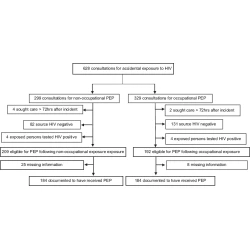
Results:There were 628 consultations for PEP of which 48% (299/628) were as a result of non-occupational post exposure prophylaxis (nPEP). Of those who consulted for HIV PEP following non-occupational exposure, 78% (234/299) were females; adolescents group (15-19 years) and young adults group (20 – 24yrs.) constituted 41% (125/299). Forty percent (1208/299) were secondary or high school students (level of education) and 88% (262/299) were non-healthcare workers. The median time-to-consultation for non-occupational PEP (nPEP) was 19 hours (IQR: 12.4-25.0) and HIV status of the source was unknown in 64% (191/299) of cases and positive for 8% (25/299) of cases. The most frequent indications for consulting were sexual assault, 75% (224/299); condom slippage or breakage, 10% (30/299); and unprotected consensual sexual intercourse, 15% (45/299).
Conclusion and Global Health Implications:Consultations for nPEP are as frequent as those occupational PEP (48% vs 52% in this study) in clinical practice at YCH. A good history of the source is important as it prevents unnecessary prescriptions of ART (which themselves have potential side effects) for persons consulting for potential HIV non-occupational exposure. In our study, we found that 27% (82/299) unnecessary ART prescriptions were avoided by determining that the exposure source person had negative HIV status. In addition, adolescent or young females consulting for nPEP in clinics could be potential victims of sexual assault or gender-based violence. Where possible, we recommend that clinicians consider the source of suspected viral exposure in clinical practice prior to administering ART for PEP.
Downloads
Most read articles by the same author(s)
- Claude Ngwayu Nkfusai, Claude Ngwayu Nkfusai, Samuel Nambile Cumber, Fala Bede, Emerson Njokah Wepngong Wepngong, Tabe Armstrong Tambe, Frankline Sevidzem Wirsiy, Jacintha Rebang Achu, Bih Moki Suh, Frankline Che Anyang, Joyce Mahlako Tsoka-Gwegweni, Barriers towards the Prevention and Treatment of Malaria among Pregnant Women at the Nkwen Health Center Bamenda, Cameroon , International Journal of Maternal and Child Health and AIDS: Vol. 11 No. 1 (2022): International Journal of Maternal and Child Health and AIDS
- Onana Akoa Francois Anicet, Charles Kouanfack, Ulrich Dama, Claude Ngwayu Nkfusai, Jean Ndibi Abanda, Désiré Tchoffo, Pearl Nsom Mbu, Pierre Yassa Yoniene, Prevalence, Epidemiological, and Clinical Profile of Patients Coinfected with Human Immunodeficiency Virus and Tuberculosis in the Coronavirus Disease 2019 Context in Health Facilities in the East Region, Cameroon , International Journal of Maternal and Child Health and AIDS: Vol. 13 No. Continuous (2024): International Journal of Maternal and Child Health and AIDS
- Charles Kouanfack, Skinner Nguefack Lekelem, Fala Bede, Claude Ngwayu Nkfusai, Yvette Micha Nouafo, Christian Tchokonte, Nicaise Tsomo Zephirin, Pierre Joseph Fouda, Use of Trained Non-Medical Staff to Improve Access to HIV Testing Services in Africa: Implementation of the World Health Organization Opt-out Approach in Cameroon , International Journal of Maternal and Child Health and AIDS: Vol. 10 No. 1 (2021): International Journal of Maternal and Child Health and AIDS
- Ornella Sybile D. Kouanfack, Charles Kouanfack, Serges Clotaire Billong, Samuel N. Cumber, Claude N. Nkfusai, Fala Bede, Emerson Wepngong, Chombong Hubert, Georges Nguefack-Tsague, Madeleine N. Singwe, Epidemiology of Opportunistic Infections in HIV Infected Patients on Treatment in Accredited HIV Treatment Centers in Cameroon , International Journal of Maternal and Child Health and AIDS: Vol. 8 No. 2 (2019): International Journal of Maternal and Child Health and AIDS
- Charles Kouanfack, Fala Bede, Claude Ngwayu Nkfusai, Emerson Wepngong, Mbinkar Adeline Venyuy, Chombong Hubert, Denise Movuh Sam, Samuel Nambile Cumber, Retention in HIV/AIDS Management Services: is it Really Poor? The Case of Yaounde Central Hospital in Cameroon , International Journal of Maternal and Child Health and AIDS: Vol. 9 No. 2 (2020): International Journal of Maternal and Child Health and AIDS
Similar Articles
- Wah Wah Myint, Human Immunodeficiency Virus (HIV) Knowledge and Stigma: Findings from a Cross-sectional Survey , Vol. 15 (2026): International Journal of Maternal and Child Health and AIDS
- Sorochi H. Iloanusi, Osaro O. Mgbere, Susan. M. Abughosh, Ekere J. Essien, HIV Non-Occupational Post Exposure Prophylaxis in Nigeria: A Systematic Review of Research Evidence and Practice , Vol. 8 No. 2 (2019): International Journal of Maternal and Child Health and AIDS
- Esum Mathias Eyong, Nwana Yvette Ngwe, Claude Ngwayu Nfuksai, Loveline Lum Niba, Akoachere Jane-Francis, Prevalence of Occupational Exposure to HIV and Factors Associated with Compliance with Post-Exposure Prophylaxis Among Health Workers of the Biyem-Assi, Buea, and Limbe Health Districts of Cameroon Maternal and Child Health and AIDS , Vol. 11 No. 1 (2022): International Journal of Maternal and Child Health and AIDS
- Kolawole A. Fasakin, Christopher T. Omisakin, Idowu O. Adebara, Wasiu A. Ajetunmobi, Adebayo A. Adeniyi, Ayodele J. Esan, Olufunke B. Bolaji, Oluwafemi D. Ajayi, Abayomi J. Afe, Assessment of PMTCT Success Rates Based on Antiretroviral Interventions and Feeding Options: A Prospective Cohort Study , Vol. 7 No. 2 (2018): International Journal of Maternal and Child Health and AIDS
- Chaw Hay Thar, Young Hwa Lee, Young June Choe, Human Immunodeficiency Virus/Acquired Immunodeficiency Syndrome Knowledge and Attitude among Myanmar Women , Vol. 13 No. Continuous (2024): International Journal of Maternal and Child Health and AIDS
- Bartholomew Boniface Ochonye, Paul Umoh, Olaniyi Felix Sanni, Abiye Kalaiwo, Roger Abang, Agboola Oguntonade, Paul Amechi, Godwin Emmanuel, Pre-Exposure Prophylaxis and HIV Prevention Among Key Populations in Nigeria , Vol. 13 No. Continuous (2024): International Journal of Maternal and Child Health and AIDS
- Fatima M. Damagum, Zainab D. Ahmed, Rabiu I. Jalo, Hamisu M. Salihu, C. William Wester, Muktar H. Aliyu, Adapted Counseling Care Model for Management of Female Sexual Dysfunction Among Women Living With and Without HIV , Vol. 13 No. Continuous (2024): International Journal of Maternal and Child Health and AIDS
- Charles Kouanfack, Skinner Nguefack Lekelem, Fala Bede, Claude Ngwayu Nkfusai, Yvette Micha Nouafo, Christian Tchokonte, Nicaise Tsomo Zephirin, Pierre Joseph Fouda, Use of Trained Non-Medical Staff to Improve Access to HIV Testing Services in Africa: Implementation of the World Health Organization Opt-out Approach in Cameroon , Vol. 10 No. 1 (2021): International Journal of Maternal and Child Health and AIDS
- Céline N. Nkenfou, Marie-Nicole Ngoufack, Georges Nguefack-Tsague, Barbara T. Atogho, Constantin Tchakounte, Brian T. Bongwong, Carine N. Nguefeu-Tchinda, Elise Elong, Laeticia H. Yatchou, Joel K. Kameni, Aline Tiga, Wilfred F. Mbacham, Alexis Ndjolo, Maternal Socio-Demographic Factors and Mother-to-Child Transmission of HIV in the North Region of Cameroon , Vol. 12 No. 1 (2023): International Journal of Maternal and Child Health and AIDS
- George Chidi Anwuri, Michael S. Dunn, Frederick Schulze, Determinants of Voluntary HIV/AIDS Counseling and Testing among Community College Students in the United States , Vol. 6 No. 2 (2017): International Journal of Maternal and Child Health and AIDS
You may also start an advanced similarity search for this article.
Published
How to Cite
Issue
Section
License
Copyright © 2019 Charles Kouanfack, Hermine Meli, Samuel N. Cumber, Fala Bede, Claude N. Nkfusai, Patience Y. Ijang, Emerson Wepngong, Olga Yvonne M. Bassong, Benjamin-Alexandre Nkoum. Published by Global Health and Education Projects, Inc., USA.

This is an open-access article distributed under the terms of the Creative Commons Attribution-NonCommercial-ShareAlike 4.0 International License , which permits others to remix, transform, and build upon the work non-commercially, provided the original author is credited and the new creations are licensed under the same terms.