
Cervical Precancer Treatment Outcomes in Cameroon
DOI:
https://doi.org/10.25259/IJMA_8_2024Keywords:
- Cervical Precancer,
- Clinical Outcome,
- Ablative and Excisional Procedures,
- Cameroon
Abstract
The ablative and excision treatment procedures are effective, accessible, and affordable in resource-constrained settings, but the rollout and posttreatment follow-up are not remarkable. The outcomes of treatment procedures among women treated for precancerous lesions of the cervix have not been adequately studied in Cameroon. This study assessed the outcome of ablative and excisional treatment procedures.
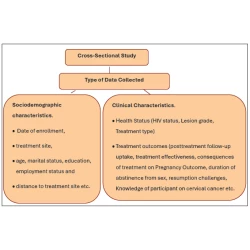
MethodsThis was a cross-sectional study that assessed the clinical outcome of 170 women treated for cervical precancers using ablative and excisional procedures in 2019 and 2020. Demographic and clinical data (treatment and posttreatment follow-up) were abstracted from the program registry. The data was analyzed to assess the clinical outcomes of cervical precancer treatment. The association between each independent variable and the dependent variable was examined in a simple logistic regression. All variables with p < 0.2 in the bivariate logistic regression model were subjected to a multivariable logistic model to get rid of cofounders and obtained adjustable odds ratios. The data was summarized using odds ratios, with p-value < 0.05 considered significant. All statistical analyses were performed using STATA version 17.
ResultsThe cervical precancer treatment effectiveness of 93.55% was disaggregated into 94.37% and 88.23% for ablative and excisional procedures, respectively, with less severe adverse clinical effects. Despite the high awareness of women on the importance and timing of posttreatment follow-up, its uptake was 54.71%. Most of the women who got pregnant after the procedures delivered live and healthy babies. Women who were HIV positive were 89% (0.89 times) [aOR = 0.11, 95%CI (0.01 0.85), p = 0.034] less likely to have effective treatment for cervical precancer when compared to HIV-negative women. Those with low-grade lesions were eight times [aOR = 8.39, 95%CI (1.10 64.06), p = 0.04] more likely to have effective treatment for cervical precancer treatment compared to those with high-grade lesions.
Conclusion and Global Health ImplicationsAblative and excisional treatment procedures for cervical precancer were effective with limited adverse effects in Cameroon. Women living with HIV and those with large lesions experienced lower treatment effectiveness. Most of the women who got pregnant after the procedures delivered live and healthy babies. Posttreatment follow-up which is highly recommended because of recurrent/persistent lesions was barely above average.
Downloads
Most read articles by the same author(s)
- Bestina Forkwa Ewang, Mathias Esum Eyong, Samuel Nambile Cumber, Claude Ngwayu Nkfusai, Brenda Mbouamba Yankam, Cho Sabastine Anye, Jacintha Rebang Achu, Bih Moki Suh, Mildred Njoache Nkeng, Rosette Boseme Nzoyom, Joyce Mahlako Tsoka-Gwegweni, Eric Achidi Akum, Vaccination Coverage Under the Expanded Program on Immunization in South West Cameroon , International Journal of Maternal and Child Health and AIDS: Vol. 9 No. 2 (2020): International Journal of Maternal and Child Health and AIDS
Similar Articles
- Mamour Gueye, Mame D. Ndiaye-Gueye, Serigne M. Kane-Gueye, Omar Gassama, Moussa Diallo, Jean C. Moreau, Diagnosis, Treatment and Outcome of Gestational Trophoblastic Neoplasia in a Low Resource Income Country , Vol. 5 No. 2 (2016): International Journal of Maternal and Child Health and AIDS
- Wael Hafez, Jalal Al Shareef, Afraa Alyoussef, Mirvat Ghanem, Reem Rizk Abazid, Antesh Yadav, Asrar Rashid, Fardeen Mohammad Sayfoo, Sneha Venkataramani, Pamela Orozco Restrepo, Mohamed Maher Elkott, Vikram Satish Lakshman, Taahira Arief, Alaa Gamal Mohammed, Fatema Abdulaal, Yossef Hossam, Pulmonary Injury as a Complication of Urinary Tract Infection in Pregnancy , Vol. 13 No. Continuous (2024): International Journal of Maternal and Child Health and AIDS
- Barbara Burmen, Gregory Kurtzman, Anthony A Olashore, Leyla Baghirova Busang, Ohemaa Poku, Phenyo Morakanyane, Ontibile Tshume, Onkemetse Phoi, Mogomotsi Matshaba, Elizabeth D Lowenthal, Knashawn H Morales, Merrian J Brooks, HIV Virologic Suppression and Mental Well-being in Adolescents and Young Adults Living with HIV , Vol. 14 No. Continuous (2025): International Journal of Maternal and Child Health and AIDS
- Andrew Walubo, Refuoe Baleni, Hillary Mukudu, Henry Kambafwile, Mukesh Dheda, Thanduxolo Thengwa, Tshepang Jiane, Clinical Characteristics of Children with HIV Initiated on Antiretroviral Treatment at HIV Clinics in Bloemfontein, South Africa , Vol. 10 No. 1 (2021): International Journal of Maternal and Child Health and AIDS
- Daisy Ruto, Michael Muthamia, Edith Njeri, Freda Nyaga, Christine Muia, Morris Kiio, Jane Wausi, Introduction of Heat-Stable Carbetocin for Postpartum Hemorrhage Prevention in Public Sector Hospitals in Kenya: Provider Experience and Policy Insights , Vol. 13 No. S1 (2024): International Journal of Maternal and Child Health and AIDS
- Wah Wah Myint, Human Immunodeficiency Virus (HIV) Knowledge and Stigma: Findings from a Cross-sectional Survey , Vol. 15 (2026): International Journal of Maternal and Child Health and AIDS
- Chioma A. Ikedionwu, Deepa Dongarwar, Courtney Williams, Evelyn Odeh, Maylis Peguy Nkeng Peh, Hilliary Hooker, Stacey Wiseman, Tramauni Brock, Erinn Payne-Green, Chidinma Chukwudum, Grace Loudd, Andrea Shelton, Jonnae O. Atkinson, Kiara K. Spooner, Jason L. Salemi, Hamisu M. Salihu, Omonike A. Olaleye, Trends and Risk Factors for Leishmaniasis among Reproductive Aged Women in the United States , Vol. 10 No. 2 (2021): International Journal of Maternal and Child Health and AIDS
- Prakash R Ganesh, Rachel Mernoff, Renske Dikkers, William Nundwe, Rachel Pope, A Comparison of Postoperative Surgical Outcomes among Women Undergoing Obstetric Fistula Repair with and without HIV , Vol. 10 No. 2 (2021): International Journal of Maternal and Child Health and AIDS
- Ebenezer Ahenkan, Anastasia Asare-Bediako, Kingsley Adeoye Damilare, David Antwi-Agyei, Paul Atawuchugi, Frederick Osei-Owusu, Sarah Konadu Agyemang, Gifty Konadu, Richard Agyemang Opoku, Kofi Oduro Yeboah, Oumou Maiga-Ascofare, Eric Boakye-Gyasi, Newman Osafo, Prevalence and Predictors of Mother-to-Child Transmission of Human Immunodeficiency Virus (HIV) among HIV-exposed Infants , Vol. 14 No. Continuous (2025): International Journal of Maternal and Child Health and AIDS
- Cabiria M. Barbosu, Lisette Alcántara, Saloni Sharma, Jahron Marriott, Oksana Babiy, Rebecca Deamer, Marcia Kindlon, Timothy Dye, The Implementation of a State-wide Rapid Initiation of Antiretroviral Therapy as a Best Practice in Primary Care Practices Using an Academic Detailing Approach: Lessons Learned from NewYork State, United States , Vol. 11 No. 1 (2022): International Journal of Maternal and Child Health and AIDS
<< < 1 2 3 4 5 6 7 8 9 10 > >>
You may also start an advanced similarity search for this article.
Published
How to Cite
Issue
Section
License
Copyright © 2025 Joseph F. Nkfusai, Simon M. Manga, Kathleen Nulah, Calvin Ngalla, Florence Manjuh, Claude Ngwayu Nkfusai, Tendongfor Nicholas, Halle Ekane Edie Gregory. Published by Global Health and Education Projects, Inc., USA.

This is an open-access article distributed under the terms of the Creative Commons Attribution-NonCommercial-ShareAlike 4.0 International License , which permits others to remix, transform, and build upon the work non-commercially, provided the original author is credited and the new creations are licensed under the same terms.