
Cervical Precancer Treatment Outcomes in Cameroon
DOI:
https://doi.org/10.25259/IJMA_8_2024Keywords:
- Cervical Precancer,
- Clinical Outcome,
- Ablative and Excisional Procedures,
- Cameroon
Abstract
The ablative and excision treatment procedures are effective, accessible, and affordable in resource-constrained settings, but the rollout and posttreatment follow-up are not remarkable. The outcomes of treatment procedures among women treated for precancerous lesions of the cervix have not been adequately studied in Cameroon. This study assessed the outcome of ablative and excisional treatment procedures.
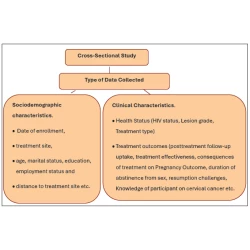
MethodsThis was a cross-sectional study that assessed the clinical outcome of 170 women treated for cervical precancers using ablative and excisional procedures in 2019 and 2020. Demographic and clinical data (treatment and posttreatment follow-up) were abstracted from the program registry. The data was analyzed to assess the clinical outcomes of cervical precancer treatment. The association between each independent variable and the dependent variable was examined in a simple logistic regression. All variables with p < 0.2 in the bivariate logistic regression model were subjected to a multivariable logistic model to get rid of cofounders and obtained adjustable odds ratios. The data was summarized using odds ratios, with p-value < 0.05 considered significant. All statistical analyses were performed using STATA version 17.
ResultsThe cervical precancer treatment effectiveness of 93.55% was disaggregated into 94.37% and 88.23% for ablative and excisional procedures, respectively, with less severe adverse clinical effects. Despite the high awareness of women on the importance and timing of posttreatment follow-up, its uptake was 54.71%. Most of the women who got pregnant after the procedures delivered live and healthy babies. Women who were HIV positive were 89% (0.89 times) [aOR = 0.11, 95%CI (0.01 0.85), p = 0.034] less likely to have effective treatment for cervical precancer when compared to HIV-negative women. Those with low-grade lesions were eight times [aOR = 8.39, 95%CI (1.10 64.06), p = 0.04] more likely to have effective treatment for cervical precancer treatment compared to those with high-grade lesions.
Conclusion and Global Health ImplicationsAblative and excisional treatment procedures for cervical precancer were effective with limited adverse effects in Cameroon. Women living with HIV and those with large lesions experienced lower treatment effectiveness. Most of the women who got pregnant after the procedures delivered live and healthy babies. Posttreatment follow-up which is highly recommended because of recurrent/persistent lesions was barely above average.
Downloads
Most read articles by the same author(s)
- Bestina Forkwa Ewang, Mathias Esum Eyong, Samuel Nambile Cumber, Claude Ngwayu Nkfusai, Brenda Mbouamba Yankam, Cho Sabastine Anye, Jacintha Rebang Achu, Bih Moki Suh, Mildred Njoache Nkeng, Rosette Boseme Nzoyom, Joyce Mahlako Tsoka-Gwegweni, Eric Achidi Akum, Vaccination Coverage Under the Expanded Program on Immunization in South West Cameroon , International Journal of Maternal and Child Health and AIDS: Vol. 9 No. 2 (2020): International Journal of Maternal and Child Health and AIDS
Similar Articles
- Deepa Dongarwar, Morgan Lee, Christo Manikkuttiyil, Hamisu M. Salihu, Association Between Social Determinants of Health Issues and Maternal Obesity Among American Racial/Ethnic Groups , Vol. 12 No. 1 (2023): International Journal of Maternal and Child Health and AIDS
- Abdul-Wahab Inusa, Nana Asha Alhassan, Ana Maria Simono Charadan, Roy Rillera Marzo, Shamsu-Deen Ziblim, Influence of Sociodemographic Factors and Obstetric History on Choice of Place of Delivery: A Retrospective Study Among Post-Natal Women in Ghana , Vol. 12 No. 2 (2023): International Journal of Maternal and Child Health and AIDS
- Alice Rosmini, Kidza Mugerwa, Awatta Walter Ochan, Sarah Muwanguzi, Jemelia Sake, Richard Mwesigwa, Okpwoku Sukere, Catrin Schulte-Hillen, Nguyen Toan Tran, Empowering Midwives in Humanitarian Settings: Integrating Heat-Stable Carbetocin and Tranexamic Acid into Postpartum Hemorrhage Training , Vol. 13 No. S1 (2024): International Journal of Maternal and Child Health and AIDS
- John Humphrey, James G Carlucci, Esther Karen Wanjama, Violet Naanyu, Lindah Muli, Joy Marsha Alera, Edwin Were, Alan McGuire, Winstone Nyandiko, Gregory Zimet, Julia Jerono Songok, Kara Wools Kaloustian, Implementing WHO Differentiated Service Delivery Model for Pregnant and Breastfeeding Women and Infants Living with HIV: Insights from Kenyan Healthcare Providers , Vol. 14 No. Continuous (2025): International Journal of Maternal and Child Health and AIDS
- Aradhana Singh, Vibha Rani Pipal, Raj Kishore Singh, Preeti Bala Singh, Nidhi Singh, Anupama Singh, Incidence and Predictors of Uterine Rupture with Maternal and Perinatal Outcome: A Cross-sectional Study , Vol. 14 No. Continuous (2025): International Journal of Maternal and Child Health and AIDS
- Claude Ngwayu Nkfusai, Olivia Ngou, Caroline Ekoko Subi, Sofia Mohlin, Fidele Bemadoum, Sylvanus Teboh, Frankline Sevidzem Wirsiy, Luchuo Engelbert Bain, Malaria Elimination: What Can Africa Learn from China? , Vol. 11 No. 2 (2022): International Journal of Maternal and Child Health and AIDS
- Abhiruchi Galhotra, Sanjana Agrawal, Aditi Chandrakar, Effectiveness of Human Immunodeficiency Virus Index Testing: A Global Scoping Review , Vol. 14 No. Continuous (2025): International Journal of Maternal and Child Health and AIDS
- Faith D. Ihekweazu, Deepa Dongarwar, Hamisu M. Salihu, Richard Kellermayer, National Trends in Hospitalization, Surgical Resection, and Comorbidities in Pediatric Inflammatory Bowel Disease in the United States, 2002-2015 , Vol. 11 No. 1 (2022): International Journal of Maternal and Child Health and AIDS
- Sara Rushwan, Fatu Forna, Ferid Abbas Abubeker, Tesfaye Tufa, Tieba Millogo, Miriam Nakalembe, Kwame Adu-Bonsaffoh, Francis L. Moses, Lester Chinery, Gilda Piaggio, Metin Gülmezoglu, Integrating Heat-Stable Carbetocin and Tranexamic Acid for Prevention and Management of Postpartum Hemorrhage in Sub-Saharan Africa: A Five-Country Pilot Implementation Study , Vol. 13 No. S1 (2024): International Journal of Maternal and Child Health and AIDS
- Anne Esther Njom Nlend, Mpox and Breastfeeding in Sub-Saharan Africa: Clinical, Program, and Policy Recommendations , Vol. 14 No. Continuous (2025): International Journal of Maternal and Child Health and AIDS
<< < 3 4 5 6 7 8 9 10 11 12 > >>
You may also start an advanced similarity search for this article.
Published
How to Cite
Issue
Section
License
Copyright © 2025 Joseph F. Nkfusai, Simon M. Manga, Kathleen Nulah, Calvin Ngalla, Florence Manjuh, Claude Ngwayu Nkfusai, Tendongfor Nicholas, Halle Ekane Edie Gregory. Published by Global Health and Education Projects, Inc., USA.

This is an open-access article distributed under the terms of the Creative Commons Attribution-NonCommercial-ShareAlike 4.0 International License , which permits others to remix, transform, and build upon the work non-commercially, provided the original author is credited and the new creations are licensed under the same terms.