
Postpartum Hemorrhage in Humanitarian Settings: Heat-Stable Carbetocin and Tranexamic Acid Implementation Study in South Sudan
DOI:
https://doi.org/10.25259/IJMA_8_2023Keywords:
- Health Services Research,
- Postpartum Hemorrhage,
- Heat-Stable Carbetocin,
- Tranexamic Acid,
- Public Health Intervention Package,
- Humanitarian Settings,
- Fragile Settings
Abstract
Postpartum hemorrhage (PPH) remains a significant concern in crisis-affected contexts, where the implementation of heat-stable carbetocin (HSC) and tranexamic acid (TXA) for PPH prevention and treatment lacks evidence. This study aims to evaluate the effects of a capacity-strengthening package on the use of uterotonics for PPH prevention and detection, and the use of TXA for PPH treatment in basic maternity facilities in South Sudan.
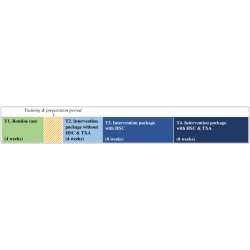
MethodsIn this implementation study, the six chosen facilities followed a stepwise sequence of PPH management: T1 (routine care), a transition period for package design; T2 (package without HSC and TXA); T3 (package and HSC); and T4 (package with HSC and TXA). The intervention comprised refresher training, an online provider community, PPH readiness kits, alarm bells, and displayed algorithms. The main outcomes were trends in prophylactic uterotonic use, including HSC, visual diagnosis of bleeding, and oxytocin and TXA use for PPH treatment. Analyses were adjusted for cluster effect and baseline characteristics. The study was registered in the Pan-African Clinical Trials Registry (PACTR202302476608339).
ResultsFrom February 1, 2022, to February 17, 2023, 3142 women were recruited. Nearly all women received prophylactic uterotonics across all four phases, with a significant increase after T3 (T4-T1: 100%–98%; 95% CI: 4.4–0.4). Oxytocin alone was the most used in T1 (98%) and T2 (94%) and HSC alone in T3 (87%) and T4 (82%) (T4-T1: 95% CI: 75.5–83.3). PPH diagnosis tripled from 1.2% of all births to 3.6% (T2-T1: 95% CI: 0.4–5.2) and stayed roughly at 3% in T3 and T4. For treatment, universal oxytocin use in T1 and T2 decreased in T3 upon HSC initiation (T3-T2: 27%–100%; 95% CI: 95.5–49.9), whereas TXA use increased in T4 (T4-T1: 95%–0%; 95% CI: 54.6–99.0).
Conclusion and Global Health ImplicationsAn intervention package to improve the quality of PPH prevention and treatment can effectively increase HSC and TXA use in crisis settings. It could be scaled up in similar contexts with ongoing supervision to mitigate confusion between the existing and new medications, such as the reduced use of oxytocin for PPH treatment. Sustaining cold chain investments remain vital to ensure oxytocin quality.
Downloads
Most read articles by the same author(s)
- Nguyen Toan Tran, Kidza Mugerwa, Awatta Walter Ochan, Sarah Muwanguzi, Jemelia Sake, Richard Mwesigwa, Okpwoku Sukere, Catrin Schulte-Hillen, Postpartum Hemorrhage in Humanitarian Settings: Implementation Insights from Using Heat-Stable Carbetocin and Tranexamic Acid , International Journal of Maternal and Child Health and AIDS: Vol. 13 No. S1 (2024): International Journal of Maternal and Child Health and AIDS
- Nguyen Toan Tran, Kidza Mugerwa, Sarah Muwanguzi, Richard Mwesigwa, Damien Wasswa, Willibald Zeck, Armando Seuc, Catrin Schulte-Hillen, Postpartum Hemorrhage in Humanitarian Settings: Heat-Stable Carbetocin and Tranexamic Acid Implementation Study in Uganda , International Journal of Maternal and Child Health and AIDS: Vol. 13 No. S1 (2024): International Journal of Maternal and Child Health and AIDS
- Alice Rosmini, Kidza Mugerwa, Awatta Walter Ochan, Sarah Muwanguzi, Jemelia Sake, Richard Mwesigwa, Okpwoku Sukere, Catrin Schulte-Hillen, Nguyen Toan Tran, Empowering Midwives in Humanitarian Settings: Integrating Heat-Stable Carbetocin and Tranexamic Acid into Postpartum Hemorrhage Training , International Journal of Maternal and Child Health and AIDS: Vol. 13 No. S1 (2024): International Journal of Maternal and Child Health and AIDS
Similar Articles
- Hamisu M. Salihu, Amina A. Umar, Romuladus E. Azuine, Special Collection: Implementation Research Evidence for Prevention and Treatment of Postpartum Hemorrhage in High-Burden Low- and Middle-Income Countries , Vol. 13 No. S1 (2024): International Journal of Maternal and Child Health and AIDS
- David Rakotonandrasana Harimbola, Kaori Mizumoto, Individual and Household Risk Factors for Severe Acute Malnutrition among Under-Five Children in the Analamanga Region, Madagascar , Vol. 7 No. 1 (2018): International Journal of Maternal and Child Health and AIDS
- Gopal K. Singh, Hyunjung Lee, Lyoung Hee Kim, Housing and Inequalities in US Life Expectancy, Child and Youth Mortality, and All-Cause and Cause-Specific Mortality, 1979-2020: Results from the National Longitudinal Mortality Study and the National Vital Statistics System , Vol. 12 No. 2 (2023): International Journal of Maternal and Child Health and AIDS
- Sudip Bhattacharya, Sandip Bhattacharya, Vidisha Vallabh, Roy Rillera Marzo, Ruchi Juyal, Ozden Gokdemir, Digital Well-being Through the Use of Technology–A Perspective , Vol. 12 No. 1 (2023): International Journal of Maternal and Child Health and AIDS
- Elizabeth Armstrong-Mensah, David-Praise Ebiringa, Kaleb Whitfield, Jake Coldiron, Genital Chlamydia Trachomatis Infection: Prevalence, Risk Factors and Adverse Pregnancy and Birth Outcomes in Children and Women in sub-Saharan Africa , Vol. 10 No. 2 (2021): International Journal of Maternal and Child Health and AIDS
- Cabiria M. Barbosu, Lisette Alcántara, Saloni Sharma, Jahron Marriott, Oksana Babiy, Rebecca Deamer, Marcia Kindlon, Timothy Dye, The Implementation of a State-wide Rapid Initiation of Antiretroviral Therapy as a Best Practice in Primary Care Practices Using an Academic Detailing Approach: Lessons Learned from NewYork State, United States , Vol. 11 No. 1 (2022): International Journal of Maternal and Child Health and AIDS
- Wah Myint, Aishatu Yusuf, Angela Nguyen, Elfreda Samman, HIV Testing, Household and Reproductive Health Decision-Making: The Role of Women Autonomy in a Nationally Representative Study in Cambodia , Vol. 14 No. Continuous (2025): International Journal of Maternal and Child Health and AIDS
- Gopal K. Singh, Romuladus E. Azuine, Mohammad Siahpush, Global Inequalities in Cervical Cancer Incidence and Mortality are Linked to Deprivation, Low Socioeconomic Status, and Human Development , Vol. 1 No. 1 (2012): International Journal of Maternal and Child Health and AIDS
- Justice Ajaari, Honorati Masanja, Renay Weiner, Shalom Akonvi Abokyi, Seth Owusu-Agyei, Impact of Place of Delivery on Neonatal Mortality in Rural Tanzania , Vol. 1 No. 1 (2012): International Journal of Maternal and Child Health and AIDS
- Hyunjung Lee, Gopal K. Singh, Contributions of Socioeconomic, Demographic, and Behavioral Risk Factors to All-Cause Mortality Disparities by Psychological Distress in the United States: A Blinder-Oaxaca Decomposition Analysis of Longitudinal Data , Vol. 11 No. 1 (2022): International Journal of Maternal and Child Health and AIDS
<< < 6 7 8 9 10 11 12 13 14 15 > >>
You may also start an advanced similarity search for this article.
Published
How to Cite
Issue
Section
License
Copyright © 2024 Nguyen Toan Tran, Awatta Walter Ochan, Jemelia Sake, Okpwoku Sukere, Willibald Zeck, Armando Seuc, Catrin Schulte-Hillen. Published by Global Health and Education Projects, Inc., USA.

This is an open-access article distributed under the terms of the Creative Commons Attribution-NonCommercial-ShareAlike 4.0 International License , which permits others to remix, transform, and build upon the work non-commercially, provided the original author is credited and the new creations are licensed under the same terms.