
Postpartum Hemorrhage in Humanitarian Settings: Heat-Stable Carbetocin and Tranexamic Acid Implementation Study in South Sudan
DOI:
https://doi.org/10.25259/IJMA_8_2023Keywords:
- Health Services Research,
- Postpartum Hemorrhage,
- Heat-Stable Carbetocin,
- Tranexamic Acid,
- Public Health Intervention Package,
- Humanitarian Settings,
- Fragile Settings
Abstract
Postpartum hemorrhage (PPH) remains a significant concern in crisis-affected contexts, where the implementation of heat-stable carbetocin (HSC) and tranexamic acid (TXA) for PPH prevention and treatment lacks evidence. This study aims to evaluate the effects of a capacity-strengthening package on the use of uterotonics for PPH prevention and detection, and the use of TXA for PPH treatment in basic maternity facilities in South Sudan.
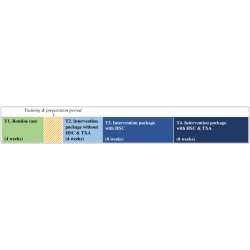
MethodsIn this implementation study, the six chosen facilities followed a stepwise sequence of PPH management: T1 (routine care), a transition period for package design; T2 (package without HSC and TXA); T3 (package and HSC); and T4 (package with HSC and TXA). The intervention comprised refresher training, an online provider community, PPH readiness kits, alarm bells, and displayed algorithms. The main outcomes were trends in prophylactic uterotonic use, including HSC, visual diagnosis of bleeding, and oxytocin and TXA use for PPH treatment. Analyses were adjusted for cluster effect and baseline characteristics. The study was registered in the Pan-African Clinical Trials Registry (PACTR202302476608339).
ResultsFrom February 1, 2022, to February 17, 2023, 3142 women were recruited. Nearly all women received prophylactic uterotonics across all four phases, with a significant increase after T3 (T4-T1: 100%–98%; 95% CI: 4.4–0.4). Oxytocin alone was the most used in T1 (98%) and T2 (94%) and HSC alone in T3 (87%) and T4 (82%) (T4-T1: 95% CI: 75.5–83.3). PPH diagnosis tripled from 1.2% of all births to 3.6% (T2-T1: 95% CI: 0.4–5.2) and stayed roughly at 3% in T3 and T4. For treatment, universal oxytocin use in T1 and T2 decreased in T3 upon HSC initiation (T3-T2: 27%–100%; 95% CI: 95.5–49.9), whereas TXA use increased in T4 (T4-T1: 95%–0%; 95% CI: 54.6–99.0).
Conclusion and Global Health ImplicationsAn intervention package to improve the quality of PPH prevention and treatment can effectively increase HSC and TXA use in crisis settings. It could be scaled up in similar contexts with ongoing supervision to mitigate confusion between the existing and new medications, such as the reduced use of oxytocin for PPH treatment. Sustaining cold chain investments remain vital to ensure oxytocin quality.
Downloads
Most read articles by the same author(s)
- Nguyen Toan Tran, Kidza Mugerwa, Awatta Walter Ochan, Sarah Muwanguzi, Jemelia Sake, Richard Mwesigwa, Okpwoku Sukere, Catrin Schulte-Hillen, Postpartum Hemorrhage in Humanitarian Settings: Implementation Insights from Using Heat-Stable Carbetocin and Tranexamic Acid , International Journal of Maternal and Child Health and AIDS: Vol. 13 No. S1 (2024): International Journal of Maternal and Child Health and AIDS
- Nguyen Toan Tran, Kidza Mugerwa, Sarah Muwanguzi, Richard Mwesigwa, Damien Wasswa, Willibald Zeck, Armando Seuc, Catrin Schulte-Hillen, Postpartum Hemorrhage in Humanitarian Settings: Heat-Stable Carbetocin and Tranexamic Acid Implementation Study in Uganda , International Journal of Maternal and Child Health and AIDS: Vol. 13 No. S1 (2024): International Journal of Maternal and Child Health and AIDS
- Alice Rosmini, Kidza Mugerwa, Awatta Walter Ochan, Sarah Muwanguzi, Jemelia Sake, Richard Mwesigwa, Okpwoku Sukere, Catrin Schulte-Hillen, Nguyen Toan Tran, Empowering Midwives in Humanitarian Settings: Integrating Heat-Stable Carbetocin and Tranexamic Acid into Postpartum Hemorrhage Training , International Journal of Maternal and Child Health and AIDS: Vol. 13 No. S1 (2024): International Journal of Maternal and Child Health and AIDS
Similar Articles
- Abhiruchi Galhotra, Sanjana Agrawal, Aditi Chandrakar, Effectiveness of Human Immunodeficiency Virus Index Testing: A Global Scoping Review , Vol. 14 No. Continuous (2025): International Journal of Maternal and Child Health and AIDS
- Phillips Edomwonyi Obasohan, Paul Gana, Mahmud A. Mustapha, Ahmed Egbako Umar, Audu Makada, Dorcas Nike Obasohan, Decision Making Autonomy and Maternal Healthcare Utilization among Nigerian Women , Vol. 8 No. 1 (2019): International Journal of Maternal and Child Health and AIDS
- Sahra Ibrahimi, Korede K. Yusuf, Deepa Dongarwar, Sitratullah Olawunmi Maiyegun, Chioma Ikedionwu, Hamisu M. Salihu, COVID-19 Devastation of African American Families: Impact on Mental Health and the Consequence of Systemic Racism , Vol. 9 No. 3 (2020): International Journal of Maternal and Child Health and AIDS
- Samantha A. Slinkard, Jennifer R. Pharr, Tamara Bruno, Dina Patel, Amaka Ogidi, Michael Obiefune, Echezona E. Ezeanolue, Determinants of Infant Mortality in Southeast Nigeria: Results from the Healthy Beginning Initiative, 2013-2014 , Vol. 7 No. 1 (2018): International Journal of Maternal and Child Health and AIDS
- Amina Abdullahi, Hassan Adam Murtala, Aisha Adam Abdullahi, Amina Aminu, Muktar H. Aliyu, Sani H. Aliyu, Ololade D. Adeyemi, Deepa Dongarwar, Jordi B. Torrelles, Gambo Aliyu, Hamisu M. Salihu, Drivers of Human Immunodeficiency Virus among Pregnant Women in Conflict and Non-conflict Zones of Nigeria , Vol. 14 No. Continuous (2025): International Journal of Maternal and Child Health and AIDS
- Claude Ngwayu Nkfusai, Olivia Ngou, Caroline Ekoko Subi, Sofia Mohlin, Fidele Bemadoum, Sylvanus Teboh, Frankline Sevidzem Wirsiy, Luchuo Engelbert Bain, Malaria Elimination: What Can Africa Learn from China? , Vol. 11 No. 2 (2022): International Journal of Maternal and Child Health and AIDS
- Deepa Dongarwar, Hamisu M. Salihu, Place of Residence and Inequities in Adverse Pregnancy and Birth Outcomes in India , Vol. 9 No. 1 (2020): International Journal of Maternal and Child Health and AIDS
- Nathan Isabirye, Amara E. Ezeamama, Rachel Kyeyune-Bakyayita, Danstan Bagenda, Wafaie W. Fawzi, David Guwatudde, Dietary Micronutrients and Gender, Body Mass Index and Viral Suppression Among HIV-Infected Patients in Kampala, Uganda , Vol. 9 No. 3 (2020): International Journal of Maternal and Child Health and AIDS
- Margaret Macherera Macherera, Lindani Moyo, Mkhanyiseli Ncube, Angella Gumbi, Social, Cultural, and Environmental Challenges Faced by Children on Antiretroviral Therapy in Zimbabwe: a Mixed-Method Study , Vol. 1 No. 1 (2012): International Journal of Maternal and Child Health and AIDS
- Roger J. Chin, Domrongphol Sangmanee, Lisa Piergallini, PEPFAR Funding and Reduction in HIV Infection Rates in 12 Focus Sub-Saharan African Countries: A Quantitative Analysis , Vol. 3 No. 2 (2015): International Journal of Maternal and Child Health and AIDS
<< < 12 13 14 15 16 17 18 19 20 21 > >>
You may also start an advanced similarity search for this article.
Published
How to Cite
Issue
Section
License
Copyright © 2024 Nguyen Toan Tran, Awatta Walter Ochan, Jemelia Sake, Okpwoku Sukere, Willibald Zeck, Armando Seuc, Catrin Schulte-Hillen. Published by Global Health and Education Projects, Inc., USA.

This is an open-access article distributed under the terms of the Creative Commons Attribution-NonCommercial-ShareAlike 4.0 International License , which permits others to remix, transform, and build upon the work non-commercially, provided the original author is credited and the new creations are licensed under the same terms.