
HIV Serodiscordance among Couples in Cameroon: Effects on Sexual and Reproductive Health
DOI:
https://doi.org/10.21106/ijma.370Keywords:
- HIV,
- Serodiscordance,
- Sexual health,
- Childbearing,
- Cameroon,
- Reproductive health
Abstract
Background and Objectives: One of the main reasons for risky sexual behavior observed in HIV serodiscordant couples despite the knowledge of the partner’s status and counselling is childbearing. In Cameroon, there are few reports on HIV serodiscordant couples. This paper describes the influence of HIV on sexual relationships and decision to procreate.
Methods: This cross-sectional study was conducted in five health centers. Self-administered questionnaire was used to collect social and demographic information, while semi-structured in-depth individual and couple interviews were used to explore sexual relationships and decisions about fatherhood/motherhood. Blood samples were collected from the couples and tested for HIV to confirm serodiscordance. The data were analyzed using the GraphPad Prism Version 6 software.
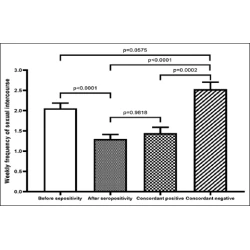
Results: A total of 53/192 (27.6%) HIV serodiscordant couples participated in the study, and 18/74 (24.32%) HIV positive seroconcordant couples and 32/80 HIV negative seroconcordant couples were used as controls. The majority of HIV-positive partners in serodiscordant couples were women (30/53), of whom 25/30 were on antiretroviral therapy. Nearly half of the respondents (23 /53) reported tensions related to serodiscordance, shown by reduced sex frequency. The use of condoms was not systematically observed among seroconcordant and serodiscordant couples with respective proportions of 55.55% and 20.75% (p = 0.0086). Thirty seven out of 53 HIV serodiscordant couples wanted children, among them, seven couples did not have any and expressed their aspiration for parenthood despite fear of infecting one’s partner.
Conclusion and Global Health Implications: Sexuality of serodiscordant couples as well as of HIV positive seroconcordant couples was affected by the presence of HIV/AIDS. The desire to procreate may lead couples to adopt risky sexual behaviors. It is important to define specific guidelines for serodiscordant couples in order to improve their sexual life and consequently enable them to procreate with minimal risk of infecting their partner and or to transmit the virus to their baby.
Downloads
Most read articles by the same author(s)
- Céline N. Nkenfou, Marie-Nicole Ngoufack, Georges Nguefack-Tsague, Barbara T. Atogho, Constantin Tchakounte, Brian T. Bongwong, Carine N. Nguefeu-Tchinda, Elise Elong, Laeticia H. Yatchou, Joel K. Kameni, Aline Tiga, Wilfred F. Mbacham, Alexis Ndjolo, Maternal Socio-Demographic Factors and Mother-to-Child Transmission of HIV in the North Region of Cameroon , International Journal of Maternal and Child Health and AIDS: Vol. 12 No. 1 (2023): International Journal of Maternal and Child Health and AIDS
Similar Articles
- Gopal K. Singh, Gem P. Daus, Michelle Allender, Christine T. Ramey, Elijah K. Martin, Chrisp Perry, Andrew A. De Los Reyes, Ivy P. Vedamuthu, Social Determinants of Health in the United States: Addressing Major Health Inequality Trends for the Nation, 1935-2016 , Vol. 6 No. 2 (2017): International Journal of Maternal and Child Health and AIDS
- Fatima M. Damagum, Zainab D. Ahmed, Rabiu I. Jalo, Hamisu M. Salihu, C. William Wester, Muktar H. Aliyu, Adapted Counseling Care Model for Management of Female Sexual Dysfunction Among Women Living With and Without HIV , Vol. 13 No. Continuous (2024): International Journal of Maternal and Child Health and AIDS
- Deepa Dongarwar, Toi B. Harris, Hamisu M. Salihu, Fourth Annual Summer Research Summit on Health Equity Organized by the Center of Excellence in Health Equity, Training and Research, Baylor College of Medicine, Houston, Texas 77030, USA on May 20, 2021 , Vol. 10 No. S3 (2021): International Journal of Maternal and Child Health and AIDS
- Esum Mathias Eyong, Nwana Yvette Ngwe, Claude Ngwayu Nfuksai, Loveline Lum Niba, Akoachere Jane-Francis, Prevalence of Occupational Exposure to HIV and Factors Associated with Compliance with Post-Exposure Prophylaxis Among Health Workers of the Biyem-Assi, Buea, and Limbe Health Districts of Cameroon Maternal and Child Health and AIDS , Vol. 11 No. 1 (2022): International Journal of Maternal and Child Health and AIDS
- Ernest Tambo, Chidiebere E. Ugwu, Yayi Guan, Ding Wei, Xiao-Ning, Zhou Xiao-Nong, China-Africa Health Development Initiatives: Benefits and Implications for Shaping Innovative and Evidence-informed National Health Policies and Programs in Sub-saharan African Countries , Vol. 5 No. 2 (2016): International Journal of Maternal and Child Health and AIDS
- Alana F. Hairston, Emily A. Bobrow, Christian S. Pitter, Towards the Elimination of Pediatric HIV: Enhancing Maternal, Sexual, and Reproductive Health Services , Vol. 1 No. 1 (2012): International Journal of Maternal and Child Health and AIDS
- Wah Myint, Aishatu Yusuf, Angela Nguyen, Elfreda Samman, HIV Testing, Household and Reproductive Health Decision-Making: The Role of Women Autonomy in a Nationally Representative Study in Cambodia , Vol. 14 No. Continuous (2025): International Journal of Maternal and Child Health and AIDS
- George Chidi Anwuri, Michael S. Dunn, Frederick Schulze, Determinants of Voluntary HIV/AIDS Counseling and Testing among Community College Students in the United States , Vol. 6 No. 2 (2017): International Journal of Maternal and Child Health and AIDS
- Zubairu Iliyasu, Fatimah Hassan-Hanga, Sadiq Isah Ajuji, Musa M. Bello, Safiyya S. Abdulkadir, Nafisa S. Nass, Hamisu M. Salihu, Muktar H. Aliyu, Correlates of Health Care Workers’ Knowledge and HIV-Exposed Infant Immunization Counseling Practice in Northern Nigeria , Vol. 10 No. 1 (2021): International Journal of Maternal and Child Health and AIDS
- Wah W. Myint, David J. Washburn, Brian Colwell, Jay E. Maddock, Determinants of HIV Testing Uptake among Women (aged 15-49 years) in the Philippines, Myanmar, and Cambodia , Vol. 10 No. 2 (2021): International Journal of Maternal and Child Health and AIDS
<< < 1 2 3 4 5 6 7 8 9 10 > >>
You may also start an advanced similarity search for this article.
Published
How to Cite
Issue
Section
License
Copyright © 2020 Constantin Tchakounté, Céline N. Nkenfou, Thibau F. Tchouangueu, Nicole M. Ngoufack, Salomon B. Tchuandom, Olivier D. Ngono, Jules-Rogers Kuiate, Alexis Ndjolo. Published by Global Health and Education Projects, Inc., USA.

This is an open-access article distributed under the terms of the Creative Commons Attribution-NonCommercial-ShareAlike 4.0 International License , which permits others to remix, transform, and build upon the work non-commercially, provided the original author is credited and the new creations are licensed under the same terms.