
Does Pre-Survey Training Impact Knowledge of Survey Administrators and Survey Outcomes in Developing Countries? Evaluation Findings of a Training of Trainers Workshop for National AIDS and Reproductive Health Survey-Plus in Nigeria
DOI:
https://doi.org/10.21106/ijma.18Keywords:
- Training,
- Survey,
- NARHS-Plus,
- State AIDS Program Coordinators,
- Reproductive Health Coordinators,
- State Laboratory Scientists,
- Lead Supervisors and Counselor Testers,
- Abuja,
- Nigeria
Abstract
Although, Nigeria had conducted various national surveys followed by central and state level trainings for survey administrators, prior pre-survey trainings have not been systematically evaluated to assess their impact on knowledge gain and final outcome of the survey. A central training of trainers' session was organized for master trainers on the conduct of the 2012 National AIDS and Reproductive Health Survey.
Objectives:To evaluate the impact of training on the quality of conduct of a national research survey in the 36 states and the Federal Capital Territory in Nigeria.
Method:A total of 185 participants consisting of State AIDS Program Coordinators, Reproductive Health Coordinators, State Laboratory Scientists, Lead Supervisors and Counselor Testers were invited from the 36 states in Nigeria and the FCT for the central training of trainers in Abuja. The training lasted 5 days and the trainees were grouped into two on the basis of behavioral epidemiology and laboratory components. Training tools such as the developed protocol, training power point slides, practical sessions such as role plays, and usage of HIV rapid test kits were utilized during the training. The facilitators were drawn from Federal Ministry of Health (FMoH), universities and research Institutions as well as Non-Governmental Organizations (NGOs). The facilitators prepared and administered 25 structured questions for the behavioral group and 28 questions for the laboratory group at the beginning of the training to assess the participants' knowledge of HIV and the survey. The same questions answered by Trainees responded to the same questions prior to the commencement and at the end of the trainings. Scores were aggregated to 100 for each test. We conducted paired t-test to determine statistically significant differences between pre-test and post-test results at 0.05 significance level and ANOVA to determine if there were differences in knowledge level among different groups.
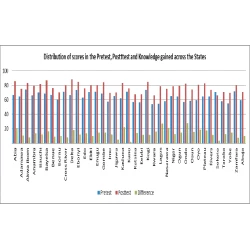
Result:The overall mean pre-test and post-test scores were 64.0% and 77.4% respectively indicating a 13.4% knowledge gain above what it was at the beginning of the training. The mean pre-test score and post-test score for the Southern states (SN) were 64.7% and 80.3% while that of the Northern states (NN) were 63.5% and 75.3% representing a knowledge gain of 15.6% and 11.8% respectively. There was statistical significant difference in the post-test scores between the two regions (p=0.001) and in knowledge gained after the training (p=0.017).
Conclusions and Public Health Implications:Comparison between the pre test and post test scores at the 5-day training showed a significant gain in knowledge of participants. The survey training contributed positively to the preparation and building of knowledge needed for the conduct of 2012 NARHS-plus.
Downloads
Similar Articles
- Sorochi H. Iloanusi, Osaro O. Mgbere, Susan. M. Abughosh, Ekere J. Essien, HIV Non-Occupational Post Exposure Prophylaxis in Nigeria: A Systematic Review of Research Evidence and Practice , Vol. 8 No. 2 (2019): International Journal of Maternal and Child Health and AIDS
- Hamisu M. Salihu, Deepa Dongarwar, Toi B. Harris, Third Annual Summer Research Summit on Health Equity Organized by the Center of Excellence in Health Equity, Training and Research, Baylor College of Medicine, Houston, Texas 77030, USA on June 9, 2020: ABSTRACT: Advancing Health Equity Through Innovation , Vol. 9 No. S3 (2020): International Journal of Maternal and Child Health and AIDS
- Gopal K. Singh, Gem P. Daus, Michelle Allender, Christine T. Ramey, Elijah K. Martin, Chrisp Perry, Andrew A. De Los Reyes, Ivy P. Vedamuthu, Social Determinants of Health in the United States: Addressing Major Health Inequality Trends for the Nation, 1935-2016 , Vol. 6 No. 2 (2017): International Journal of Maternal and Child Health and AIDS
- Charles Ikeanyionwu, Deepa Dongarwar, Zenab Yusuf, Rafeek Yusuf, Meishon Bell, Toi Harris, Hamisu M. Salihu, 2019 Health Equity Summer Research Summit Organized by the Center of Excellence in Health Equity, Training and Research, Baylor College of Medicine, Houston, Texas 77030, USA on June 18th, 2019 , Vol. 9 No. S1 (2020): International Journal of Maternal and Child Health and AIDS
- Kolawole A. Fasakin, Christopher T. Omisakin, Idowu O. Adebara, Wasiu A. Ajetunmobi, Adebayo A. Adeniyi, Ayodele J. Esan, Olufunke B. Bolaji, Oluwafemi D. Ajayi, Abayomi J. Afe, Assessment of PMTCT Success Rates Based on Antiretroviral Interventions and Feeding Options: A Prospective Cohort Study , Vol. 7 No. 2 (2018): International Journal of Maternal and Child Health and AIDS
- Ernest Tambo, Chidiebere E. Ugwu, Yayi Guan, Ding Wei, Xiao-Ning, Zhou Xiao-Nong, China-Africa Health Development Initiatives: Benefits and Implications for Shaping Innovative and Evidence-informed National Health Policies and Programs in Sub-saharan African Countries , Vol. 5 No. 2 (2016): International Journal of Maternal and Child Health and AIDS
- Zubairu Iliyasux, Amina A. Umar, Fatima S. Gaya, Nafisa S. Nass, Hadiza M. Abdullahi, Aminatu A. Kwaku, Taiwo G. Amole, Fatimah I. Tsiga-Ahmed, Hadiza S. Galadanci, Hamisu M. Salihu, Muktar H. Aliyu, ‘We delivered at home out of fear’: Maternity Care in Rural Nigeria During the COVID-19 Pandemic , Vol. 12 No. 1 (2023): International Journal of Maternal and Child Health and AIDS
- Ndidiamaka Amutah-Onukagha, Monica Rodriguez, Ijeoma Opara, Michelle Gardner, Maame Araba Assan, Rodney Hammond, Jesus Plata, Kimberly Pierre, Ehsan Farag, Progresses and challenges of utilizing traditional birth attendants in maternal and child health in Nigeria , Vol. 6 No. 2 (2017): International Journal of Maternal and Child Health and AIDS
- Ahmad Abdulhadi, Nasiru Abdullahi, Ibrahim Yusuf, Basheer I. Waziri, Kasimu Mamuda , Husna F. Ibrahim, Khadija Muhammad, Maryam M. Ibrahim , Aisha A. Abdullahi, Hassan A. Murtala, Muhammad A. Abbas, Hamisu M. Salihu, A Systematic Review and Meta-analysis on Innovative Approaches in Tuberculosis Diagnosis: Challenges and Future Directions , Vol. 15 (2026): International Journal of Maternal and Child Health and AIDS
- Muhammad Adamu Abbas, Aisha A Abdullahi, Hassan A Murtala, Abubakar L Yusuf, Rahila A Mukhtar, Hamisu M Salihu, New Paradigm for Battling Hospital-Acquired Infections in Developing Countries , Vol. 14 No. Continuous (2025): International Journal of Maternal and Child Health and AIDS
<< < 1 2 3 4 5 6 7 8 9 10 > >>
You may also start an advanced similarity search for this article.
Published
How to Cite
Issue
Section
License
Copyright © 2015 Kolawole Solomon Oyedeji, Adeniyi Francis Fagbamigbe, Johnbull Sonny Ogboi, Adebobola Toluwalashe Bashorun, Kawu Bolakale Issa, Perpetua Amida, Adeniyi Ogundiran, Ezire Onoriode. Published by Global Health and Education Projects, Inc., USA.

This is an open-access article distributed under the terms of the Creative Commons Attribution-NonCommercial-ShareAlike 4.0 International License , which permits others to remix, transform, and build upon the work non-commercially, provided the original author is credited and the new creations are licensed under the same terms.